Doc Henry – 1875-1915 – support
The Story of Henry “Doc” Reeves as told by the 1914 Alcalde
DOC HENRY “Gunga Din”

AlCalde magazine say, “Henry joined the team when Mr. Jack Phillips was the manager. His duties included cleaning the bathroom, looking after the 20 lockers the gym had at the time, sweeping up in the evenings, and handling various odd jobs. On the “Varsity” during his first year were Lamar and Cade Bethea. Henry believed that Semp Russ, the quarterback, was one of the greatest football players in the first 15 years of Doc Henry’s tenure at the University of Texas. “Semp found the hole and never fumbled the ball.”
Second on his list of great players was Arnold Kirkpatrick. Henry said , “he was such a great player because he used his head, carried more weight, and he was a great kicke.
Henry says, “I love football becasue I have been with it so long I believe I thoroughly undersatnd the game. I enjoy seeing men play it the way it should be played and I will stay with the game as long as they let me….”
Henry Reeves attends to injured Longhorns.

Long before the University of Texas at Austin hired Charlie Strong, and even before the first African-American athlete was admitted, the university had Henry Reeves. From 1895 to 1915, Reeves was trainer, doctor, and manager — generally the most significant figure in early UT football. The students loved him.
But Reeves, who was black, wasn’t permitted to eat with the players or stay in the room with them. Despite this separation, the students rebelled when the UT president sought to fire him, and upon his death, they collected money to pay his funeral expenses. Doc Henry, as the students called him, was elected posthumously to the Longhorn Hall of Fame.

More than 40 years after Reeves’ death, UT Austin allowed African-American athletes from other schools to participate in intercollegiate events, including football, on its campus but prohibited its own black students from playing on teams in those same events. Among Southwest Conference teams there was an unwritten policy that “if you don’t play your black students, we won’t play ours.” Few Texans noticed or cared if there was a black student in the Chemistry Department or the Latin Club, “but having just one on the football team was another matter,” according to Richard Pennington, author of Breaking the Ice: Racial Integration of Southwest Conference Football.

Doc Henry was the most important pioneer of all pioneers at UT. His legacy should be celebrated and honored for all time.

Even with a segregated South, Doc Henry managed to get a job at the UT athletic office that lasted from 1895 to 1915. He was the ultimate pioneer for blacks in the history of Texas Sports. His hard work and the respect he earned eventually led to his position on the football team as a water boy, assistant to the coaches, and equipment manager, and the name he cherished– “Doc” His tools were a medicine bag, towel, and water bucket. He did everything in his power to heal the athletes and, along the way, became the benchmark for future managers and trainers. He was called “the most famous character connected with the football at the University of Texas in one publication.”
Once, a school official released him, but the student body protested, and Doc kept his job. The Director of the gymnasium wanted to fire Henry, stating that Henry was “shiftless and never did the work he was supposed to do; he let the gym stay dirty and put in too much time working on the athletic field. Once Henry was fired, the water in the baths grew colder, and the gym grew dirtier. Mr Gregory hired him back, and Henry worked for Mr. Metzenthin until the gym job opened and he was promoted to that position.
Henry also made a list of the top baseball players, naming John Douglas as the best pitcher. He selected two teams of baseball players, and the list is attached.


Henry’s best football player list
 Henry’s the best football players


Henry’s best baseball player list


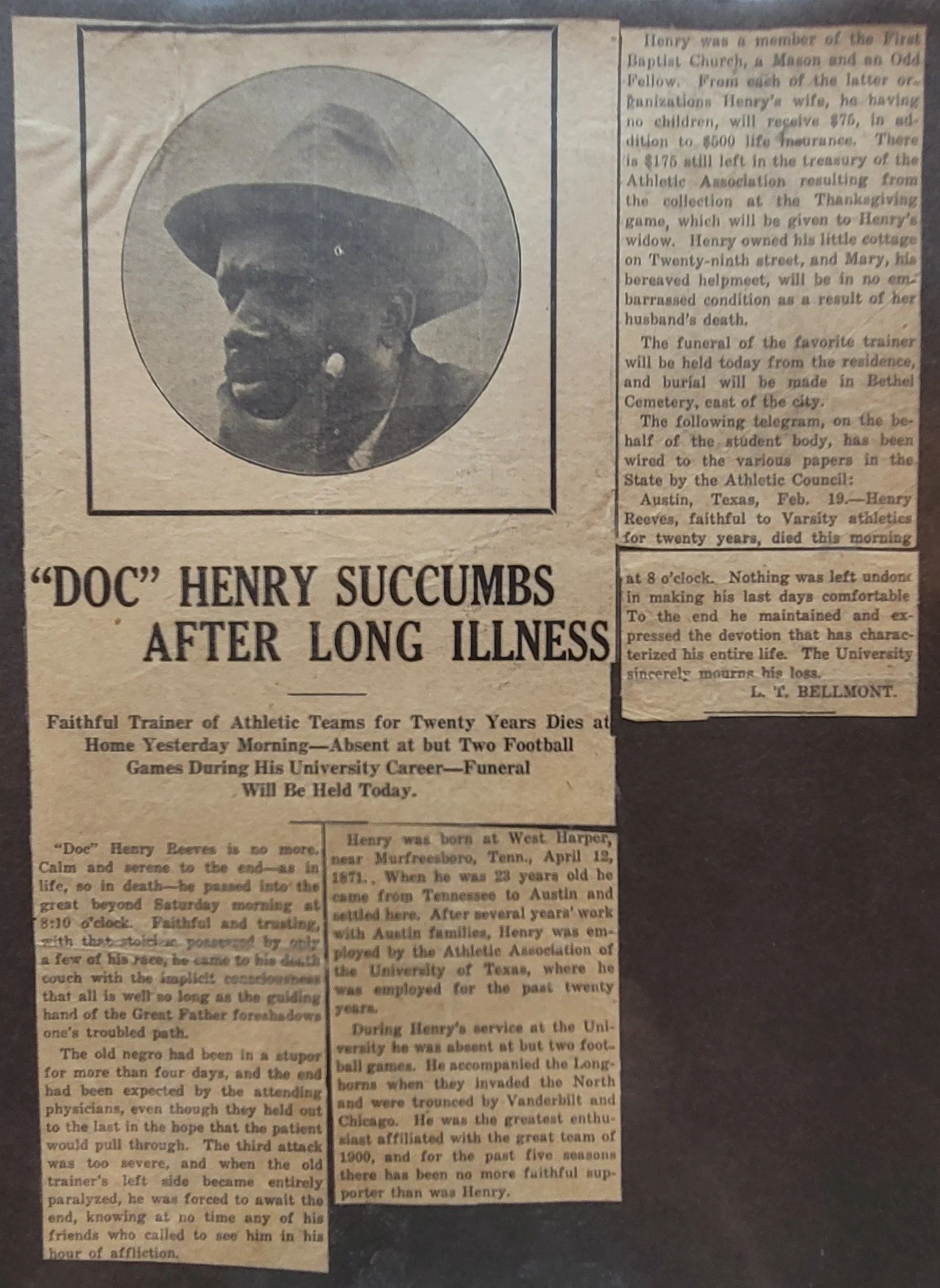
In 1915, Doc suffered a stroke and died 2 months later. The student body paid for his hospital bills, raised $103, and gave his wife $175 after his passing.
After his death, the Houston Post paid tribute to him. The Post asked a penetrating question: why does a system celebrate a man who was not allowed to attend UT or eat with the athletes? It takes 60 more years to answer this question and resolve the injustice.
The following article was written in the Houston Post. Read the article and form your own opinions. Regardless of content, Doc Henry is an important part of Longhorn sports History.