GOOD COACHING; NO CHEATING by Roy Jones
Roy Jones was senior manager of the 1963 national champions who writes frequently about Longhorn football. The retired newspaper reporter/editor, Army Reserve officer and state employee lives in Abilene.
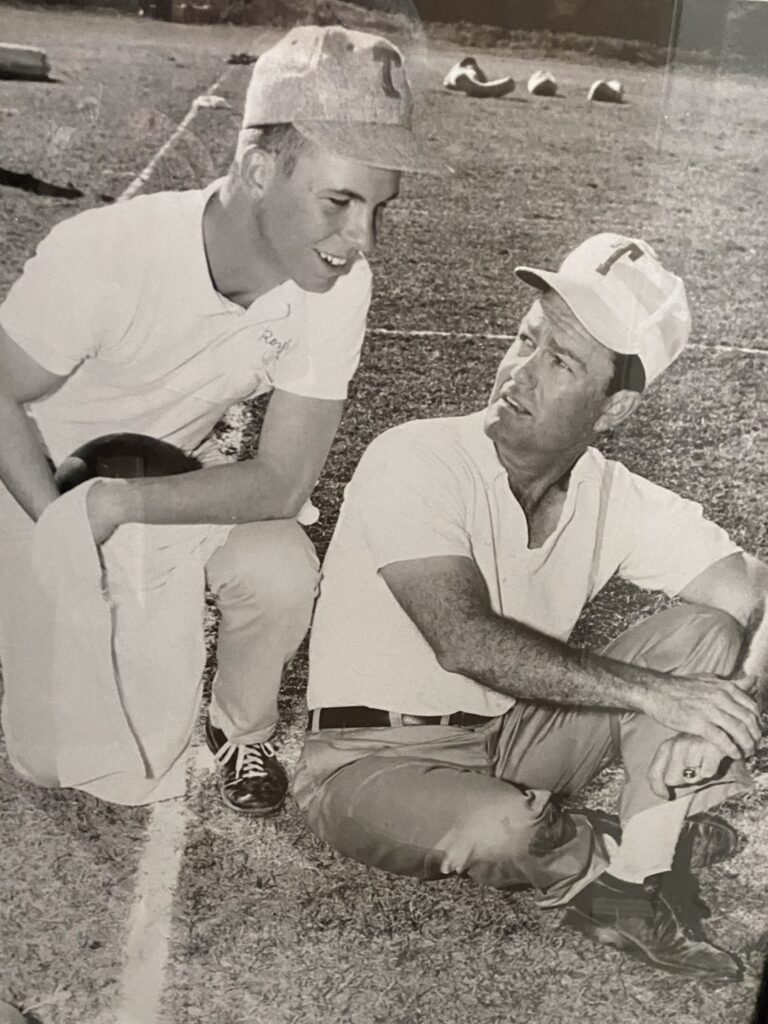
Coach Royal made my role quite clear when I became a Longhorn student manager in 1960. He had no problem with me also being a sportswriter for The Daily Texan but emphasized I was not to report anything about the team that other sportswriters or reporters from other media did not have equal access to,- never did.
I sat on the biggest story for 50 years after we had trounced Navy in the 1964 Cotton Bowl game, before letting the press in the locker room, he told the team to never mention how we exploited Navy’s defense that day. He said revealing our secret would detract from our overwhelming victory and we would wrongfully be accused of cheating. Our lips were sealed.
Below are two video stories about stealing signals.
https://youtu.be/UK81aq1uUAI?si=IC0aQH9Txtj3g5_a
https://youtu.be/VC2CcizDEUE?si=tX0liMK6DoTicPZ6
Several decades later a prominent Metroplex sportswriter broke the story in that year’s Cotton Bowl Classic program. But his assertion that a rival coach had leaked Navy’s hand signals to us may not have been true.
I never heard Coach Royal or any of his assistants mention such a tip, and I was in a position to see or hear something. Perhaps there was a tip that Navy used hand signals. Period. I just can’t see the coaches studying film for as long and intently as they did IF they had already been given the signals.
Trust but verify, you say? I admit that’s a possibility but I don’t believe it. As one of my writing idols, Kirk Bohls would say, “I think I know” this is how it happened: It started with the teams exchanging film of all their games that season, a custom before bowl games.
Next, led by future athletic director Bill Ellington, the assistant coaches started poring over the films almost frame by frame. Ten to 12 hours a day the first week was not uncommon. I know because I was in charge of setting up the projectors and securing them for the night. About a week into the meticulous film study, the coaches struck paydirt. They matched some hand signals from a Navy assistant on the sideline to the defense that Navy would shift into right before the ball was snapped.
https://youtu.be/1IxppS0gI0c?si=w8CzXt7asfStyw8D
Navy might as well be using ship-to-ship semaphore flags from the 18th century. But how to get that information to quarterback Duke Carlisle?
We had three weeks after the Aggie game to prepare for Navy. We practiced in Memorial Stadium instead of the regular practice fields that were more open. To help Duke get the information from our
sidelines, the coaches worked out some hand signals of our own.
To ensure that Duke could see the signals, Coach Royal revamped our huddle. Instead of the familiar oval shape, he had two rows of five players with their backs to the line of scrimmage. Duke, who was kneeling, positioned himself to see our sideline while the huddle “hid” him from the Navy bench. Using binoculars, an assistant coach in the press box (I think it was Russell Coffee) would observe the hand signals from a Navy coach and immediately relay the information by telephone to hulking assistant coach Charlie Shira on the Longhorn sideline. At about 6-8 and 285 pounds, the former lineman at West Point and Texas A&M was a walking billboard.

Coach Shira wore the only burnt orange parka on the Texas sideline so Duke could easily see him before he called the next play. A manager was assigned to make sure no one on the sideline blocked Duke’s view of Coach Shira. Coach Shira is in the top row, second from the left.
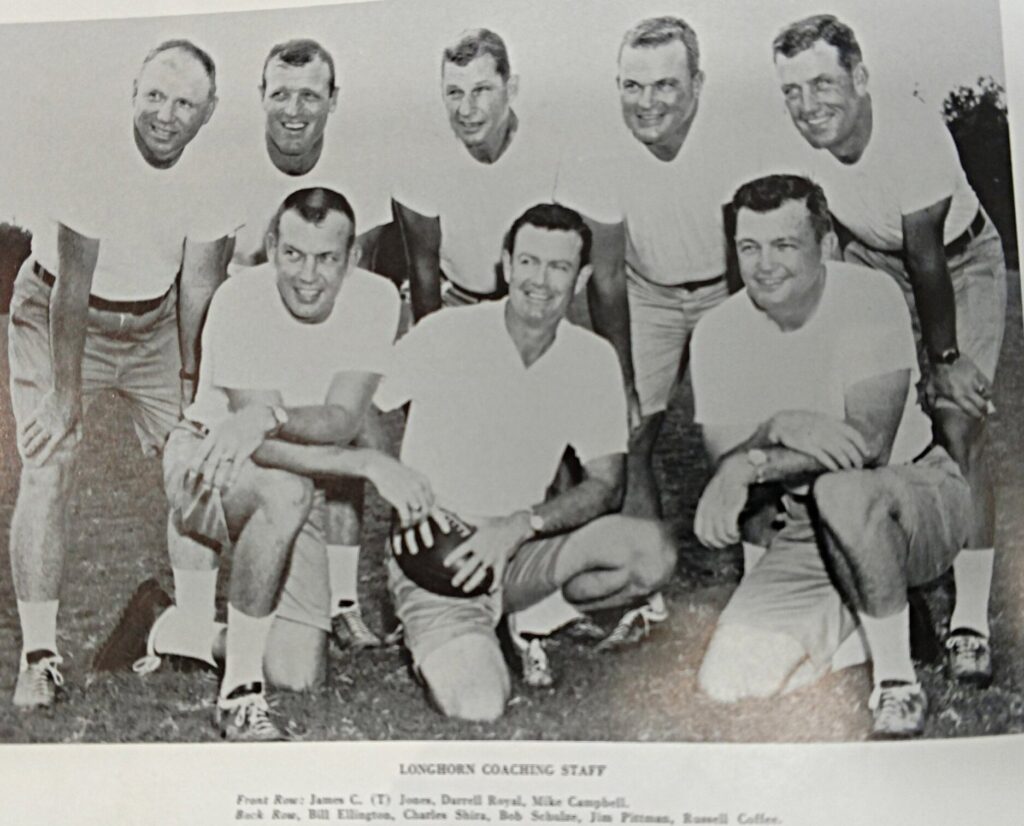
I was handling Coach Royal’s water (a nervous sip between most plays), a senior manager’s coveted task. Having him move a few steps was the only time I ever told that coaching legend what to do! He understood.
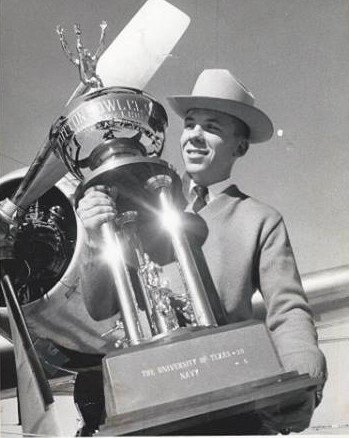
THE TEST: On Jan. 1, 1964, Texas had already been declared national champion but a loss to #2 Navy in the Cotton Bowl Classic in Dallas would tarnish the trophy forever.
Texas wasted little time in exploiting the Navy signals. We won the toss and elected to receive. On the game’s sixth play, Duke got the signal he was looking for. As the Navy safety ran himself right out of the play, Duke hit 18- year-old sophomore Phil Harris — the youngest player on the field — with a 58-yard touchdown pass. Untouched.
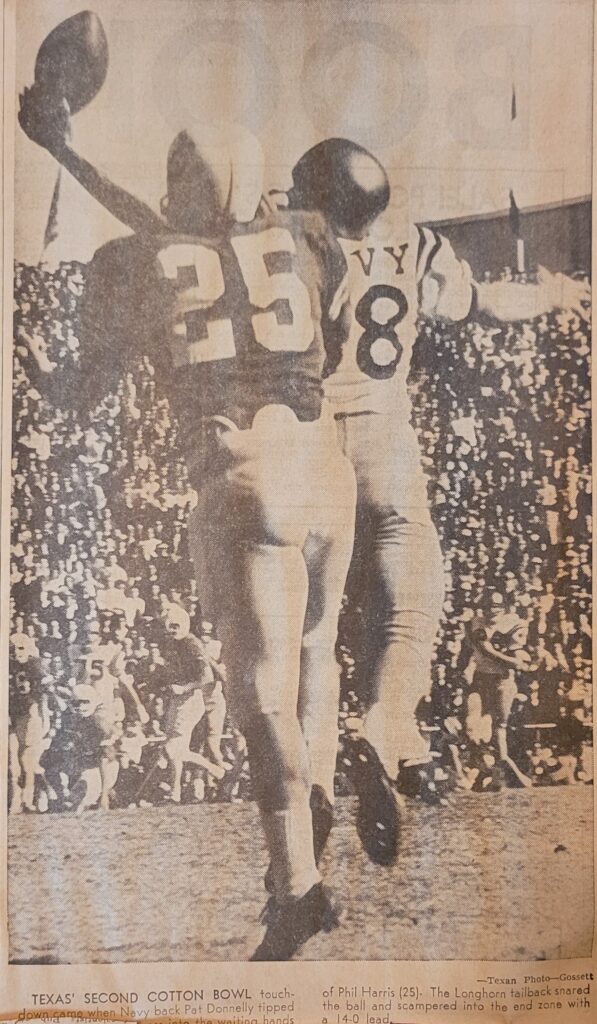
Less than three minutes had come off the clock. The TD marked the eighth time in 11 games that the Horns scored on their first possession. Six minutes into the second quarter Duke got the green light again. This time the TD pass to Harris covered 63 yards, again untouched. Navy was so shell shocked it fumbled on the next possession and Duke’s nine-yard scamper made it 21-0 at halftime.
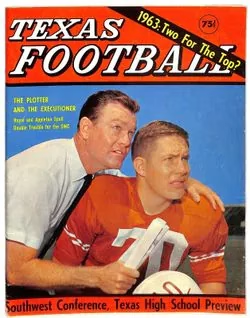
Meanwhile, Scott Appleton and the rest of the Longhorn defense, hounded the Heisman-winning Staubach unmercifully. Although the future Dallas Cowboy Super Bowl winner would wind up with 228 yards passing, he was sacked for 47 yards in losses. Appleton had 12 tackles alone and the Middies never made a single first down rushing the whole game. The 28-6 score was not only a team victory but a coaching staff victory as well. breaking the code to the Navy air defense.
ANOTHER SECRET WEAPON: I don’t think this has come up before, but I think the Longhorns were better prepared physically than our opponents due to logistics. You see, back then the practice fields were an estimated quarter mile from the locker room.
Concrete and buildings now cover what was three full-size football fields All that is still recognizable is Waller Creek. More on that later.
I submit that my Longhorns learned balance and footwork while walking to and from practice each day. I say “walking.” They were literally SKATING across San Jacinto Blvd., maintaining their balance on hard rubber cleats slipping on unforgiving pavement.
Dodging the two-way traffic called for some fancy footwork, quick stops and fast go’s.
After surviving San Jacinto’s traffic, there was one last test; one at a time, players had to practice critical balancing skills while crossing Waller Creek. That meant not slipping on 18-inch square stepping stones, placed about a foot apart.
Oh, did I mention that they were often wet after rain made the creek rise? Or that the players sometimes had to dodge branches, beer bottles and other debris coming downstream?
I don’t remember a player falling in — it was usually no more than a foot deep — but I fell in more than once while shagging footballs kicked there by Tony Crosby practicing field goals.
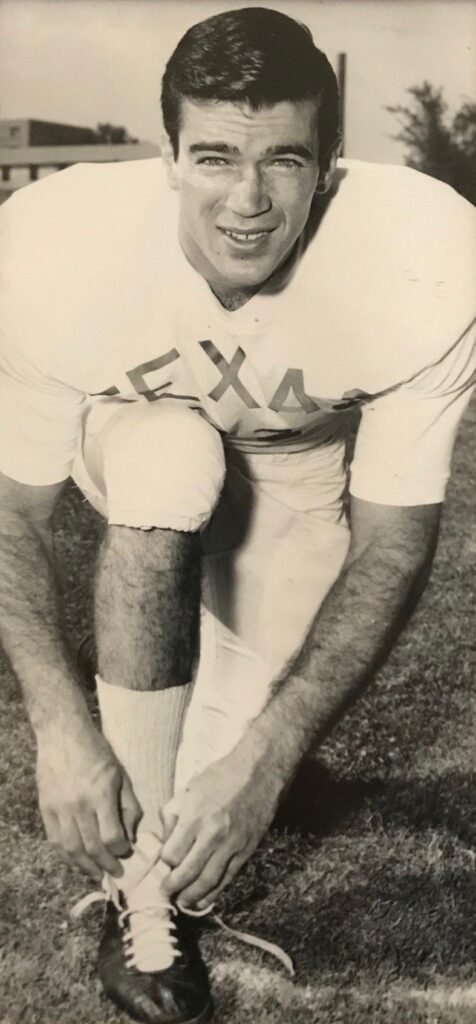
Caught poison ivy twice as well. I eventually turned over the shagging duties to an eager junior high kid who said he wanted to kick for the Longhorns someday himself.
Sure, kid, I thought to myself. And I want to be Blackie Sherrod or Lou Maysel. As long as you keep shagging the walls out of the creek for me, you can be Lou Groza if you want to. Oh, you might recognize the kid’s name: Billy “Sure” Schott.