
The smallest UIL schools to produce a Texas Longhorn, Part Two
The smallest UIL schools to produce a Texas Longhorn, Part TwoMore small-town schools that can claim a Texas Longhorn in their history.Earlier this week I published Part One of a series on the smallest public high schools in Texas that have produced a University of Texas football letterman, and today’s Part Two post will complete that series. If you missed “Part One”, you can read it by clicking the link below.
To briefly recap that post’s introduction, the schools mentioned in these two posts are found on the final pages of the University Interscholastic League’s most recent “Rank Order” list, published this past February. Every two years the UIL — the governing body overseeing and organizing athletic and academic competitions between public schools in Texas — conducts its realignment of schools, organizing them in different classifications based on enrollment (from Class 1A to Class 6A) and into different regions and districts within those classifications. The smallest schools are in Class 1A, and for football 1A is reserved for schools that play six-man football, while 2A and above is for standard eleven-man football. The eight schools mentioned in Part One had an enrollment of 72 or less at the time of the 2026 realignment, and they all play football in Class 1A (six-man). They are the eight smallest schools on the 2026 Rank Order list that I can connect with a UT football letterman. Part Two will cover the remainder of the high schools with Class 1A enrollments (104 students or less) which have a historic connection with a Longhorn. In the case of two schools mentioned in this post that connection is tenuous and uncertain, but they are included anyway because there is some interesting history there. A few of the schools appearing in this post still elect to maintain eleven-man football teams and compete with Class 2A for that sport but are aligned with Class 1A for all other sports. You might not be able to locate — or pronounce the name of — some of these places, but they are towns that Longhorns of old have called home. Five of the lettermen mentioned in this post were picked in an NFL Draft, and two were among the very best linemen the Texas Longhorns had during the middle decades of the 20th century. The number in parentheses after each school’s name is the enrollment figure submitted for the UIL’s 2026 realignment and will not necessarily reflect what each school has right now a few weeks into the 2026-27 academic year. After each player’s name the year(s) in parentheses indicates the years in which they are recognized as a letterman with the UT football program, or for non-lettermen it will be the years they were part of the program. Menard (75)
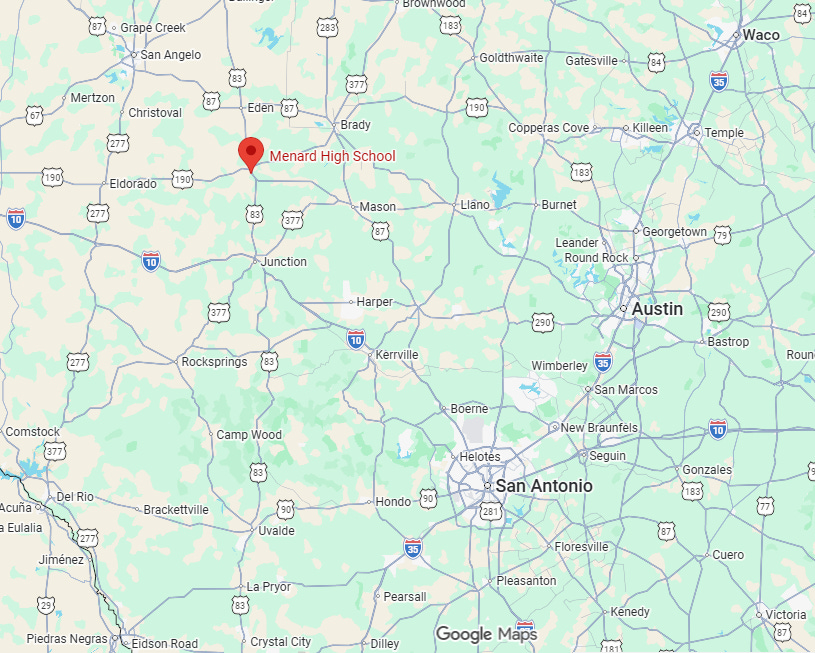
A Google Maps image with a dot on the location of Menard High School. S Reagan Willman (1996) Menard is a town in west Texas in the middle of… not much. It is about 67 miles’ driving distance southeast of San Angelo, and 115 miles south of Abilene. Its population recorded in the 2020 census (1,348) was its lowest since 1920. Menard High School had an enrollment of 92 at the time of the 2024 realignment, but dropped to 75 two years later. Its football team began playing six-man in 2022 after fielding eleven-man teams for more than a century. Reagan Willman, the lone Menard graduate to letter at Texas, played center and linebacker as a 190-pound high school senior in 1992 and received honorable mention all-state honors at center. He walked on with the Longhorn football team and was a reserve safety. He made one tackle as a senior in 1996 during his only game appearance, according to program records. After graduating from UT he coached football and tennis for many years in Austin and Georgetown. There was another Longhorn from Menard about seven decades earlier, but he received his high school education at the Allen Academy in Bryan. This was Joseph Wesley Nixon, a letterman on UT’s 1929 football team. He went on to a long career as a school principal and administrator in Laredo, and he is the namesake of J.W. Nixon High School in Laredo. Rotan (76)
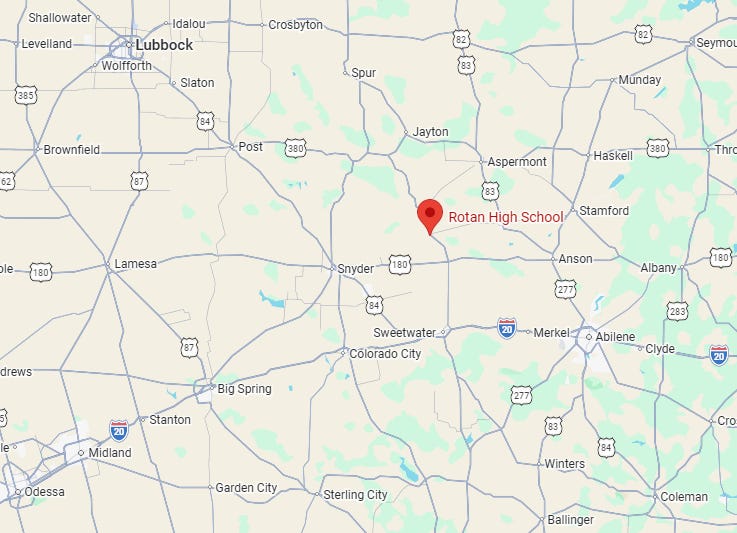
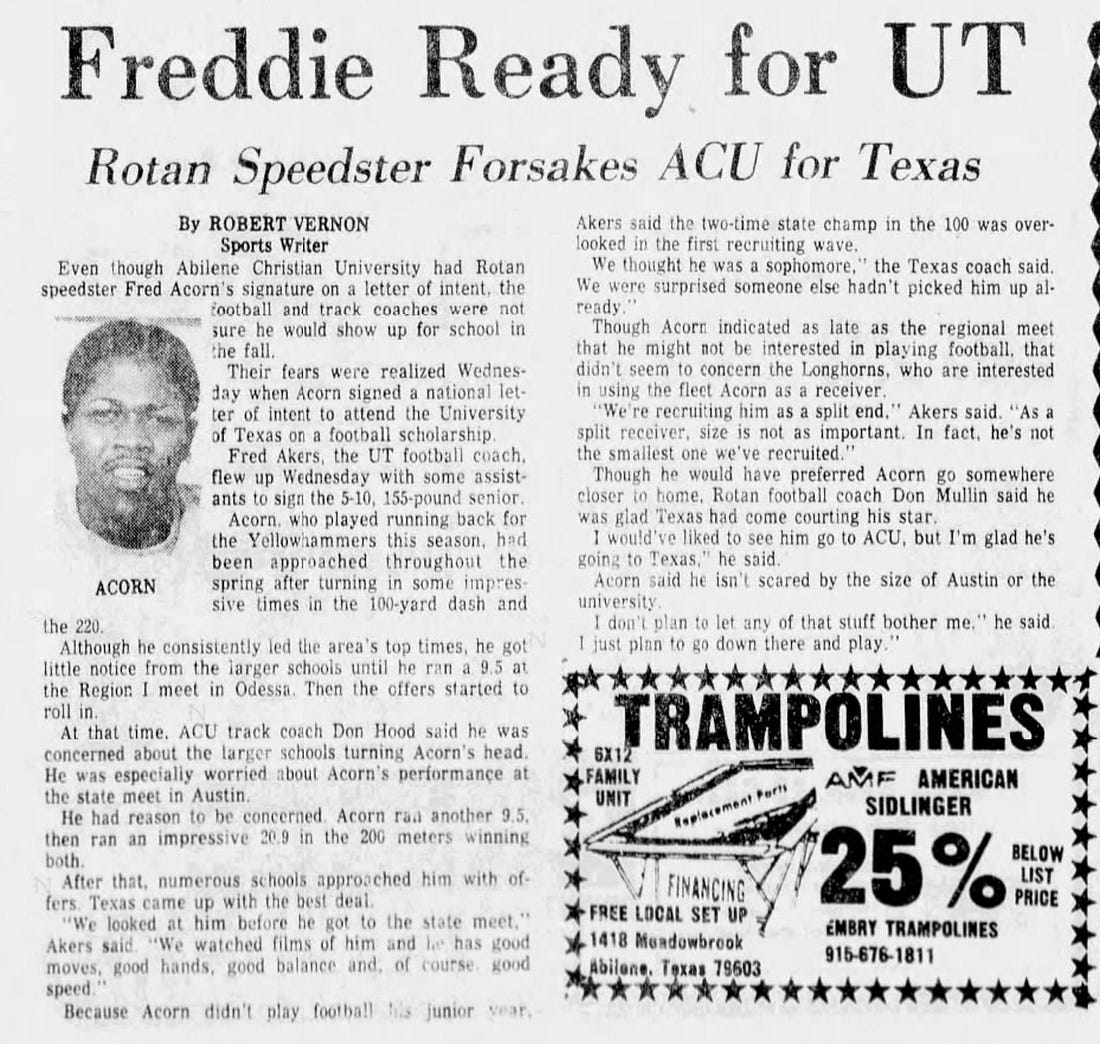
A Google Map with a dot showing the location of Rotan High School. DB Fred Acorn (1982-83) Rotan is a West Texas town in Fisher County that is about a 60-mile drive northwest of Abilene, and its population has been trending downward for more than 70 years. After recording exactly 1,000 residents in the 1920 census, it tripled in size over the next three decades and had a population of more than 3,100 in 1950, but it has decreased in every census since then. The 2020 census recorded Rotan’s population as 1,332, its lowest number since 1920. Rotan High School (mascot: the Yellowhammers) played eleven-man football until dropping to the six-man level in 2012, and it had some notable football success in prior years, most prominently winning the Class 1A state championship in 1962. Rotan has also had a remarkable number of coaches who led its football program for a time before going on to greater success elsewhere. By my count, five Rotan head coaches went on to lead other schools to a state championship game. Tommy Watkins, who led Rotan to that 1962 state championship in his fourth season as its head coach, was hired by Iowa Park the following year, and he would win two more state championships at that school (1969-70). Weldon Nelms, who was Rotan’s head coach from 1987 to 1989, later won two state championships as head coach at Wimberley in 2005 and 2011. Steve Warren was Rotan’s head coach for two so-so seasons from 1992-93 before joining the coaching staff at Abilene High School. He became Abilene’s head coach in 1996, and in his 19 seasons leading AHS his teams finished with a double-digit win total nine times and won the Class 5A Division II state championship in 2009. Bob Shipley, the father of standout Texas Longhorn wide receivers Jordan and Jaxon Shipley, was hired at Rotan for his first head coaching job in 1999. He only spent two seasons there, and he later had some very successful years at Burnet and Brownwood. His 2002 and 2003 teams at Burnet both lost in the Class 3A Division I state championship, and his 2010 Brownwood team reached the 3A Division II semifinals before losing to eventual state champion Carthage. And Russell Lucas got his first head coaching job at Rotan in 2004, and 15 years later he led Hamlin to its first-ever state championship appearance, where they lost in the 2019 Class 2A Division II final to Mart. Lucas retired after the 2024 season following his fourth season at Sweetwater and 21 years overall as a head coach. If a school’s athletic director is in the process of searching for a new head football coach, they could do a lot worse than simply reaching out to whoever is coaching Rotan, apparently. Rotan’s enrollment has been up and down between the 60s and 70s since dropping to the six-man level in 2012. Its enrollment figure for the 2026 realignment (76) was ten higher than it had been two years earlier, though one less than in 2014. Rotan’s contribution to the UT football program was Fred Acorn, who was a football, basketball, and track star at Rotan High School in the late 1970s. Acorn was Class 1A’s 100-yard dash state champion as a junior in 1978, and he won that event again as a senior while adding a gold medal in the 200-meter dash.¹ His time in the 200 meters was recorded as 20.9 seconds by handheld stopwatch, but the UIL’s Track & Field State Champion archive — which uses the standard conversion method for hand-timed results — now lists his winning time as 21.14. Acorn originally signed a “pre-enrollment application” to attend and play football and run track at Abilene Christian, but after his success at the state track & field meet in May of 1979 he was pursued by Southwest Conference football programs, and he ended up signing with Texas four days after the state meet.
An article on page 1-C of the May 18, 1979 Abilene Reporter-News reporting on Fred Acorn’s signing with the University of Texas. Acorn began his Longhorn career at receiver (more commonly referred to as “slit end” in that era), but the UT coaching staff moved him to cornerback in his second year. He won a letter as a sprinter on the UT track & field team in 1980 but barely saw the field in his first three years with the Longhorn football team. Head football coach Fred Akers was ready to tell Acorn in the spring of 1982 that he should focus on track going forward, but Acorn impressed during spring practices and was a backup cornerback in the fall of that year. He broke into the starting lineup as a fifth-year senior in 1983 and was the right cornerback on perhaps the most dominating defense the Longhorns have ever had. He did not record an interception but was credited with 12 pass break-ups and was one of three Longhorn defensive backs named to the All-Southwest Conference first team, and he also received honorable mention on the Associated Press All-America team. He was picked in the third round of the 1984 NFL Draft and spent his only NFL season with the Tampa Bay Buccaneers. Savoy (80)
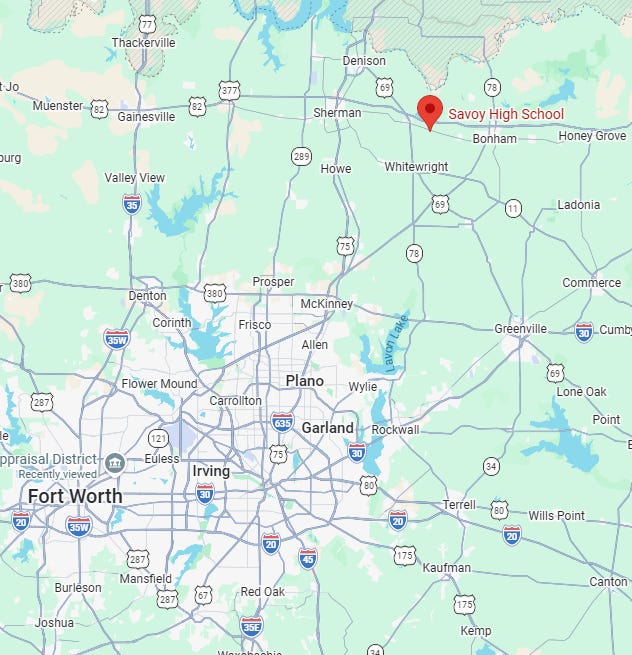
A Google Maps image with a dot on the location of Savoy High School. T Marshall Morgan “Mark” McMahon (1898-1901) The University of Texas had two football players at the turn of the 20th century who hailed from Savoy. Whether they should be credited to today’s Savoy High School is not clear, for reasons I’ll explain, but I’m including them in this post. Savoy is a small town in north Texas on the western edge of Fannin County, about six miles south of the Red River. Fannin County had a population of almost 52,000 at the time of the 1900 census and was one of the ten most populous counties in Texas. But its population has never reached that level since then and it had dropped below 23,000 by 1970. It has since rebounded somewhat and had over 35,000 residents in 2020. The town of Savoy has always been small, and its population ranged from 712 to 877 in the six censuses taken between 1970 and 2020. William Emmet McMahon (who was sometimes identified by his initials “W.E.”, though his grandson tells me he was called by his middle name) and his brother Marshall Morgan McMahon (who was known as “Mark”) were both born during the mid-1870s and grew up in Savoy. They received their earliest education at a local institution called the Savoy Male & Female College, which offered not only college courses but also education for primary and preparatory students from the north Texas and southern Oklahoma region, some of whom boarded in town. It was in operation for about 14 years after its founding in 1876, but its building burned down in the summer of 1890 and the college never reopened. Emmet McMahon was 14 when the college burned down, while Mark was 12. They surely received further education somewhere because five years passed before Emmet enrolled at the University of Texas in 1895. An alumni catalogue contained within volume 10 of the 1902 University of Texas Record stated that both McMahon brothers “prepared for University at Savoy public school”. Emmet was an academic student at UT for four years, then a law student for another two, and he was a halfback on the 1900 and 1901 Texas football team while a law student. Mark McMahon enrolled at UT two years after Emmet but had a longer football record. He played tackle on the football team and was one of the program’s earliest four-year lettermen, receiving a “T” in every season from 1898 to 1901. He was captain of UT’s 1901 football team and was also captain of the track & field team, on which he was a thrower. After graduating with a Bachelor of Literature, he spent two seasons as the football coach at the University of Oklahoma (1902-03).
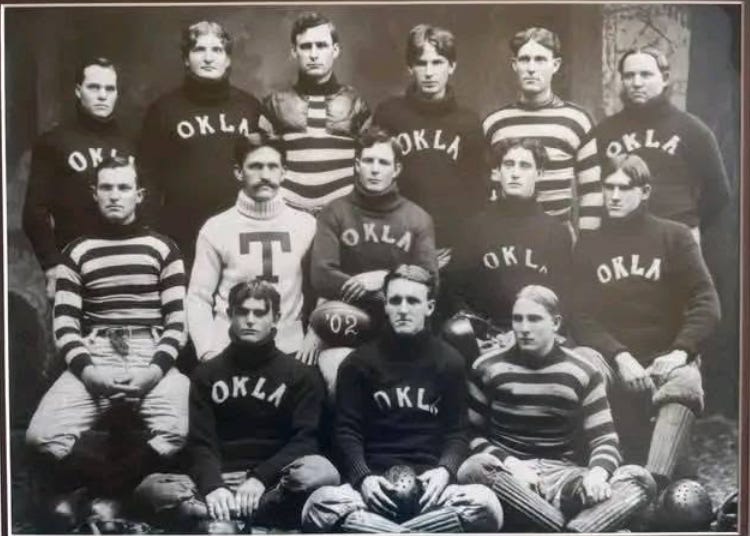
The 1902 University of Oklahoma football team. Its coach, former University of Texas team captain Mark McMahon, is easy to spot in his varsity “T” sweater. It was common for college football coaches to wear the varsity sweater from their own college when pictured with their teams at that time. Mark McMahon returned to Texas in 1904 and began a long career as a lawyer. He died in 1947, while his older brother Emmet lived to the age of 91 before his passing in 1967. Emmet was believed to be one of the last four surviving former students of the Savoy Male & Female College when he attended its reunion in 1962. Crosbyton (84)
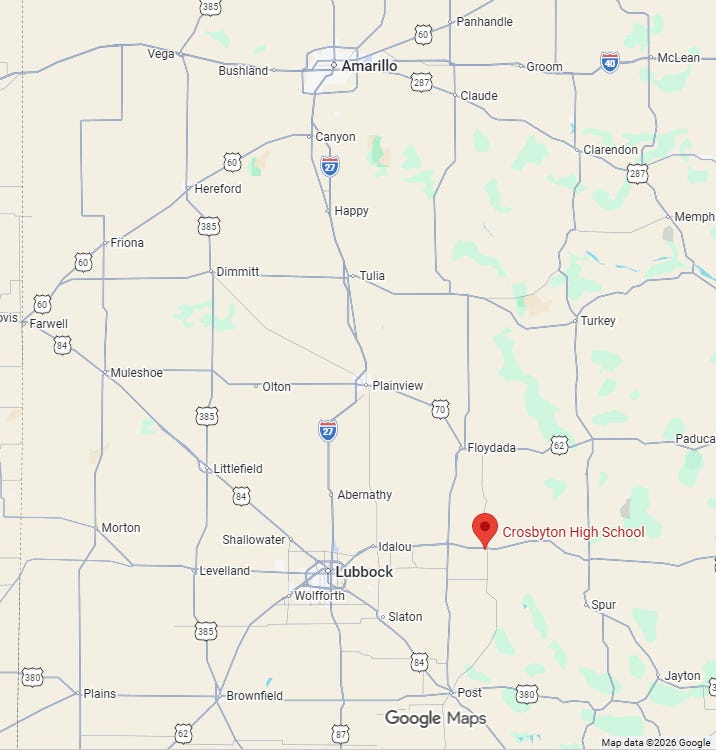
A Google Maps image with a dot on the location of Crosbyton High School. E Shelby Buck (1938-39) Crosbyton, which had just under 1,500 residents at the time of the 2020 census, is in Crosby County in west Texas, about 35 miles east of Lubbock. Crosbyton recorded its highest ever census figure in 1980 (2,289), but its population has decreased marginally in every census since then. Crosbyton High School has had Class 1A numbers for several realignment cycles but has maintained enough participation in football to remain in Class 2A (and thus in eleven-man competition) for that sport, though it is aligned in Class 1A for all other sports. Crosbyton High’s enrollment dropped from 92 to 84 between 2024 and 2026, and it remains to be seen how long the Chiefs can maintain an eleven-man football team. Shelby Buck, a 1936 graduate of Crosbyton High School, is the only Longhorn football letterman to come from there. He grew up in a large farming family, and was the tallest of his parents’ six sons, all of whom grew to be 6 feet or taller. Buck was a two-year letterman at the end position on the 1938 and 1939 Longhorn varsity football teams and also used his 6’3” 195+ pound frame to good effect in the boxing ring. He was the University of Texas’s intramural heavyweight boxing champion and also competed at the 1940 Golden Gloves Texas state tournament, where he reached the heavyweight final but lost by decision. He served in the U.S. Army Air Force during World War II and was killed on a training flight in England on May 30, 1943, when the P-47 he was piloting broke apart during a descent from over 30,000 feet. He was 24 years old. He was not the first Longhorn football letterman to die while in military service during World War II, but was the first to do so in Europe. I’ll have much more to say about Shelby Buck and his life and war service in a future post. Covington (85)
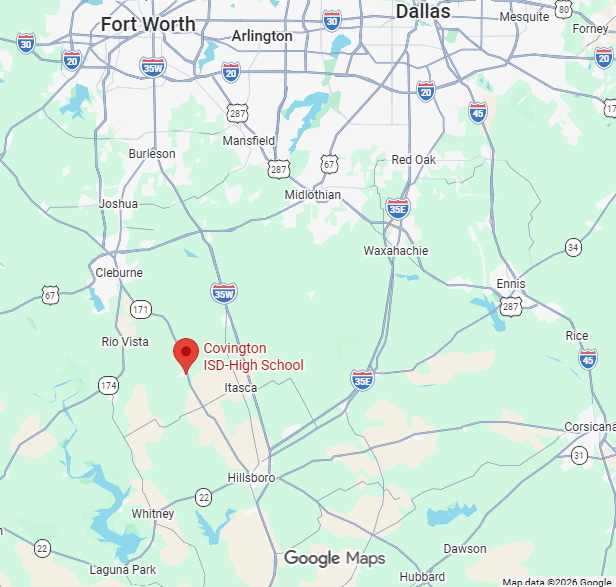
A Google Maps image with a dot on the location of Covington High School. G William Covington Gathings (1901) Covington is a small community in northern Hill County about halfway between Cleburne and Hillsboro. It was founded in the 1850s by James Jackson Gathings, a North Carolina native who had moved his family (and his numerous slaves) west to Texas and settled in Hill County. He named the town Covington after his wife’s maiden name. Gathings founded and ran many businesses in the town from its founding until his death in 1880. Covington’s population was not recorded for the U.S. census until 1980, and every census between that year and 2020’s has shown a population between 238 and 282. Covington High School’s football team played in the eleven-man ranks for the first time in 2000 after previously fielding six-man teams, but after eight seasons it dropped back to the Six-Man level in 2008 and has remained there ever since. It had an enrollment of 105 in 2007, its last season to play eleven-man football, and its enrollment has dropped into the 80s in the nearly two decades since then. William Covington Gathings Jr. was a grandson of Covington’s founder, and he grew up in that town. He was born in 1875, served in the military during the Spanish-American War, and enrolled at UT soon afterward. He was grouped with the “irregular” students in the 1901-02 University of Texas catalogue, which named Covington as his hometown. He was 25 years old at the start of that academic year, and neither the UT catalogue nor any other source I have searched reveals where he received his preparatory education, but he most likely got at least some of his schooling from Covington’s public school. I can’t definitively connect him with Covington High School, but hey, we’re journeying through Texas history here! Gathings was a regular starter at guard on the 1901 UT football team, but does not appear to have been a student beyond that school year. He died in 1953 and was buried in the Covington Cemetery, which is now the resting place of no less than 58 people with the last name Gathings, according to FindAGrave.com. Saint Jo (87)
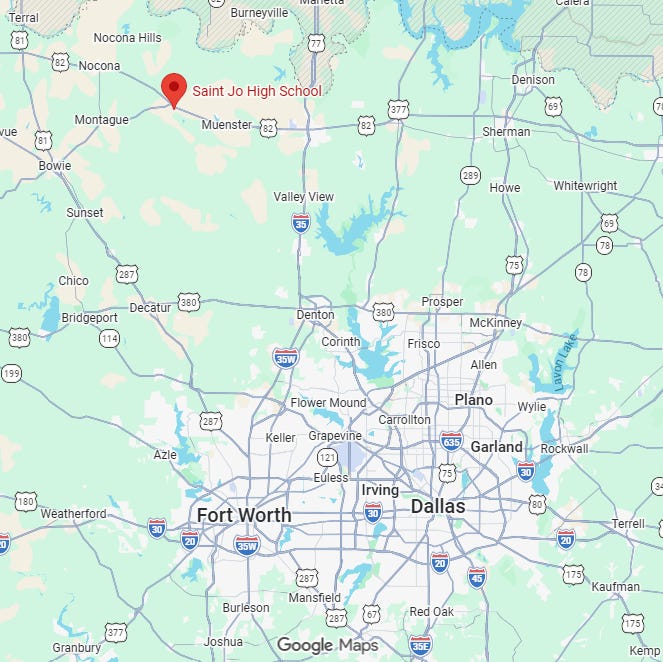
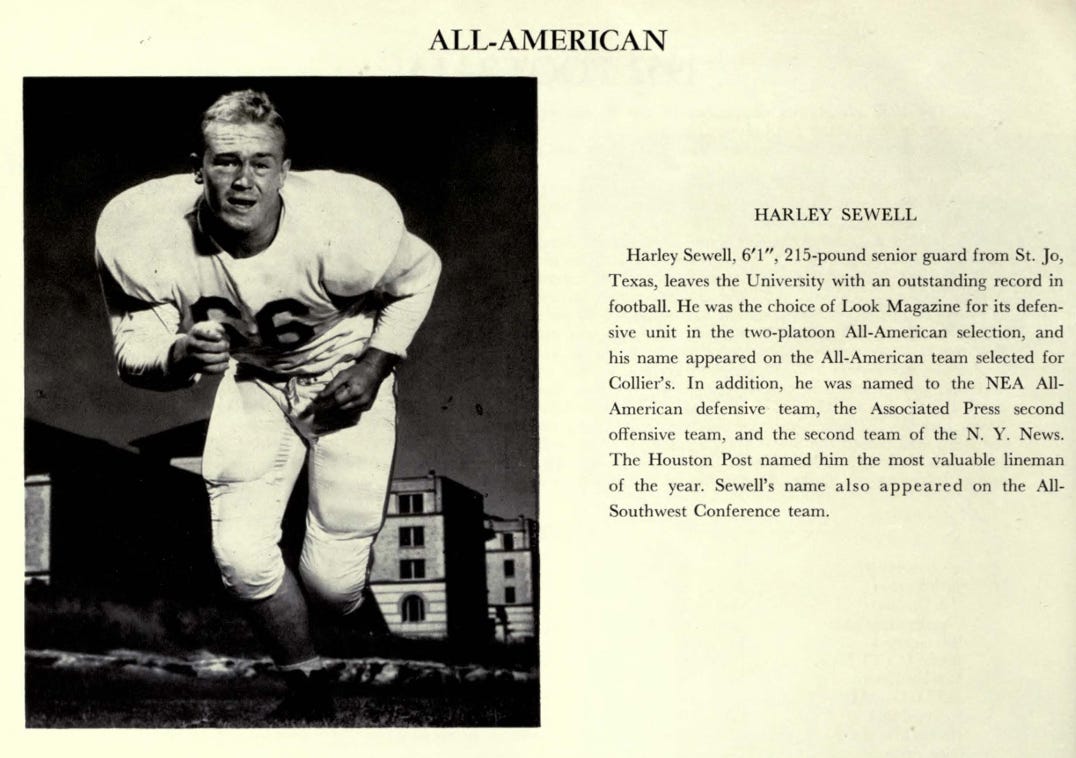
A Google Maps image with a dot on the location of Saint Jo High School. G Harley Sewell (1950-52) Saint Jo is a town in Montague County, one of the North Texas counties that borders the Red River. U.S. Highway 82 runs through Saint Jo, and the town is roughly halfway between Wichita Falls and Sherman. Its population at the time of the 2020 census was 881, the smallest figure it had recorded since 1910 (822), though its population has been fairly stable over the past 120+ years. Dating back to the 1900 census it has never recorded a population of more than 1,150 or less than 820. Saint Jo High School’s enrollment figure for the 2026 realignment was 87, a decrease from the 100 it had two years earlier, but in line with the 86 students it had in 2018. It had an eleven-man football team through the 2007 season (when its enrollment was in the high 90s), but has competed in six-man for the entire lifetime of its current students. A pair of Saint Jo alums suited up for the Longhorn football team in the early 1950s, one of whom went on to a long NFL career. Harley Sewell was a three-year standout lineman for Texas. As a sophomore in 1950 he primarily played on the defensive line. During that season he was described as “a blond customer out of Saint Jo, Texas, who dips snuff and climbs telephone poles for a summer living”.² He was a two-way starter as a junior and senior, and he was named to the All-Southwest Conference first team in both years. As a senior in 1952 he was named a first team All-American guard by the Central Press Association and was voted a second team All-American by the Associated Press.
Harley Sewell’s 1952 honors hailed on page 438 of the 1953 Cactus yearbook. Sewell was the 13th overall pick in the 1953 NFL Draft by the Detroit Lions, and he went on to play eleven NFL seasons. He was named to four Pro Bowls and was the starting left guard on a pair of NFL Championship-winning Lions teams in 1953 and 1957. He was inducted into the College Football Hall of Fame in 2000, and was named to the Detroit Lions All-Time Team in 2019. James Pierson was a teammate of Harley Sewell on the Saint Jo football team in the late 1940s, though he graduated a year later. Pierson was captain of Saint Jo’s 1949 football team and was later a halfback on the Texas Longhorn varsity for three seasons, winning his only letter in 1952. He graduated from UT with a geology degree in 1955. White Deer (88)
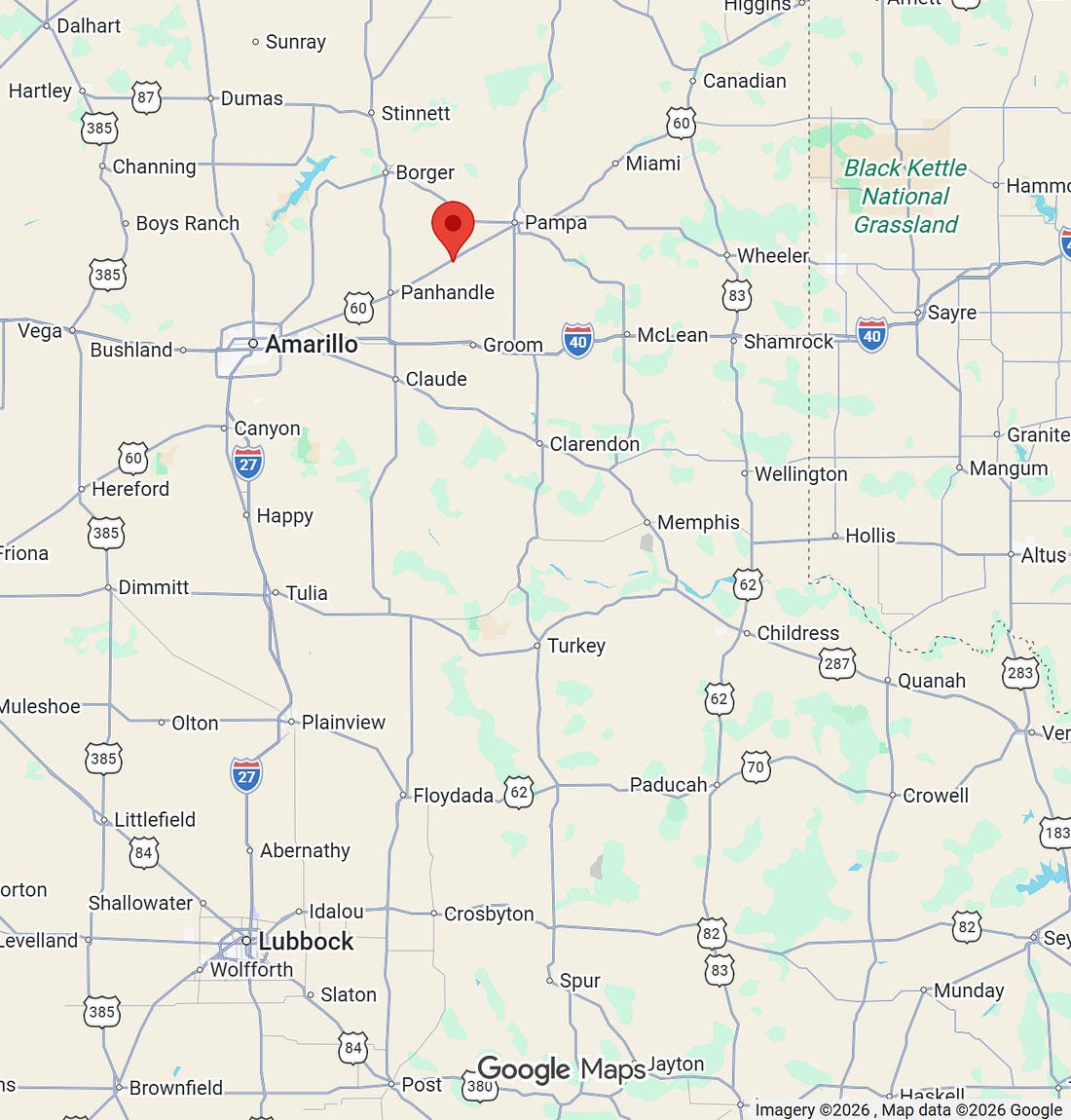
A Google Maps image with a dot on the location of White Deer High School. DT/OT Rick Thurman (1973-75) White Deer is a town in the Texas panhandle about 40 miles northeast of Amarillo. The 2020 census showed 918 residents, its smallest figure since the 1950 census. But as with Saint Jo and some other cities named in this series its population has not varied a great deal in recent decades. Every census between 1960 and 2010 produced a population for White Deer between 1,000 and 1,210. White Deer High School ‘s enrollment at the time of the 2026 realignment was 88, which is 11 more than it had at the previous realignment in 2024. Its football team has had several very successful seasons, including three state championship appearances. The White Deer Bucks won Class 1A state titles in 1958 and 1988, and one of the defensive starters on its 1988 team was future Pro Football Hall of Fame inductee Zach Thomas, who was a freshman linebacker at the time.³ White Deer had an enrollment of 106 in 2012 when it last played eleven-man football, but it switched to six-man in 2013 and has remained at that level ever since. Rick, Ken, and Donnie Thurman, three brothers from White Deer, suited up for the Texas Longhorns during the 1970s and the first two are recognized lettermen with the program. Rick Thurman was the oldest and highest-touted of the three. As a senior at White Deer in 1970, he was one of three Texans who were named to the Parade Magazine All-America High School Football Team.⁴ He made the team as a defensive end, and was joined by fellow future Longhorns Joey Aboussie (a Wichita Falls running back) and John Boecker (an offensive lineman from Seguin). During the 1971 track & field season, he finished 2nd in the shot put at the Class 1A state track & field meet. He signed with Texas and played on the Longhorn freshman football team in 1971, the final year that freshmen were ineligible to play on collegiate varsity football teams. He had good size for a lineman at that time at 6’5” and 230-240 pounds. After redshirting in 1972 he was a backup offensive tackle for most of the 1973 season, but was moved to defensive tackle late in the year after an injury to starter Fred Currin, and he remained at that position for the final two regular season games and for UT’s loss to Nebraska in the Cotton Bowl. Rick returned to the offensive side of the ball and was the Longhorns’ starting left tackle in 1974 until he suffered a season-ending injury in the seventh game. He was contending for his old left tackle spot as a fifth-year senior during Fall camp in 1975 when he suffered a broken ankle and torn ligaments in one of his knees in late August, which ended his senior season before it could begin. Despite not being able to play in 1975 he was still awarded a varsity letter for that season, and he finished his career as a three-year letterman. Rick Thurman was picked in the 14th round (#388 overall) of the 1976 NFL Draft by the Kansas City Chiefs but was released only a week after signing his rookie contract, and he never played in the NFL. Ken Thurman, the second oldest, enrolled at Texas in 1973 and played center on the Longhorn freshman team that fall. He was listed at 6’1” and 215 pounds on the Longhorns’ 1974 varsity roster. He evidently had a growth spurt (or benefited from some embellishment on his roster listing), as he spent the 1975 season as the backup right tackle (behind consensus All-American Bob Simmons) and was listed at 6’4” and 230 pounds. He was moved to right guard and was the backup at that spot going into the 1976 season, but a knee injury in September sidelined him for that year. He was a member of the team in 1977 but was not on the two-deep roster and was not mentioned in newspaper reports from that year that I searched. He was awarded his only letter as a fifth-year senior in 1977. Youngest brother Donnie Thurman signed with Texas in the 1974 recruiting class. Donnie also had good size at a reported 6’2” and 240 pounds, and like his older brother Rick, he finished 2nd in the shot put at the state track & field meet in his senior year at White Deer. Donnie was a reserve lineman in both 1975 and 1976 but was seldom mentioned in news reports and evidently did not see the field much, if at all, and he is not named on the program’s lettermen list. Iraan (98)
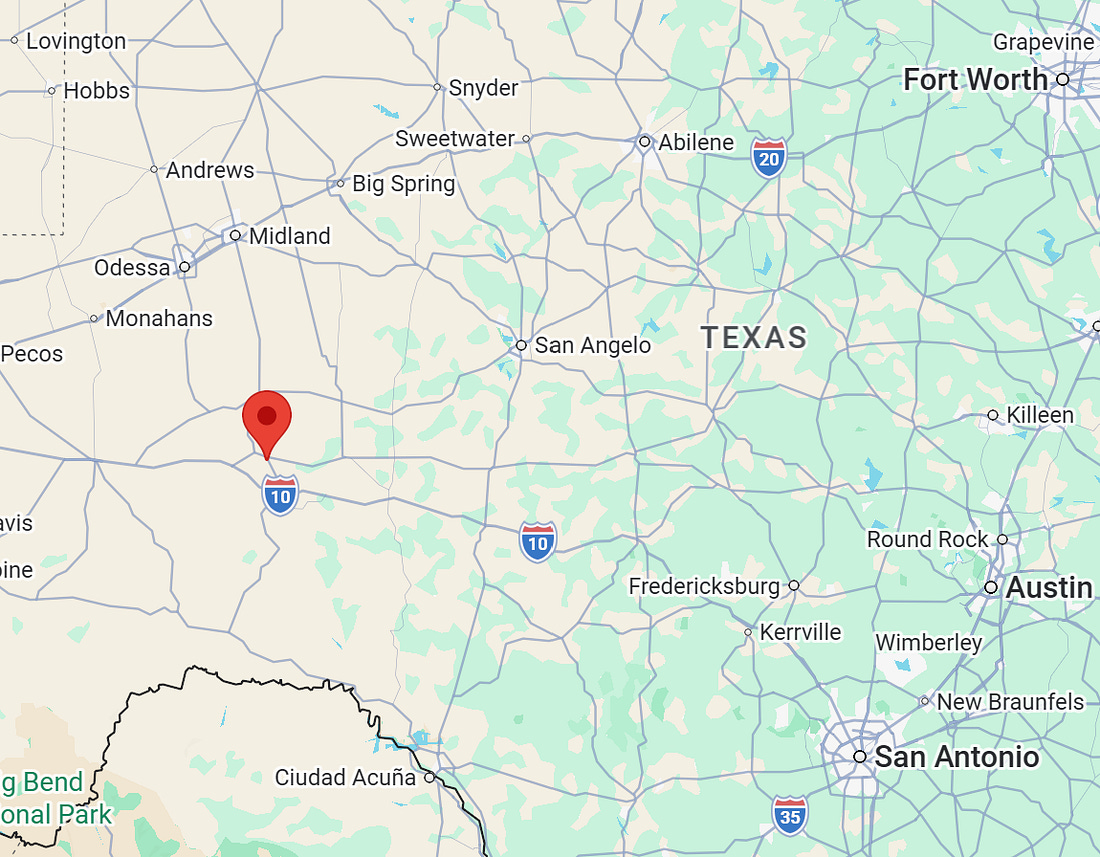
A Google Maps image with a dot on the location of Iraan’s schools. G Lewis “Bud” McFadin (1948-50) Iraan (pronounced “Eye-ruh-Ann”) is a west Texas town that’s a fair distance from any city of significant size. It is about 80 miles south of Odessa and a driving distance of almost 115 miles southwest of San Angelo. The town’s name is a sort of portmanteau of the first names of Ira and Ann Yates, who owned the land where the town was built. It was first settled in the 1920s when oil was discovered nearby. Iraan’s population was 1,255 when it first appeared on census results in 1960. The 1980 census recorded its highest population figure, 1,358, and in 2020 it was down to just 1,055. Iraan High School’s enrollment was listed as 109 at the time of the 2024 UIL realignment, making it one of the smallest 2A schools in the state. Two years later that figure had dropped to 98. Iraan will continue to field an eleven-man football team and will compete in Class 2A Division II through at least the 2027 season, but will be a 1A team for all other sports. From this small and desolate town have come two Longhorns who had outstanding careers in Austin, and another promising athlete who had a brief run at UT before spending the majority of his college career elsewhere. Lewis “Bud” McFadin was reported to be 6’4” and 240 pounds when he reported to UT as a freshman in 1947, which was very large for that time. He initially worked out as a T-formation fullback on the Longhorn freshman team before being moved to tackle. In the spring of McFadin’s freshman year, Longhorn line coach Ed Price called him, “The best physical prospect I ever saw come to Texas.”⁵ McFadin did not disappoint Price or Longhorn fans over the next few years. He was a regular at guard as a sophomore, then a starter as a junior and senior. As a junior in 1949 he made the All-Southwest Conference first team and received honorable mention on the AP’s All-America team, and as a senior in 1950 he was a consensus All-American.
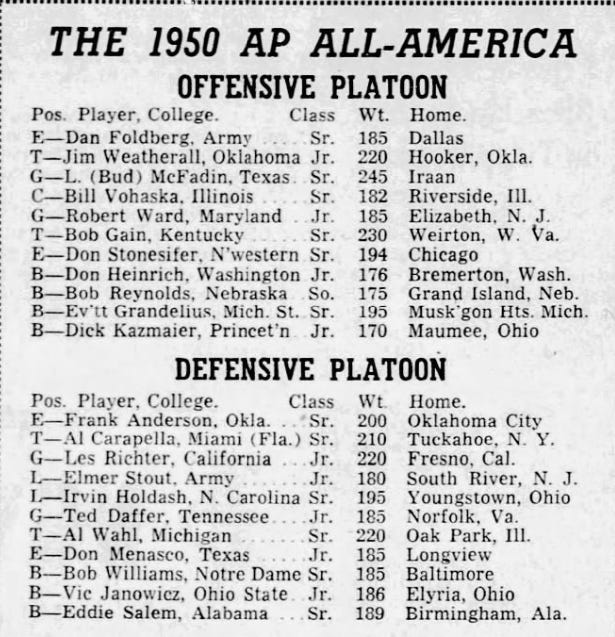
The 1950 Associated Press All-America first team football lineup. Bud McFadin was by far the heaviest player on the first team at a listed 245 pounds. McFadin was the 11th overall pick in the 1951 NFL Draft. His service in the military during the Korean War delayed the start of his pro football career until 1952, and afterwards he played for five seasons with the NFL’s Los Angeles Rams (1952-56). He retired from football in 1957, a few months after he was accidentally shot in the abdomen when a pistol discharged while it was being handed to him by a friend. After recovering from his gunshot wound he managed the Atascocita County Club in Houston for the next few years, then returned to pro football at age 32 in 1960 after signing with the Denver Broncos of the new American Football League (AFL). He played defensive tackle for the Broncos for four seasons, followed by two more with the Houston Oilers before retiring for good after the 1965 season. He made five Pro Bowls in his career and was named to the All-AFL team on three occasions. McFadin was inducted into the College Football Hall of Fame in 1983. His grandson Tillman Holloway also attended UT and was a four-year letterman as an offensive lineman with the Longhorn football team from 2000 to 2003. About a decade after McFadin’s arrival at UT came another star athlete from Iraan in the form of James Linden “Lindy” Lyles, who had made the Class 1A all-state teams in both football and basketball before signing with Texas in 1958. He played on the Longhorn freshman football team at both guard and end that fall, then served in the Army for the next three years. He enrolled at Texas again in 1962 but did not play with the Longhorns and he ultimately transferred to Southwest Texas State University (now Texas State University) in San Marcos. He played on the SWT football team and was named to the All-Lone Star Conference team at center as a 23-year-old sophomore in 1963, then was moved to linebacker and made the All-LSC team at that position as a junior and senior. Mark Lang was another Iraan Brave who left an impact on the gridiron at Texas. He began his college career at Oklahoma State after graduating from Iraan, but he did not return to OSU after playing linebacker and defensive end as a freshman in 1979. He transferred to Texas and played linebacker for the Longhorns for three seasons. He was the team’s leading tackler as a junior in 1982 and was tied for second on the team in total tackles as a senior in 1983, and in the latter season he was named to the All-Southwest Conference second team. He was picked in the 12th round of the 1984 NFL Draft by the Kansas City Chiefs but spent the 1984 season on injured reserve. He was waived during the preseason in 1985 and never appeared in an NFL game. Leakey (98)
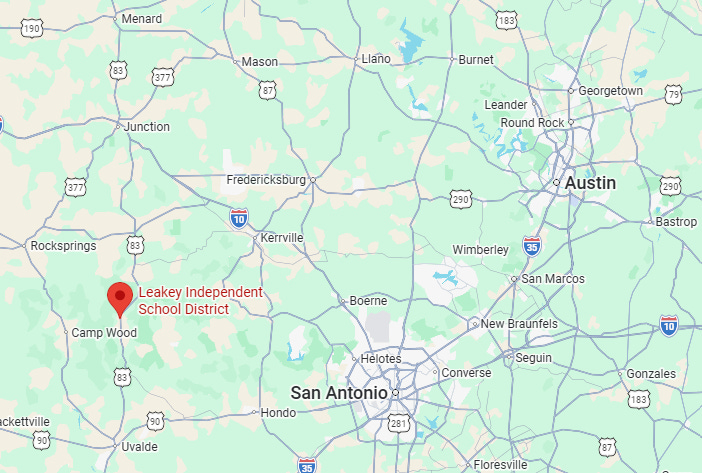
A Google Maps image with a dot on the location of Leakey’s public schools. E Jack Rushing (1970) Leakey is a town close to the part of the state where West Texas and South Texas meet. It is on U.S. Highway 83 between Junction and Uvalde and about 100 miles of driving distance west of San Antonio. It is the seat of Real County, the population of which (around 2,700) would not be large by Class 6A standards if it were a high school. Leakey’s population was 587 when it was first counted for a U.S. census in 1960, and its most recent census figure (315) was the smallest it has ever recorded. Leakey High School’s enrollment at the time of this year’s UIL realignment was 98, a marginal decrease from the 104 it had two years earlier, though quite a bit higher than the 72 students it had in 2018, the year it began competing in Class 1A after having an eleven-man football team since 1976. Prior to 1976 Leakey played eight-man football, a style now extinct in Texas public schools but which is still played in several other states. Eight-man football is actually far more common in small high schools nationwide than six-man football, and at least 14 states award a public-school state championship for eight-man football, while others have eight-man championships only in private or parochial school leagues. In Texas, the UIL awarded state championships for both eight-man and six-man football between 1972 and 1975, but eight-man football was phased out after the 1975 season. Leakey High School’s 1975 team won the UIL’s last eight-man state championship. Jack Rushing was a star halfback at Leakey during its eight-man football era. His family lived in nearby Rio Frio, and his parents were both teachers in Leakey for three decades. He signed with Texas in its 1968 recruiting class and spent his first two seasons with the program primarily at halfback. He was moved to offensive end in 1970, then was a reserve linebacker as a senior in 1971. He won his only letter during the 1970 season. After graduating from UT, Rushing went on to receive a master’s degree from Sul Ross State University and was a longtime high school coach. He was the head football coach at four high schools between 1982 and 2002, and in his fifteen seasons as head coach his teams reached the playoffs eleven times. Several Longhorns went to high schools that are now small enough that they compete at the six-man levels of football, but Jack Rushing and Rocky Allen (mentioned in Part One) are the only two Longhorn lettermen I’m aware of who actually played six-man or eight-man football while in high school. If any readers know of others, please message me or mention them in a comment. Thanks for reading Journey through Texas (and) Longhorn history! Subscribe for free to receive new posts and support my work highlighting past Longhorns and the places they came from. If you enjoyed this post, please click the “like” button and/or share it with others. 1 This was within the period when the UIL track & field running events were switching to metric distances. Most races that had been run at distances measured by yards (i.e. the 440-yard dash and 880-yard run) switched to metric distances starting in 1978, but the 100-yard dash was still run at the state meet in 1979 before being phased out for the 100-meter dash in 1980. Thus, Fred Acorn was Class 1A’s final state champion in the 100-yard dash. 2 “‘I Love Neely,’ Admits Cherry”, Houston Post, November 19, 1950; page 1. 3 Zach Thomas transferred to Pampa High School after his sophomore year and spent his junior and senior years there. 4 “Three Texans On A-A Teams”, Longview Morning Journal, December 11, 1970; page 2-B. 5 “Coach Thinks Iraan’s Bud McFadin Top Texas Comer”, San Angelo Evening Standard, April 6, 1948; page 10. “Journey through Texas (and) Longhorn history” is free today. But if you enjoyed this post, you can pledge a future subscription. You won’t be charged unless payments are enabled.
|
 Like
Like Comment
 Restack