College football Hall of Fame
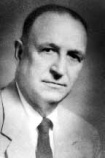
Harrison Stafford
Michael Huff
2005 Thorpe Award winner and Defensive MVP of the National Championship game, Michael Huff becomes 23rd Longhorn College Football Hall of Famer.
By: Grace Tafolla
AUSTIN, Texas – The University of Texas and The National Football Foundation (NFF) announced Wednesday that they will jointly honor 2025 NFF College Football Hall of Fame inductee Michael Huff with an NFF Hall of Fame On-Campus Salute, presented by Fidelity Investments.
The Salute will take place on Nov. 22, during the Longhorns’ home football game vs. Arkansas, which is set for 2:30 p.m. CT at DKR-Texas Memorial Stadium. The game will broadcast on ABC.
“A defensive back with exceptional speed and impeccable instincts, Michael Huff consistently thwarted opposing offenses while making clutch plays and helping Texas claim the 2005 national title,” said NFF President & CEO Steve Hatchell. “We are thrilled to honor him at Darrell K Royal-Texas Memorial Stadium as a member of the 2025 College Football Hall of Fame Class.”
A Longhorn legend who was the 2005 Jim Thorpe Award winner and Defensive MVP of the 2005 National Championship game, Huff (2002-05) was selected for enshrinement into the College Football Hall of Fame as a member of the class of 2025 in January. Huff was chosen from a ballot that included 77 players and nine coaches from the NCAA Football Bowl Subdivision and 101 players and 34 coaches from the NCAA divisional and NAIA ranks.
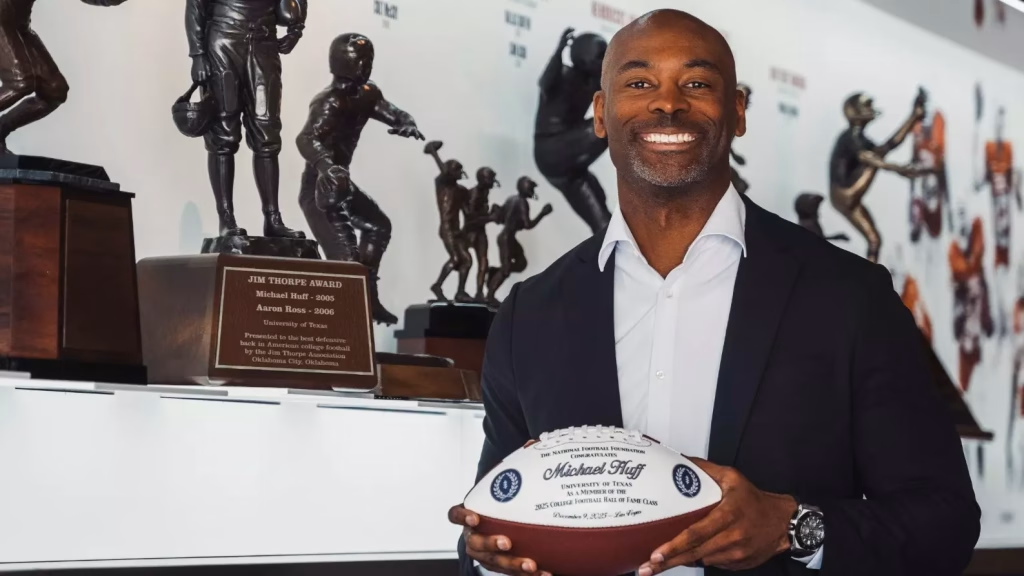
Huff, who currently serves as Texas Football’s assistant director of player development, was a two-sport athlete for the Longhorns who earned All-Big 12 honors in both football and track and field. Texas’ first-ever Thorpe Award winner as the nation’s top defensive back in 2005, he capped off a tremendous season and career that year by earning Defensive MVP honors in the Longhorns’ thrilling BCS Championship game victory over USC, 41-38. Best known for his football IQ, pass defending and playmaking skills, one of Huff’s most memorable plays was the tackle he made on fourth-and-2, late in the National Championship game, that gave Texas the ball for their game-winning drive. He recorded 12 tackles, one tackle for loss and a fumble recovery in helping the Horns secure their first national title in 35 years.
A two-time All-American who earned unanimous first-team honors as a senior, Huff was a four-year starter for the Longhorns, starting 50-of-51 career games. One of only 25 unanimous first-team All-Americans in the history of Texas Football, he was a two-time first-team All-Big 12 selection who recorded 318 tackles, 26 tackles for loss, seven interceptions, 44 pass breakups (No. 6 in program history), six forced fumbles and three fumble recoveries. Texas registered a 45-6 record (28-4, Big 12) in his four seasons, posting at least 10 wins each year and three Top 6 final rankings (1st/2005, 4th/2004, 11th/2003, 6th/2002). He was 3-1 in bowl games, including back-to-back Rose Bowl victories in 2004 and 2005. Huff still holds UT records for interception returns for touchdowns for both a single season (two, in both 2002 and 2003) and career (four), along with career defensive scores (five). His 23.1 yards per interception return in a career is also still a Longhorn record, and his 162 career interception return yards rank fifth. He was additionally a special teams standout who blocked three kicks.
In his one season of track, he qualified for the NCAA regional meet with a 10.48 in the 100 meters and ran the lead leg on Texas’ 400-meter relay that took second place at the Big 12 Championships. That foursome went on to finish third at the NCAA Midwest Regional meet.
A first-round draft pick (7th overall) of the Oakland Raiders in 2006, Huff played eight NFL seasons, mostly as a versatile player who started at both safety spots and cornerback during his career. He played in 118 career games with 94 starts and posted 446 tackles, 11 interceptions and 55 passes defended. He culminated his career by playing in the Super Bowl with the Denver Broncos in 2013. Huff was tabbed second-team All-Pro in 2010.
Very active in the community both during his time at UT and currently, Huff was recognized by the University of Texas campus group SafeHorns with the Community Impact Award in 2021. The Raiders also named Huff their Walter Payton Man of the Year honoree in 2012 for his community, charity and volunteer efforts.
Huff graduated with a degree in youth and community studies in December 2005 and was enshrined in the Texas Athletics Hall of Honor in 2015. He was inducted into the Irving Independent School District Athletic Hall of Fame in 2023, and his jersey number 23 has been retired in his honor at his high school, Nimitz.
During the 2025 season, each member of the Hall of Fame Class will be honored on the field at his respective school with an NFF Hall of Fame On-Campus Salute, presented by Fidelity Investments. The Class will be officially inducted during the 67th NFF Annual Awards Dinner Presented by Las Vegas on Dec. 9, 2025, at the Bellagio Hotel & Resort, and permanently immortalized at the Chick-fil-A College Football Hall of Fame in Atlanta.
Texas hosts the Arkansas Razorbacks at 2:30 p.m. CT Saturday, Nov. 22, at DKR-Texas Memorial Stadium. The game will broadcast on ABC with Joe Tessitore and Jesse Palmer in the booth and Katie George on the sideline.

Jerry Sizemore 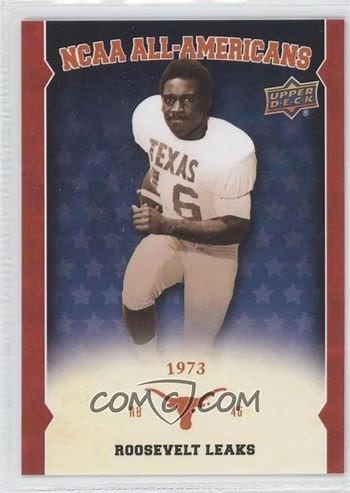
Rosy Leaks 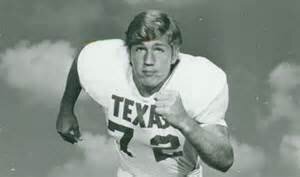
Doug English 
Ricky Williams
Bill Little commentary: A place in the Hall — Steve McMichael
April 30, 2009
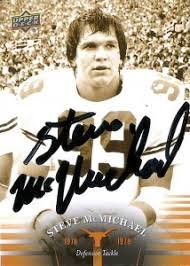

Bill Little, Texas Media Relations
If it is as they say — that there is a thin veil between life and death — then somewhere from a place beyond E. V. McMichael is smiling right now.
It has been a long time since that night in 1976 when young Steve McMichael was returning to Austin after starting his very first game as a Texas Longhorn defensive end against the Texas Tech Red Raiders in Lubbock. A lot would change that late October night. The night before the game, Darrell Royal would confide to some close associates that he likely would retire as the Texas head football coach following the season.
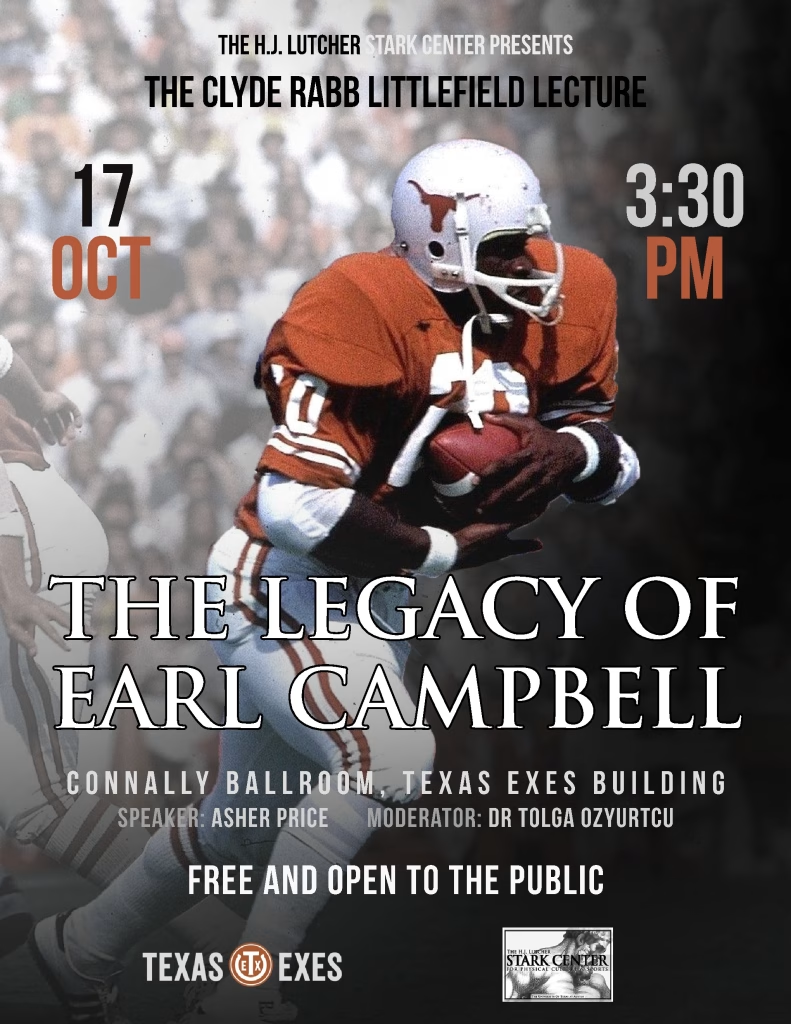
Earl Campbell, the star of the team, would re-injure a hamstring and would miss the next four games in what would turn out to be a 5-5-1 season. For Steve McMichael, a sturdy young freshman from Freer who had been considered for the tight end position, his first start as a Longhorn had ended in a 31-28 loss to the Red Raiders.
But that night — October 30, 1976 — young Steve would learn the difference between the game of football and the reality of life. That night, E. V. McMichael, an oil field superintendent, was shot to death outside his home in South Texas.
In the years that would follow, Steve would stick with the game E. V. had helped teach him. Where it was football that had brought him to The University of Texas, it would be Steve’s drive and dedication that would carry him to the greatest heights of the game.
That is why, on Wednesday, when Steve McMichael was announced as the Texas Longhorns’ 15th player and 17th overall inductee (including coaches D. X. Bible and Darrell Royal) into the National Football Foundation’s College Hall of Fame, you have to figure there was a loud cheer somewhere beyond the sky.
“I will never be able to thank The University of Texas enough for what it did for me during that time,” McMichael recalled from his home in Chicago, where he was a star in the NFL for the Bears and is now the head coach of the arena league Chicago Slaughter. “My ‘old man’ put me on the road, but if it hadn’t have been for Texas, I have no idea where I would be right now.”
McMichael joins a class that includes, among others, Tim Brown of Notre Dame, Major Harris of West Virginia, Chris Spielman of Ohio State, Curt Warner of Penn State, Gino Torretta of Miami and Grant Wistrom of Nebraska.
There were those, during his playing days at Texas, who would swear that McMichael was the poster boy for the old cartoon showing a grizzled guy with a menacing look with the take off on the Bible scripture saying, “Yea, though I walk through the valley of death, I will fear no evil…’cause I am the meanest dude in the valley.”
Back at Texas Tech his junior year, when the Red Raiders’ spirit group came to the airport and rolled out a red carpet, McMichael and his fellow tackle Bill Acker took one look at the welcome gesture, then pushed through the red-and-black clad students and walked around the carpet. Texas won the next day, 24-7.
His senior year in 1979, as part of perhaps the best defense in Texas history (it allowed an average of only nine points per game), McMichael personally dominated the 1978 Heisman Trophy winner Billy Sims in the Longhorns’ 16-7 victory over the Sooners. Sims gained only 73 yards on 20 carries, and McMichael registered 13 tackles — nine against the running game.
McMichael totaled 133 tackles during his senior season, and posted 369 tackles, 30 sacks, 40 tackles behind the line, 99 quarterback pressures and 11 caused fumbles during his career as a Longhorn.
In the NFL, McMichael’s name would become famous in Chicago, where he would help lead the Bears to some of their greatest moments, including a Super Bowl win in the 1985-86 season. Drafted and later cut by the New England Patriots in 1980, McMichael rebounded to become a two-time Pro Bowler in Chicago. He played 14 years in the league, retiring in 1994 after a final season with Green Bay. He set a Bears’ record by playing in 191 consecutive games, and during his career he registered 95 sacks and played in 213 NFL games.
He then took a spin as a professional wrestler before retiring in 1999. In 2001, he returned to Chicago where he has hosted the Chicago Bears pre- and postgame shows on the local ESPN radio affiliate.
His Chicago Slaughter Professional Arena team is 7-0 and has clinched the Western Division of the Continental Indoor Football League, doing so with a 78-25 victory over Milwaukee last Saturday.
A member of the Longhorn Hall of Honor, the Texas High School Sports Hall of Fame and the Chicagoland Sports Hall of Fame, McMichael is involved in numerous charities, most notably the Fisher House Foundation and other organizations that support wounded soldiers and their families.
McMichael becomes the second member of his Longhorn era to be inducted into the NFF Hall of Fame, joining safety Johnnie Johnson, who was enshrined in 2007. Upon his induction during the December festivities in New York, Johnson allowed that he would have made a lot more tackles, had McMichael not made them all before they could get into the secondary.
“I can tell you this,” McMichael said Wednesday. “I will be wearing orange. There is no way to describe how much this means, or how thankful I am to all of the people who helped me at Texas. All I can say is, ‘Hook ’em!'”
It is a long way from Freer, Texas, to the ballroom of the storied Waldorf Astoria in New York City. The years perhaps have dulled the pain of that night so very long ago that changed the life of a young freshman. But when Steve McMichael, his wife and new baby girl celebrate that moment in the grand old hotel, there will be a lot of pride in a lot of places, seen and unseen.
Because, you see, in his playing time at Texas and at Chicago, many people saw the tough exterior of a man carved from the dust of the land and the steel of the spirit. But what drove Steve McMichael was a wry smile that reflected someone who could see the fun side of life, even in the hard times. It was paired with a fierce determination and an unbending drive of competition.
Most of all, it was about matters of the heart — the kind which fought undaunted, perhaps bloody, but always unbowed.
One of the all-time great Longhorns is Derrick Johnson. Derrick Johnson is going in the College Football Hall of Fame. From the Texas Sports article:
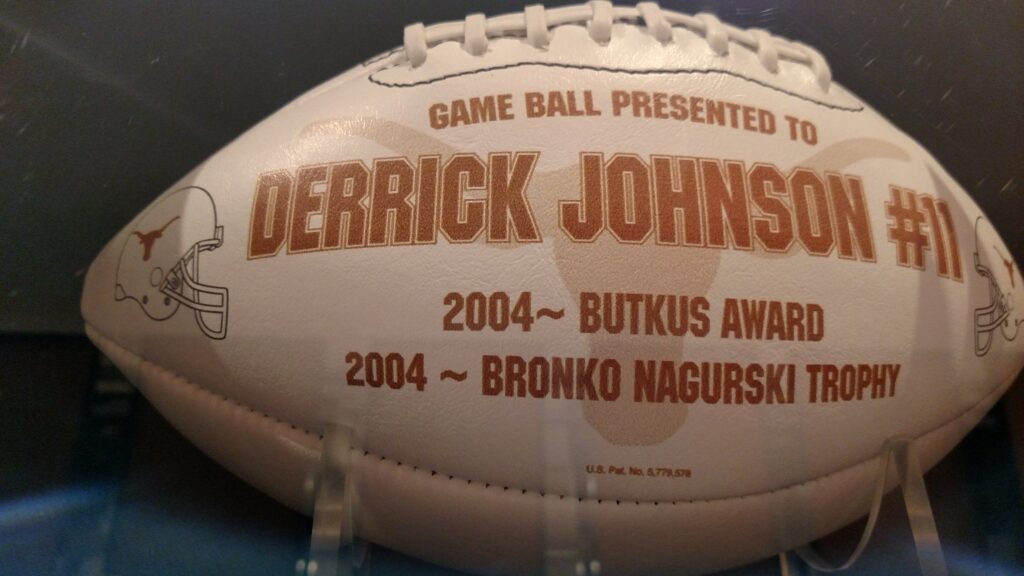

A two-time First Team All-American, consensus in 2003 and unanimous in 2004, Johnson put together a career for the ages, claiming the Butkus Award as the nation’s top linebacker and the Bronko Nagurski Trophy as nation’s top defender in 2004. He finished 12th in Heisman Trophy voting and as a finalist for the Bednarik, Lombardi and Lott IMPACT awards in 2004. His nine forced fumbles that season place him in a tie for No. 1 in NCAA history for a single season. He was also named the 2004 Big 12 Defensive Player of the Year and 2004 Big 12 Male Athlete of the Year. In 2003, he became the Longhorns’ first consensus First Team All-America linebacker since 1983; was one of three finalists for the Butkus Award; and was named the team MVP. In 2001, he was tabbed the Sporting News National Freshman of the Year, a First-Team Freshman All-American and Big 12 Co-Defensive Freshman of the Year.
I wish I had a recording of Rod Babers and Will Matthews talking about Derrick at the RBI Austin-Texas football preview lunch a few weeks ago. I laughed hard at how they described how excellent Derrick Johnson was when he stepped on The Forty Acres. My best summary of my recollection: Some guys don’t have to be coached. “The coaches start explaining what you are supposed to do, and they blow the whistle, and then DJ goes and does what he does, which is better than what the coaches are trying to do. So do your thing, Derrick.” A truly natural, gifted athlete and football player.
https://texassports.com/news/2023/8/30/football-derrick-johnson-set-for-sept-2-nff-hall-of-fame-on-campus-salute-presented-by-fidelity-investments.aspx
What’s really cool is that Derrick Johnson is back on campus, back with the team, just volunteering and helping the defensive players. Having a great person and great player like that here helping mentor and coach can really make a big difference.


Played for Texas starting in 1941 and was named to the All-American team
Professional, he was the player of the year and an All-Pro in 1947


James Saxton 1996


05.08.2013 | Football
Bill Little commentary: Jerry Gray — The road to paradise
Bill Little, Texas Media Relations
Somewhere beyond the sky, Jessie Simmons was smiling Tuesday.
Jerry Gray is going into the College Football Hall of Fame.
Simmons, who died more than a decade ago, was the driving force in instilling values and character in her son, who went from being a multi-sport star in high school at Lubbock Estacado to The University of Texas – and on to an outstanding playing career in the NFL, as well as a coach at both the collegiate and professional levels.
“My mom was a really hard worker. She worked two jobs. That’s probably where I got my work ethic. I got a chance to see her, and that was instilled in me. You had to get up and take the trash out, you got to do dishes, you got to clean the house. And guess what? I still do those today,” Gray said.
The newest Longhorn in the Hall of Fame also says his high school coach – a West Texas legend named Louis Kelley – had great influence on his life.
“He was a guy you could go to and talk about anything, and he kept you on the straight and narrow,” Gray remembers. “He was a great football coach, but he also made sure we did other sports as well. You couldn’t stop there. Those things gave me the chance to say `now you can actually make it if you put your work ethic into it.'”
It was one of those “other” sports that first started Gray’s love affair with The University of Texas.
“I got a chance to come and see The University when I was a sophomore in high school. I got a chance to run track there. It was the most incredible thing I had ever seen, especially at that time. Being from Lubbock, I had never had the chance to really go anywhere and look at other places. I had been to Dallas and stuff like that, but you never really got a chance to pick at the meat and potatoes. But as a track guy, I got a chance to go on campus and see what it really looked like. At that point, I knew where I wanted to go,” he said.
Once he made the decision to come to Texas, Jerry Gray’s evolution was underway.
“The University, from 18-years-old to 22-years-old, taught me how to be a man, and how to grow up and become a part of a society, and where you wanted to go,” he said.
Still, the pinnacle of the College Football Hall of Fame wasn’t on his radar.
“This is probably one of the highest honors you can get when you are playing college football,” he said, “but you don’t start off that way. You become a student, and then you play football. You don’t dream of being one of the elite guys to ever play college football. In order to do that, you have to go out there and play. You have to be on a good football team so they will recognize you. To me, it is a great honor to be considered as one of the top football players to ever play on the college level.”
The numbers validate Gray’s assertion. Through last year’s induction class, 4.92 million people had played college football since the first game in 1869, but only 918 players have been inducted into the Hall of Fame. That’s less than two-tenths of one percent.
At Texas, he was part of a vintage of defensive backs who forged the initial recognition of The University as “DBU”–defensive back university. Gray was a two-time all-American and two-time all Southwest Conference selection. He was selected as the team’s Most Valuable Player in both 1983 and 1984. As a star on three teams in the NFL, he played in four Pro Bowls during his nine year career, earning MVP honors in the 1990 Pro Bowl. But he is the first to stress that his college education went far beyond the football field.
“If you did the things that you were supposed to do, like get up and go to class…go to study hall…that gave you where you can really want to go in life. If you were going to be the guy who was going to cut the corners of not doing what you were supposed to do, they weren’t going to baby sit you. That was the good thing about what I love about The University–it wasn’t , for me, a babysitting center. It was like `I’m going to make you a man. I am going to treat you like a man. And when you take that by the horns, you can be a man in this society and be productive.'”
When he came to Texas, he was immediately immersed in excellence. Eight defensive backs who were on the Longhorn teams from 1981 through 1984 would be drafted to play in the NFL. But it would be Jerry Gray who drew the superlatives.
“One of the great gifts of the game is friendship,” he said. “There are some things in those four years at Texas that you could never replace. When I see guys who I played with then, it’s like you never really left. That is what football really brings to me. It brings team, and it brings other things that you are supposed to do together. Those guys are a big part of this [Hall of Fame] honor.”
The signature moments of Gray’s collegiate career – his almost mythical tackle in Texas Memorial Stadium when he caught Auburn’s eventual Heisman Trophy winner Bo Jackson from behind and separated Jackson’s shoulder with the tackle and his one-handed interception that made every highlight film in the country – might have seemed a bit bittersweet in a career that at the end would appear star-crossed to some.
In Gray’s freshman season in 1981, the Longhorns finished No. 2 in the country. In 1982, after tough losses to Oklahoma and SMU, Texas reeled off six straight wins before losing to North Carolina in a snow-smitten Sun Bowl. In 1983, Texas won eleven straight games before losing a heartbreaker to Georgia, 10-9, in a game that likely cost the `Horns the national championship. Then came 1984. Despite losing 19 players to the NFL draft off the ’83 team, Texas ascended to No. 1 in the country after beating Penn State in the Meadowlands in the second game of the season. The team would lose four of its final five games to finish 7-4-1.
“We started off 6-0-1, and it was like something just didn’t go right,” he recalls. “You say `we should have been that team contending for a national championship’ but realistically we didn’t. The biggest thing about that is that it taught me a hard lesson about going through a tough life stretch. It wasn’t going as planned, so what do you do? You tighten your boots up a little bit tighter and you work a little bit harder, and you get fortunate enough to get picked in the first round of the NFL draft by the LA Rams, and then your career takes off again.”
In its own way, the induction into the College Hall of Fame brings closure to an unfinished moment in Gray’s college career, and it is a reinforcement of a lesson already learned.
“The thing that it taught me is to not give up on what you have done. I look back on that stretch in ’84 and think `we deserved better, but we didn’t get it.’ But you still can’t harp on that. There were still great moments there. You have to remember that is was a four-year deal, and not dwell on the final two months of your career.”
Gray’s life has been intertwined with the game of football. After his playing career ended, he became a very successful coach at both the professional and collegiate level. He actually made a brief stop on the Longhorn staff a couple of years ago before getting an opportunity to become the defensive coordinator for the Tennessee Titans in the NFL. He is still focused on becoming a head coach. But as he becomes the 17th Longhorn player to be inducted in the College Hall of Fame at ceremonies at the Waldorf=Astoria Hotel in New York next December, his thoughts will return to those days when he first fell in love with the University of Texas so many years ago.
“I got a chance to play a great sport. God gave me the ability, and then I had to put the work ethic that I got from my mom together with that. Football became easy because I didn’t mind working, and then I had the ability to do it. The mental part of the game became important to me. But when I think about what it means to be a Longhorn, I realize that it is about pride and the great tradition, but it’s also about the feeling that you have that you were just a little bitty piece of that, and there are some kids who came before you and who will come after you.”
And to that, Jessie Simmons would say “Amen.”

Texas Sports Hall of Fame video is below
Below is a list of the top 25 running backs in Texas football history, ranked by all-time rushing total:
Ricky Williams – 6,279 yards, 72 touchdowns
Cedric Benson – 5,540 yards, 64 touchdowns
Earl Campbell – 4,443 yards, 40 touchdowns
Jamaal Charles – 3,328 yards, 36 touchdowns
Chris Gilbert – 3,231 yards, 28 touchdowns
Vince Young – 3,127 yards, 37 touchdowns
Roosevelt Leaks – 2,923 yards, 26 touchdowns
A.J. Jones – 2,874 yards, 27 touchdowns
D’Onta Foreman – 2,782 yards, 20 touchdowns
Malcolm Brown – 2,678 yards, 24 touchdowns
Eric Metcalf – 2,661 yards, 23 touchdowns
Jonathan Gray – 2,607 yards, 17 touchdowns
Hodges Mitchell – 2,572 yards, 19 touchdowns
Adrian Walker – 2,473 yards, 17 touchdowns
Phil Brown – 2,102 yards, 16 touchdowns
Darron Norris – 2,079 yards, 12 touchdowns
Marty Akins – 1,963 yards, 26 touchdowns
Jim Bertelsen – 1,770 yards, 20 touchdowns
Shon Mitchell – 1,725 yards, 14 touchdowns
Selvin Young – 1,713 yards, 25 touchdowns
John Walker – 1,641 yards, 17 touchdowns
Darryl Clark – 1,604 yards, 3 touchdowns
Colt McCoy – 1,571 yards, 20 touchdowns
Cody Johnson – 1,455 yards, 36 touchdowns
Donnie Little – 1,306 yards, 11 touchdowns