A Longhorn walk-on football player helped save the life of a future President of the USA
The story of John McElroy. Originally written for publication in the Waxahachie Daily Light to promote interest in the Ellis County Veterans Celebration that I helped to get started in 2000.
Everything in the story is based on true events to the best of my knowledge.Perry Giles
Waxahachie, Texas
Destiny can’t be changed. It’s decided by one’s deeds.
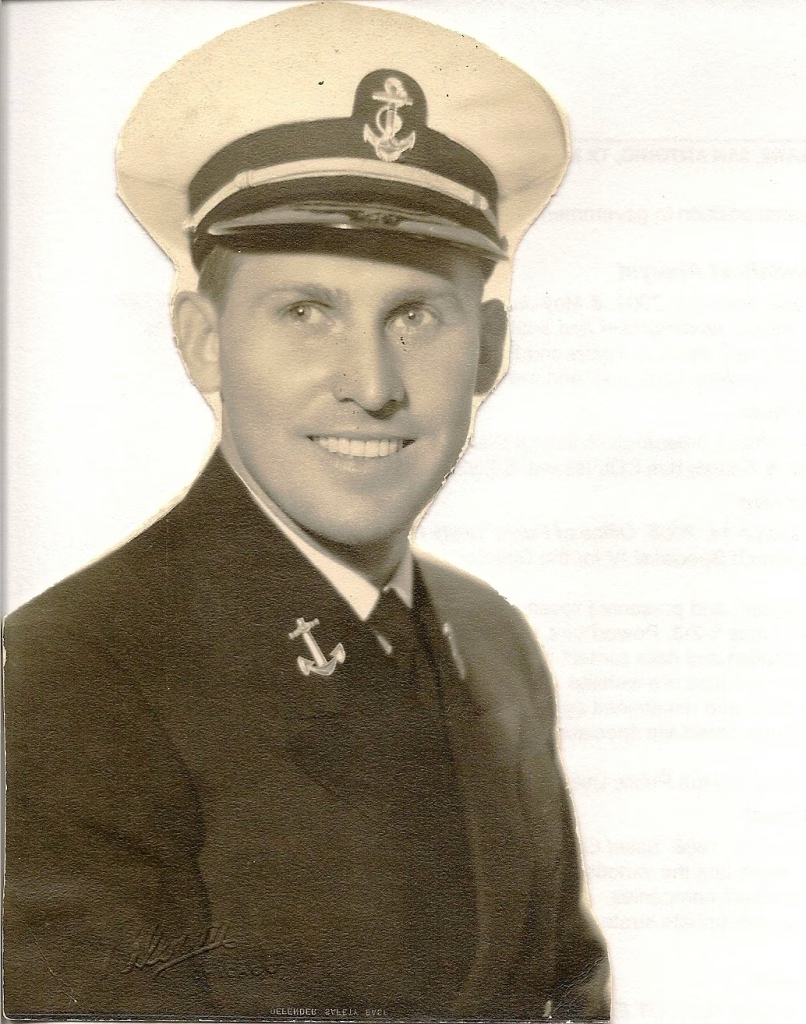
The three most important things to me… God, Family and Country … That is who I am. That is what I believe.
This is a great nation we live in, it is worth fighting for. I spent my life trying to serve my country and help others. I did the best I could.
We were sailors once, and young… Remember us.
- Award: Silver Star for “conspicuous gallantry in action” while serving aboard a PT boat.
This places him among the elite group of PT boat officers — the same class of small‑craft combat leaders as John F. Kennedy (PT‑109).
A John McElroy, a Longhorn football walk-on, saves the future President of the USA – JFK.
We stand on the backs of their sacrifice. Their history is our tradition, as long as there are Americans to remember…
John E. McElroy 1918-2007
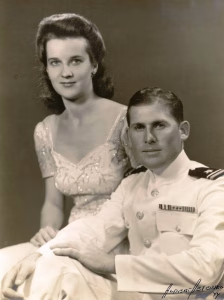
My name is John McElroy. Most of my family and my friends call me Johnny, some call me Mac. I am the son of Ed and Myrle McElroy. I am the oldest of five children, with one sister and four of us brothers. I was born and raised at 330 Harbin Street in Waxahachie. Sister Jean had her own bedroom, but we brothers, Bodie, Tom, Pat and myself, all shared the same room. For a time, we had little Pat sleeping at the foot of the bed, but eventually he grew taller than the rest of us.
There was usually a croquet game set up and ready to go in the yard. Our home was always welcoming with open arms to any guest or stranger, that’s just the way our folks were. We went to the Ferris Ward School on Gibson Street, just a twenty-minute walk from home, and later to Waxahachie High which was even closer to the house.
Mom and Dad taught us that with hard work and perseverance, you could accomplish just about anything. Dad started out as a printer’s devil at the Waxahachie Daily Light and worked himself all the way up to managing editor. When I was seventeen, he was appointed by President Roosevelt as the postmaster for Waxahachie.
We brothers all had paper routes. Mom would drive us around town as we rode on the front fenders of the car and threw newspapers. I loved to tinker on home projects, anything that was mechanical and especially cars, I really loved cars. During my high school years, I played on the golf, tennis and football teams and I worked in Dallas at the Texas Centennial Exposition as a ticket taker.
One time I heard yelling coming from the neighbor’s house and I ran outside to see what all the commotion was about. Mrs. Jenkins had her leg trapped by her car when it accidentally rolled forward into the carport, so I just grabbed hold of the car and pulled it off of her. They all made a big deal out of the incident, but it just seemed to me like the routine thing to do.
After graduating high school, I attended the University of Texas where I majored in accounting. The football team ran an ad in the school newspaper asking for guys to try out for the team, so I did… I played safety and punter for two years but gave up football my junior year because it just took too much time away from my studies.
I have always been good with numbers, and it seems as if accounting may be my calling. To help pay my way through school, I took a part time job as a junior accountant at the Texas Liquor Control Board in Austin. During all those long hours of schoolwork I would try to keep in mind my dad’s motto, “I will study and prepare myself and sometime my chance will come.”
Upon graduating from college, I was one of three accountants hired by the Stanolin Oil and Gas Company of Tulsa, Oklahoma. But first we were sent for field training in Pampa, Texas where I worked as an oilfield Roustabout. The work was tough and dirty, but I liked it.
After my training I took over the material transfer desk for the company and settled into what I thought would be a career in the oil business… December 7th, 1941 changed all that. I sat next to the radio all afternoon listening to the news about Pearl Harbor. I was completely shocked and disgusted by all this. My plans and my life seemed to be turned upside down. Before this day I never had much interest in the military, but now everything was different. The next day, December 8th, I went to Dallas to take a Navy physical. Two days later my enlistment in the Navy Reserve was complete. It seemed as though we had been wronged, especially our Navy, and I wanted to do my part to make things right. I had always thought the Navy was the best branch of the military and I thought their uniforms were sharp, especially the dress whites.
A few months later I was called to active duty and sent to Northwestern University. They had a special Navy Midshipmen’s School there for training college graduates into naval officers. We were known to the Navy as 90-day wonders. There was a thorough indoctrination course on apprentice seamanship with instruction in all sorts of nautical things, knot tying, survival skills and such. This was followed by instruction in ordnance, gunnery, navigation, engineering and PT. Oh, and did I mention PT, lots of it.
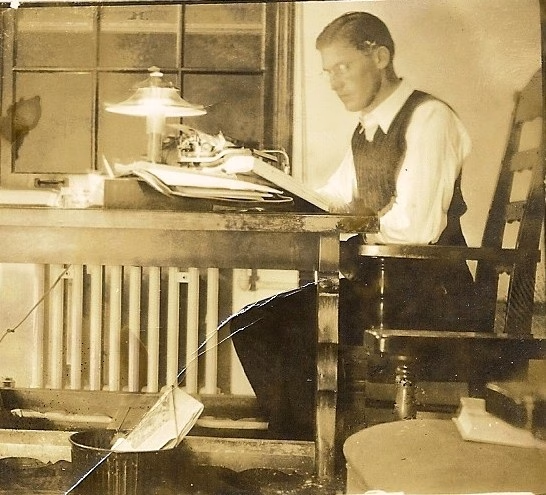
It was there in Chicago that I met her. I was in town with some friends on R&R. It was a chance meeting at a night club. She was there with some other nurses from the Presbyterian Hospital. I noticed her from across the room and finally got up the courage to walk over and ask her to dance. That day I will never forget… Her name is Eva Marie… This girl from northern Minnesota, I have a strong feeling that she may be the one.
Upon completion of Midshipman School, I was asked by Commander Bulkeley if I might consider volunteering for Motor Torpedo Boat duty. When I told him yes, he leaned forward and said, “McElroy, can you eat monkey meat?” I quickly replied, “Yes Sir, Yes Sir, I sure can!” I was drawn to the adrenaline and the independence of torpedo boat duty. It was nearly the only way that I would ever skipper my own boat. The very thought of it intrigued me. When I received orders that I had been selected for duty with the “Mosquito Fleet” it felt like a coronation, I was so proud.
They gave us a three-week special course in torpedoes before reporting for two months of torpedo boat training at Melville, Rhode Island. When I first strolled down the hill toward Narragansett Bay and saw those deadly looking boats in the lagoon, I wondered what I had gotten myself into. We were trained on the 80-foot Elco PT boat. She was quite a speedboat with three big 12-cylinder Packard gasoline engines, 4500 horsepower all together and capable of 41 knots. Each PT boat had four 21-inch torpedo tubes, and several .50 caliber machine guns. I could only imagine the kind of retribution that we could unleash with this baby.
When we started out, I didn’t know an auxiliary generator from a heat exchanger, or a lazarette from a flux gate, nor a vee drive from a butterfly muffler. But I learned quickly at the hands of those salty boat captains that never missed a chance to tell us how rugged life was “out in the area”. We learned how to make a torpedo run, how to field strip a .50 caliber machine gun, aircraft and ship recognition, but most of us never became totally proficient at blinker. We made regular torpedo runs on the Vineyard Haven light ship, patrolled outside the anti-submarine nets, ran missions to Block Island, and practiced boat handling at a dilapidated dock in the Fall River.
Upon completion of Motor Torpedo Boat training, I reported to the Brooklyn Naval Yard at Bayonne, New Jersey. I was assigned to a crew and made the skipper of the PT-161. We went through training together as a crew and our boat was commissioned into service. I was promoted to the rank of Lieutenant, Junior Grade and assigned to Squadron 9 in November of ’42.
Eve was able to come to New York City with me before I was to be shipped out. We went downtown to experience the big city and were at a night club when the owner got up and made a special announcement. Everyone there in uniform was to have free champagne and dinner. It was indeed a time of great tension and uncertainty, but also of great patriotism. It was a wonderful evening for us, but bittersweet, as we both knew that this was our last time together, perhaps for a long time.
Our squadron left the states with eight of our boats cradled on the deck of a tanker. My boat sure looks awkward sitting up there out of the water. Our destination was Panama. It was January of 1943. Once through the Panama Canal our boats were unloaded in the Gulf of Panama and we gave them a thorough shakedown at Taboga Island, the Island of Flowers. Our training here at Taboga lasted for about 30 days.
I named our boat “Jahnz Canoe”. When you really put the throttle to her the boat would lift up out of the water and shoot up a high rooster tail wake behind us. Cruising in this patrol boat was an exciting rush for me. We practiced making torpedo runs on moving targets, everything but the actual live fire of our torpedoes. I felt like a true warrior knight of the sea.
Our boats were reloaded onto the deck of another tanker and we headed for the South Pacific. Upon crossing the equator, all of us slimy Pollywogs were given the Navy rites of passage, where we all became respectable Shellbacks. I won’t go into details, but suffice it to say, I’m glad that’s over with. Other than that, it was a long and monotonous cruise southwestward toward the war. Our destination was New Caledonia in the Coral Sea.
Upon arrival at Noumea, New Caledonia our squadron, Ron 9, took part in boat exercises along with the battleships Washington, Indiana and North Carolina. This took place in a storm with mountainous seas which beat us and our boats terribly. Several of the boats had extensive damage and one crewman received a broken leg out of the deal. Our PT survived, but we had to patch 10 cracked frames and 32 planks on the bottom of our boat. The things that I will remember most about this place are the fenced off leper colony, the barrage balloons and the storm that nearly sunk my boat. It was indeed a rude welcome to the South Pacific.
After repairs we sailed under our own power North by Northwest nearly 550 nautical miles to Tulagi in the Solomon Islands. It was on this long voyage that I had plenty of time to think. I thought about Eve. I thought about my home place back on Harbin Street. I thought about my family. Dad would be proud if only he could see me now.
Once in the Solomons we were now in the middle of the shooting war. The issue here was the airstrips on all the different islands and who controlled them. Our job in the PT boats was to deny the Japanese from resupplying all their island strongholds in the area. We went on most of our combat patrols at night. That’s when the Japanese Navy ran their Tokyo Express down the slot south through the Solomons. Many a brave ship of our Navy had met its fate here in these waters of Iron Bottom Sound. Occasionally we witnessed distant flashes on the horizon followed seconds later by a muffled boom, ka-boom, which signaled the probable death of a ship and its men.
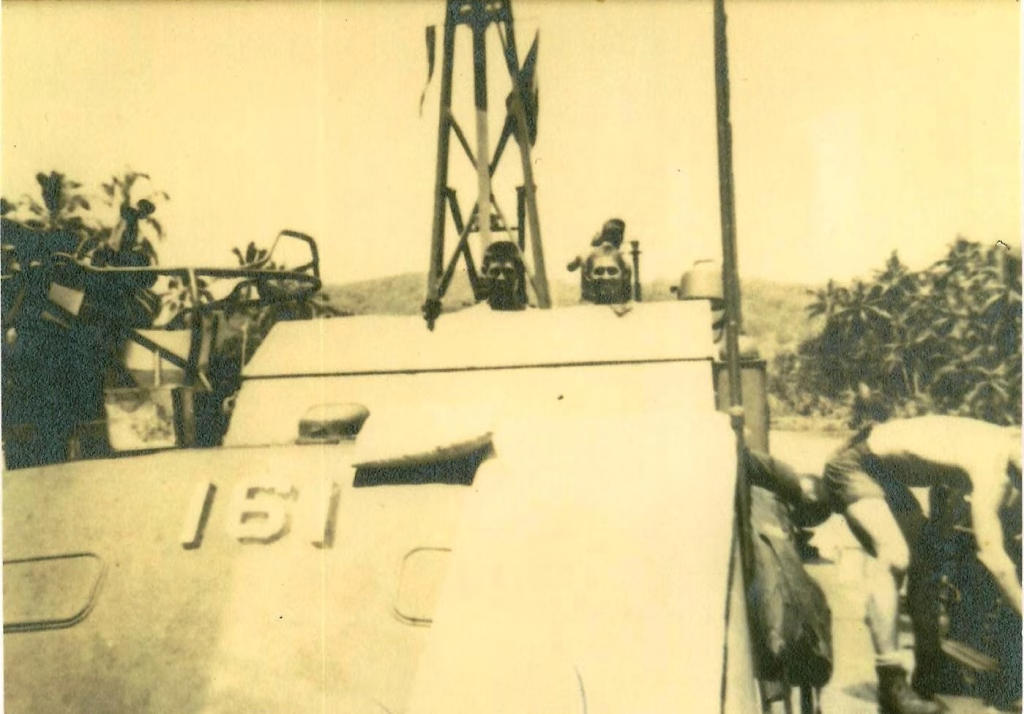
Our accommodation here at Tulagi could be best described as native casual, mosquitoes and rats were a constant nuisance. Our tents, huts, native lean-tos, and Atibrine tablets set up against the thick jungle, heavy rainfall, high temperatures, swamps, excessive mud and malaria. But I am not complaining, I knew we had it good compared to the Marines and coast watchers in these jungles.
Specially Processed American Meat, I got so sick of the spam. Fruit cocktail too, it seems as if we had everyone else’s supply of canned spam, canned fruit cocktail and powdered eggs. I saw guys sell their real breakfast egg for five dollars, five bucks for one egg.
The average age of my crew was well below the standard for the squadron, but in my estimation, they were the best darn crew of them all. There was Gunners Mate Gallagher and Taberti, Torpedo Man Taylor and Van der Heiden, Motor Machinist Mate Frost and Ufert, Chief Spivey, Link the Navigator and Sheriff the Cook. There was McWherter the Radioman and Chase the Quartermaster. My Executive Officer J. D. Litton and myself the skipper. We were all more civilian than Navy at first and our Commander was having a time making us say and do things the Navy way. He had just finished giving us unshirted hell for some land-lubber terminology someone had used. Just then one of the guys said, “Just a minute Commander and I’ll go downstairs to the kitchen and get you a glass of water.” Well, the air was nothing but “Blue Smoke” for a while after that.
I had four guys from New England, four from California, two from Florida, and one each from Pennsylvania, Georgia, and Missouri. They were a bunch of hard working All-American boys that would ride with me into any kind of perilous situation and never even flinch. Even though I started out with a very green group of sailors, we soon gained a reputation for being an outstanding crew. My boat was always chosen as the second boat in Commander Kelly’s squadron as he knew that he could depend on PT-161 to maneuver with him at close range no matter what the conditions and that we would follow him into any sort of fight.
We went up against Japanese destroyers and innumerable enemy barges. I was proud of the way my crew laid down heavy and accurate fire, changed out gun barrels, and repaired disabled guns while under return fire. Even a captured Japanese report complained that our squadron always fired first. Our squadron, Ron 9, prowled mostly in the middle and northern Solomon Islands. We patrolled many different islands, straits and passages. These places have names like Starr Harbor, Savo Island, Pavuvu, Banika, Guadalcanal, Lunga Point and Cape Esperance.
Guadalcanal was a vicious campaign for the PTs, for all ships of our Navy, for the Marines and for the Army. Many brave men were lost to the Tokyo Express and in the jungles. When one of our boats was lost, the survivors were often ravaged by the sharks. As we in the PT’s fought our way up through the Solomons, we had to bum, borrow and steal nearly everything we needed as we could carry few supplies on board. We were always up front and had inadequate supply lines. Scroungers were especially prized as crewman, for we were constantly replacing parts and guns with whatever was available at the time, either by salvage or by pirating. We acquired a 20-mm gun and mounted it to our stern and added a smoke generator to our transom. Our 161 boat now bristled with guns.
Part 2
We stand on the backs of their sacrifice. Their history is our tradition, as long as there are Americans to remember…
We had a Commander who demanded perfection in combat readiness of all boats no matter how hard the duty had been or how short the supplies, but he fought like a tiger for his men against others. It seemed to me that as far as the Navy brass was concerned, we in the plywood Navy were expendable. Our bases were bombed on a regular basis by the Japanese. When on land we spent a fair amount of time together in fox holes. All the boat crews and skippers were close, and we had fun at each other’s expense. Once during an air raid one of the guys picked up a rock and hit another fellow on top of the helmet, which sent him diving face down into the sand thinking it was shrapnel. We all had a good laugh, right in the middle of a bomb raid.
After one long period when we had no fresh meat or vegetables, the cooks started serving us fresh meat; however, we complained that they were ruining it with that dark brown gravy which gave it a peculiar taste. It was only after a couple of horse heads floated by our boat one night that we realized why our “beef” tasted so strange. Maybe I should have listened closer to our Commander back in Illinois about the monkey meat.
There was an endless game of hearts, trading of cigars, and even some torpedo juice. New crewman came and went as others were lost to injury, transfer, discharge and malaria. I got a new crewman named Wylan and I wondered if he was even old enough to be here. He had only been aboard a couple of hours when five enemy dive bombers attacked. Wylan didn’t even have a gun assignment yet, so when the first bomb hit the water, he hit the water too.
On 3 July we were on the move further north. There was going to be an invasion of the island of Rendova, and our job was to protect the flank of our destroyers and our invasion force. We made the move during the night and entered the harbor at dawn. On the following night we received a coded message that American supply ships would arrive before dawn. I had just come topside after deciphering the message when we saw naval gunfire near Banyette Point. Moments later there were shells splashing in the water nearby. It was a Japanese task force that had sailed down from Rabaul to shell our shore landing, but now they were shooting at us.
Commander Kelly was on Buddy Liebenow’s 157 boat. We were the second boat, followed by Lowry in the 162. Kelly led us straight for the enemy. We went to full speed and tore out across Blanche Channel after them. With the wind and the sea spray in my face and with enemy shells splashing around us, the thought suddenly occurred to me that this was the moment that we had been preparing for all these months. We were speeding along across the dark water, illuminated only by two-way gunfire into what looked like the sure jaws of death, but I figured we were up to it. At least I hoped so because there was no turning aside now.
Apparently, there is not much that is quite as unnerving to a Jap Commander as the sight of a three half-crazy American torpedo boats charging straight for you… This is how we celebrated the 4th of July 1943.
We set up our new forward PT boat base just outside of Rendova Harbor on a small island called Lumbaria. They named our new base “Todd City” after Ensign Leon Todd, who had been killed in action on 2 July. We in Ron 9 had been promised a trip to New Zealand for some R&R. Fifteen minutes before we were to leave the word came down that one of our cruisers, the USS Helena, had been sunk in the Kula Gulf and our R&R was now cancelled… A great blow to everyone’s morale.
It was August 1, 1943, that we of the 161 boat were given a rare night off. Several sections of our PT’s, fifteen boats in all, headed out to the northwest to patrol the Ferguson passage on the southwest side of Kolombangara, a tall volcanic island that was surrounded by nearby islands of New Georgia, Wanna Wanna, and Gizo. For someone that has not been there on a moonless night, it is hard to imagine how dark it can be in the surrounding waters. It was not until the next morning at the officers meeting that I learned that several of our boats had engaged Japanese destroyers that were coming up out of Kula Gulf through Blackett Strait. It had been the darkest of nights and the action was confusing and scattered.
Due to the inky blackness of the night, the Jap destroyers were virtually on top of the PT’s when they were first spotted, leaving little time to take action. Several boats had made torpedo runs but the results were inconclusive. One of our boats had been lost. It was struck by an enemy destroyer at high speed and cut in half. There was an explosion and a tremendous fireball flaming high into the air. Our boats that witnessed it from various distances were pretty sure that nobody could have possibly survived that inferno. There were about 1800 gallons of 100 octane gasoline in that boat. No wreckage or survivors could be detected by the other boats.
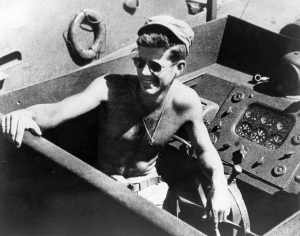
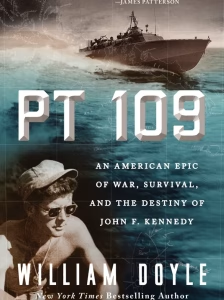
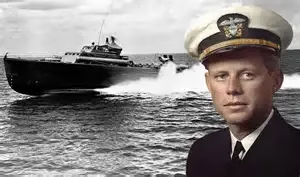
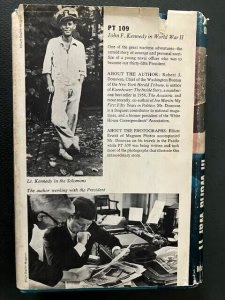
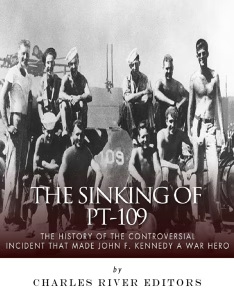
It was the PT-109 that had been lost. We all felt bad about it, being friends with many of the crew. But life went on at our base, Todd City. It was not our first loss in this war, and it certainly wouldn’t be the last. Still, it’s too bad, because I liked their skipper. His name was Jack. Five days later, I along with several others observed two natives in an outrigger canoe approach our base on Rendova. They came ashore and presented a green coconut shell, which they claimed to be from Kennedy. We were astounded, as none of us had any reason to believe that he or any other of the 109 crew was still alive. Their names were Biuku and Eroni. We questioned them extensively to determine if this was an actual message from Kennedy. I looked at the coconut husk. On it was scribbled with a knife, “Native knows pos’it… He can pilot… 11 alive… Need small boat… Kennedy.”
Within hours a rescue mission was organized, and our boat was being fueled, extra ammo was loaded on board. Buddy Liebenow of the 157 boat would go in for the actual pickup. We on the 161 and 171 boat went along to cover Buddy. He had been there on the night of the incident, so he was familiar with the proximity.
We were not completely sure that the two natives and the coconut shell was not part of a Japanese trap. It was decided that we would maintain a distance between boats so that we had two angles of fire against any possible ambush. As was normal, we made the run at night, timing our departure and speed to arrive on the scene during the blackest time of the night. We ran at patrol speed to keep our wake down. The two natives, Biuku and Eroni stood beside Buddy and helped him locate the rendezvous point. There were so many little islets out here that it would have been near impossible to find them at night on our own.
An Australian coast watcher named Evans helped set up this whole deal. We were to meet Kennedy at a predetermined spot. He would be with some natives in a canoe. Four signal shots were fired by the 157 and Jack returned signal fire. Buddy moved his boat in slowly and picked him up and Jack helped pilot us toward a very small islet near Cross Island on the West side of Ferguson Passage.
We stood off and kept a keen eye out for any surprise attack by the Japs while the 157 boat eased in toward the shoreline of Olasana Island. At first there was no sign of the 109 crew and after a short wait Kennedy started yelling for them. Slowly they emerged one by one from the trees and the pickup went forward. Nothing happened, but we were glad to finally swing the boat around and head for home. It was 0530 when we made it back to Rendova Island. It was a joyous occasion, there was much handshaking, backslapping and kidding going on. There had been a little medicinal juice passed around the 157 boat on the way back and some of the 109 survivors were “extra happy” to be back at Todd City, along with several of the natives who were joyously singing “Jesus Loves Me” … It was indeed a good night and dawn, for all of us.
Part 3
We stand on the backs of their sacrifice. Their history is our tradition, as long as there are Americans to remember…
Our war continued on as we slowly progressed to the north. We spent a short time stationed at the island of Vella LaVella at a place called Lambu Lambu Cove. The base was just a few native grass huts and some tents back in the trees. There was an abandoned Japanese barge on the beach. A small dock was used to tie up to for refueling and all the other boats were tied around the cove to trees that grew out over the water. We were told there were still Japanese on the island and to not wander too far off the base.
Other places where we saw action were Lever Harbor, Cape Torokina and Green Island. Gradually we pushed the Japanese back closer to their huge stronghold at Rabaul, their largest base in the South Pacific. Mainly because of the fine crew I had, I was made a section leader, which meant on any given mission I was in the lead of three to six PT boats on every combat patrol.
There were many nights that we returned to our base as early as 2100 hours to get more ammunition and then we would go back out to hunt for more trouble. One night we came back to our base just outside of Kula Gulf on New Georgia three or four times. We discovered that we had exhausted all of the ready ammunition, so we had to go under the coconut trees and gather up some old ammo that had been exposed to the elements. As a result, we were having misfires and hung fires the rest of the night. I will always remember my crew’s bravery that night. We were in a fight for our lives with eight enemy barges and all but one of our main guns jammed or broke down. Wylan stayed up on the bow firing his .50 Cal. like a madman while our other guns were silent. He never wavered.
I ran to check on the other guns and caught Joe Tiberti pulling a smoking 20-mm shell out of his gun and throwing it over the side with his bare hands. Van der Heiden was ramming the 20’s out of our stern mounted gun with all the force he could muster. There were buckets of water everywhere with hot 20-mm barrels in them. The last barrel was still in place and ole Van was banging away on a cleaning rod trying to clear the barrel, not knowing what second might be his last as he was hammering on a high explosive round. I ran back to see what was the matter with Chase’s twin 50’s and found him working intently on a lap full of parts from both guns plus what spare parts he had. There were tracers flying everywhere and a few uncomfortably close to my head. But Chase never noticed them except that they gave him light to work by. I mentally crossed those guns off as Wylan’s 50 was the only gun firing except for the rifles and a Tommy gun from the remainder of the crew.
But on my next run those guns were all spitting fire like a vengeance. Oh, what a wonderful sound! That was the coolest exhibition of nerve that I have ever seen. I never dreamed that they would get them back together and working in the middle of a pitch-dark firefight. I was certainly one proud skipper. It was a very satisfying feeling to witness the early dawn’s light filter over a sea as smooth as glass with a broom tied to our mast as we cruised slowly back toward our base.
About this time, I began to experience some episodes of chills, fever and the sweats. Our medical officer treated me for malaria, and I was able to rebound after several days. The mosquitoes here are very thick. You can sleep under a net and all, but there is only so much you can do.
At this point in the war our PT’s had become personnel barge fighters. The idea was to keep the Japanese from moving men from island to island so they couldn’t concentrate their forces or escape. We also helped move Marine strike forces behind enemy lines. One night we were ordered, along with the 157 boat, to escort three landing craft full of Marines around the north side of New Georgia Island. At our rendezvous the skipper of the lead landing craft and the ranking Marine officer wanted to know how two PT boats were going to defend them, especially against enemy aircraft. We told them that we didn’t have a set plan in mind but if something came up that we would handle it.
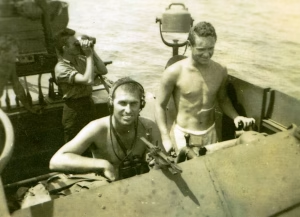
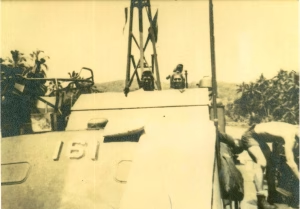
During the middle of the night the attack came. A group of Japanese planes spotted us. We decided that the only course of action was to invite the planes to attack the PT’s and draw them away from the Marines. We revved up our engines to full speed throwing up high rooster tails wakes, and we went zigzagging out across the black water. The Jap planes took the bait and dove after us. It was no trouble to outmaneuver one plane. We just waited until he committed himself to a dive and we turned sharply to port or starboard, leaving a big puff of smoke for him to shoot at or drop his bomb on. With three planes it was a little more touchy, but nothing we couldn’t handle. After three or four passes they gave up and left us alone. It was gratifying to return to the cheers of the Marines, but all in all just another routine mission, nothing to brag about.
It was early fall of ‘43 that our own forces and Tokyo Rose started reporting that I had been killed in action. I had to write a letter to my folks to let them know that regardless of reports to the contrary, I was safe and well and still had my boat. My officer friends started poking fun, talking about me in the past tense, saying “McElroy was a nice guy, wasn’t he?”
Again, we moved further north to yet another new base, this time at Stirling in the Treasury Islands. Here we also tied up our boats to huge trees that overhung the water. The water was clear, and you could see the coral twenty feet deep. Life went on as usual with powdered eggs, bugs, air raids and card games. There was a hot game of poker going on when a near miss bomb interrupted play. The men got up, put their helmets on and began arguing about the chips when a second near miss blew their helmets off and completely settled the disagreement.
I was told confidentially that orders had arrived for me to return to the states. A day or two later, Commander Kelly called me in. I thought it was to give me the good news, but instead he confronted me with, “McElroy, how would you like to volunteer for a dangerous mission – a PT boat strike on Rabaul Harbor?” The shock of the proposal almost buckled my knees. And he added, “When you come back, I’ll have a nice surprise for you”. Well, I volunteered. What else was I going to do? However, as I walked away from his hut I was mouthing the words to myself, “If I come back!” …Well at least no one will ever be able to question whether ole McElroy completely devoted himself.
As we prepared for the raid, I couldn’t help feeling a sense of dread. It was going to be a twelve PT boat attack, so we were headed for the lion’s den with 48 torpedoes and roughly 150 men. It was a long passage north through hazardous waters up to New Britain Island, then skirting east around and up to the Duke of York Islands and in to the Bismark Sea. We are most assuredly in forbidden waters now. I am not one to ask the Lord for much, but as we approached the final turning point, I did ask for his help.
Around the peninsula and past Sulphur Point and there it was, the biggest Japanese naval base in the South Pacific. If I said that I didn’t have an awful churning in my stomach, I would be lying. In we went twelve boats at combat speed, loaded and locked. This idea might just be crazy enough to work. We passed a Jap destroyer 75 yards abeam. Van der Heiden and Frost were in a very heated argument as to the number of stacks and guns on it. Their argument was very soon settled when they opened up on us with everything they had.
I will never forget the sight of all those Japanese sailors running all over the deck. We could hear their voices and if I had a sailing rock, I could have hit one of them with it. We were too close in for their big guns to be brought to bear on us. The lookout up in their crow’s nest was firing down on us with some kind of gun. I figure he was the one that put the holes in our deck. My boys put up a fight that I shall never forget. On the way back I overheard someone say, “Are those your knees knocking or mine?” We didn’t bring much ammo home. But we did make it. With help we made it.
Upon our return, Commander Kelly gave me the news that I already knew, my orders were to return to the states for leave. He also informed me that I had been recommended for a medal. That would be swell, if it happens. I sure hope they remember to cite my crew.
I was steadily losing weight and my strength. The malarial symptoms came back, and the docs stepped up my treatment. This darn medicine turns one’s skin a yellow color. And as much as I knew that I needed to eat something, this canned spam doesn’t have much appeal. Perhaps some tobasco sauce would help it, if only we had some.
There was a little ceremony under the coconut trees, and I was awarded the Silver Star with an ocean breeze cooling the sweat on my face. The citation came from Admiral Bull Halsey. I was pleased to get it but upset at the same time. They should have cited my crew. I went to my men and thanked each one of them and shook their hands. It was very hard for me to leave them, tougher than I ever imagined. We made a great team, and if it were in my power every one of them would have been decorated.
It was a long and strangely quiet voyage home, lots of time topside to reflect on everything. The doctors told me my war was now over. There is a feeling of regret about this… But I never lost any of my men, and for that I am grateful… I have seen a lot of things, some really bad things… That time off Gatere when that Japanese floatplane damaged my boat, I still can’t believe I let that happen… At least none of my crew was hurt… It sure will be good to see Eve again… I hope she can recognize me.
Sailing underneath the Golden Gate was very nearly an emotional thing. My first steps back on the dry ground of America sure felt good. I had not realized how great it would feel to be back in the states. The medical officers here treated me for a few more weeks and then I was reassigned to set up a Navy duty station here in San Francisco.
A few months later Eve and I were married in my parent’s home back on 330 Harbin Street. It was April 18, 1944, and we began our delayed life together. I was reassigned to teach seamanship at the Midshipmen’s School at Notre Dame University where I served for the remainder of the war. We operated training craft out on Lake Michigan.
Once I was sent to Jacksonville, Florida with several recruits to take delivery of a 104-foot rescue boat. I sailed it down around the Florida Keys, west across the Gulf of Mexico and all the way up the Mississippi and Chicago Rivers without the aid of a pilot. I enjoyed it immensely as no one shot at us during the entire trip. It was my last fling as a Navy boat skipper.
All three of my brothers made it into the war. Tom served as an Ensign on a tanker in the South Pacific. Pat served as a control tower operator and radar operator in the Army Air Corps. And Bodie, well Bodie was rejected by every service because of a crippled leg that he got from an accident with a horse. Turned down fifteen times, he never gave up, finally begging his way into the Navy where he served proudly in the Pacific as a chief mechanic.
After the war ended, I was released to inactive duty and took a job with the Internal Revenue Service, finally making use of my accounting degree.
When the Korean War broke out, I was recalled to active duty and served in the Office of Naval Officer Procurement in San Francisco and later in Albuquerque. Later transferred to Guantanamo Bay, Cuba where I served as the Assistant Naval Port Control Officer. Eve really enjoyed being there at GITMO raising our kids; it was such a beautiful place.
With the war over in Korea, I chose to leave active duty in May of ’55 and returned back to Texas. We settled in San Antonio where I went back to work for the IRS as a Special Agent in the Intelligence Division. With all the many places that I have been stationed over the years, I have always considered home as Texas.
During the Presidential campaign of 1960, I had the opportunity to meet with Jack Kennedy while he was in San Antonio. He introduced me to Lyndon Johnson. Jack and I talked for a while about old times. He offered me two tickets to his event that night, but as much as I hated to, I had to turn them down. Being a government employee, it just wouldn’t be right for me to accept free tickets for something that I could not otherwise afford. Anyway, it was sure good to see him again.
After more than 20 years of active duty and reserve duty, I retired from the Navy as a Captain. I will surely miss it, but it was time to move on. I am amazed how the PT-109 story gained prominence over the years. What started out as an incident, turned into a happening, turned into a glamorous adventure. So, the story grew as Kennedy gained fame in the political arena. None of us ever had any idea that he was the son of an ambassador until afterwards. To all of us in the squadron, Jack was just another one of the guys… The rescue is nothing to brag about, but I am proud that I was a part of it.
After retiring from work, I took the opportunity to do a lot of things that I had pushed aside for a long time. That trip to New Zealand that I had been so disappointed to miss out on, I finally made that trip about 50 years later. I loved to work on my cars and tinker with just about anything. Eve doesn’t believe in having any shiftless retiree around, so she utilized me as a painter, paper hanger, plumber or whatever else was called for. But that’s OK, because I can’t live without working and I can’t work without living.
The good Lord really blessed us, he didn’t bless us with wealth, but he did bless us with good health and with four wonderful children, all college graduates. All in all, we have had a very good life, a very blessed life.
John McElroy was born June 9, 1917 and died on February 10, 2001, and was buried with full military honors at the Fort Sam Houston National Cemetery in San Antonio.