THE BABY BULLS BY ROY A. JONES II
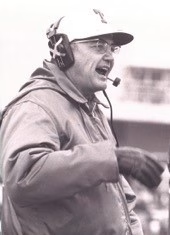
Head manager Roy Jones remembers longtime Longhorn assistant coach Mike Campbell, known to his players as “Iron Mike,” had special nicknames for two of his top prospects—Scott Appleton and Robert “Big Bob” Young. Coach Campbell, a battle-hardened World War II veteran who flew 50 missions in a B-24 bomber targeting German targets, dubbed the pair the “Baby Bulls” and pushed them especially hard during training.
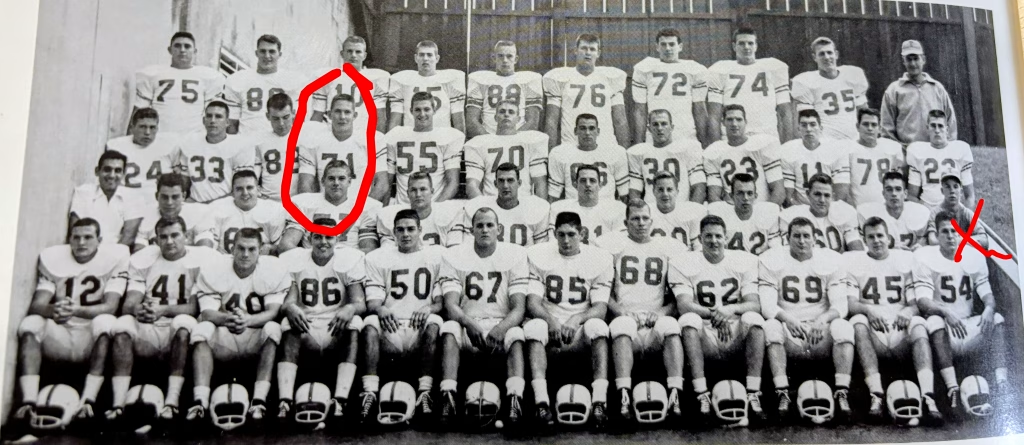
The pair came to UT as part of the talent-rich Class of 1960. Those freshmen, then ineligible for varsity competition, would form the nucleus for UT’s first football national championship team, in 1963 –after narrowly missing the title in 1961 and 1962. Counting their 5-0 freshman year, those athletes finished with a record of 35-2-1.
If the rocks of Waller Creek could talk they would tell of grunts and groans and thuds of massive forearms against leather shoulder pads as “Iron Mike” pitted Scott against “Big Bob” in various one-on-one drills. More on that later.
Except for their strength and stamina, the “Baby Bulls” were different as Longhorns and Aggies: Scott was quiet and determined. “Big Bob” was brash and cocky. But like Cassius Clay said, “It ain’t braggin’ if you can do it.”
Even through he had been named the Southwest Conference’s outstanding freshman lineman, “Big Bob” got on the bad side of Coach Darrell Royal for drinking and a toxic attitude, and his UT football career was over after just one semester.
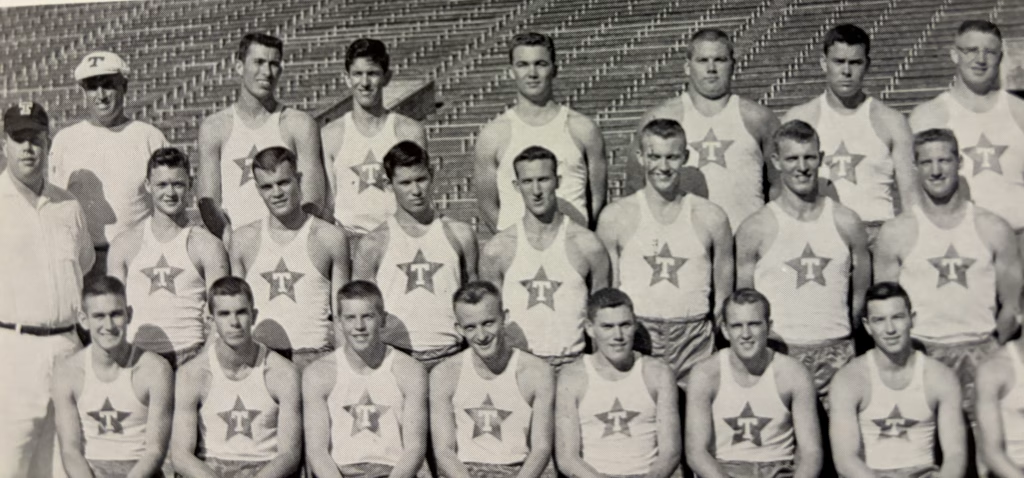
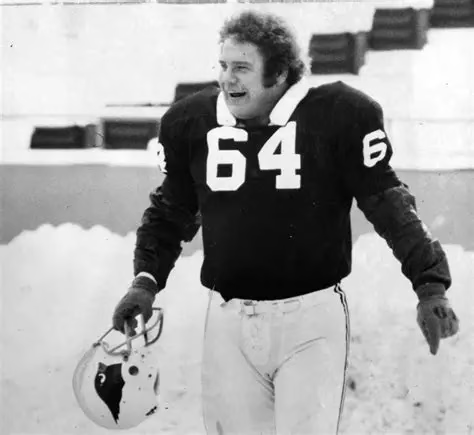
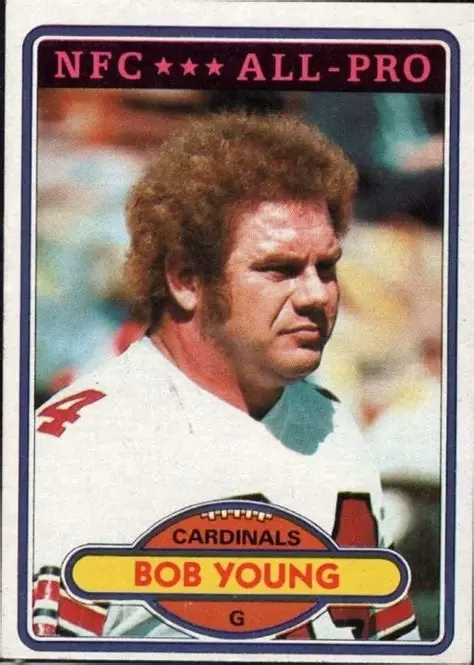
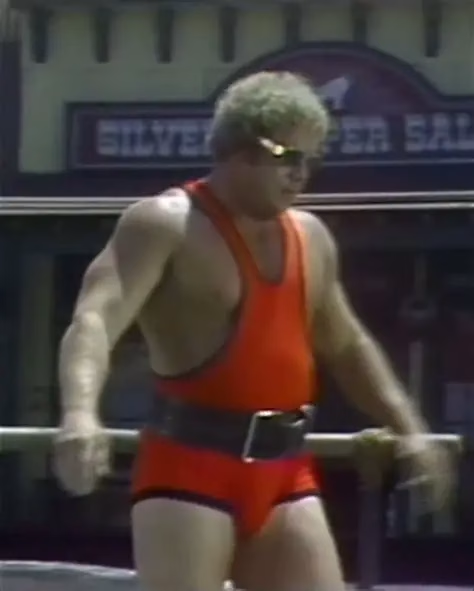
He threw the shot put and discus on the freshman track and field team in the spring, then transferred to Howard Payne University, where he lettered three years for the Yellowjackets. Graduating from alcohol to steroids, he went on to a 16-year career in the National Football League, 10 of those with the St. Louis Cardinals. At 6-3 and 275 pounds, he was the anchor on a Cardinal offensive line that gave up only eight sacks in an entire season. He freely admitted to using steroids in the NFL and in college. He and his Cardinal offensive teammates were credited with introducing modern weightlifting and powerlifting into the NFL’s training regimen.
His strength and speed — Howard Payne coaches said he could outrun backs and receivers he outweighed by 100 pounds — helped him earn All-Pro honors in 1978, at age 36 and he made the Pro Bowl a year later. He was inducted into the Howard Payne Hall of Fame in 1986. “Big Bob” competed in the inaugural World’s Strongest Man contest in 1977 and finished second. He and his younger brother Doug, who played football at Texas Tech, later set a world record for two-man dead lift. “Big Bob” died in 1995 at the age of 52; Doug in 2005 at the age of 61.
Then there was Scott Appleton.
Just the opposite of “Big Bob,” Scott Appleton excelled as a Longhorn but flopped as a pro. Failure led to alcoholism and a life out of control. Link to Scott Appleton is at https://texaslsn.org/scott-appleton/
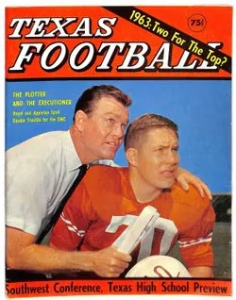
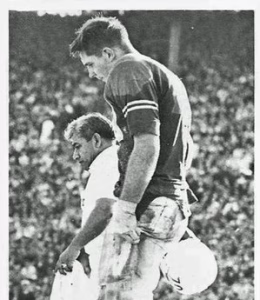
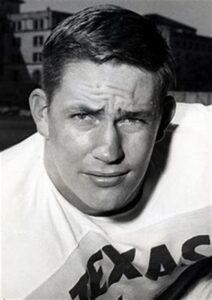
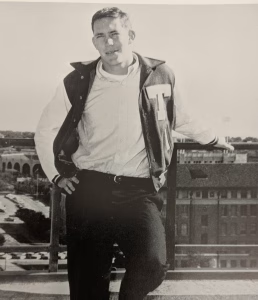
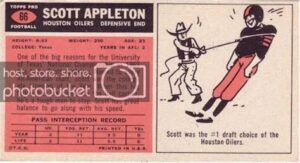
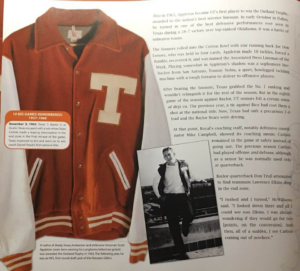
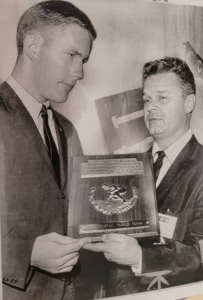
Scott had set a high bar for himself, and being around his Longhorn teammates made him better. He was a three-year starter, made all Southwest Conference twice, and All-American his senior year — when he also won the Outland Award as college football’s most outstanding interior lineman. Teammates voted him a tri-captain with David McWilliams and Tommy Ford in his senior year.
His final game as a Longhorn was Scott’s best. Texas coaches warned that Navy quarterback Roger Staubach would pick the UT defense apart if he was allowed time to pass or if he got loose on his scrambling. He didn’t get the title “Roger the Dodger” for nothing. But he couldn’t dodge Scott and his defensive teammates. Scott recorded a game-high 12 tackles, sacking Staubach twice and hurrying him into numerous errant passes. The future Super Bowl champion Dallas Cowboys quarterback suffered minus 47 yards rushing that day, and the team wound up with minus 12 rushing yards, a Cotton Bowl record.
Scott was named the defensive MVP and finished fifth in the Heisman Trophy voting, an award won by Staubach. Coach Royal called Scott the best defensive lineman he ever coached. “He simply makes tackles from sideline to sideline,” Royal said. “He’s like blocking a wall on one play and smoke the next.” “Iron Mike” said, “He’s the only player I never remember being blocked.”
Scott was named to the Longhorn Hall of Honor in 1986. Quoting novelist Thomas Hardy, the late Bill Little, longtime UT sports information director, said Scott “fled the hustle and bustle of the limelight and fame into the depths of despair.” Scott’s problem with alcohol started innocently enough. He had been drafted in the first round by the Houston Oilers and they wanted him to put more weight on his 6-3, 235-pound frame if he was doing to hold his own with pro-size athletes. Drink beer and eat steak he was told. He could eat all the steak he wanted at Austin’s famous Hill’s Steak House and charge it to the Oilers. I went to Hill’s with him several times for free steak and to drive him back to the dorm. He eventually got up to 260, but lost some of the quickness that made him famous at UT. When he switched from beer to the hard stuff, his life spiraled out of control.
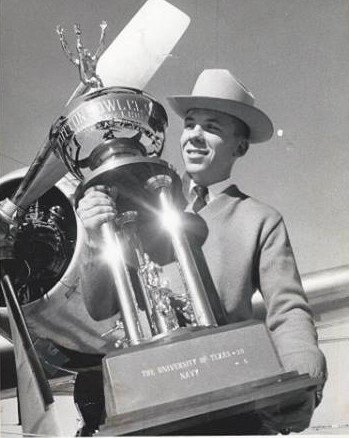
He told McWilliams, his former teammate and roommate at Moore-Hill Hall, he “felt like a failure, that he had let everybody down.” Beaten down by alcohol — and some drugs — he lasted three years with the Oilers and two with San Diego. He never made All-Pro, or even started for that matter, but he found redemption after he said the Lord helped him quit drinking “cold turkey.”
He attended seminary and became a street preacher, working with the down and out in San Antonio and sharing his story of athletic fame and failure, of alcoholism and recovery. His big heart had been damaged by years of abuser though and he was on the waiting list for a heart transplant when he died in 1992. He was only 50.
Retired Austin banker Bill Archer played tackle opposite Scott on Brady’s state champion team, and came to UT with him as part of the Class of 1960. Archer’s career was cut short by a crippling knee injury suffered against SMU, but not before he got to compare Scott and Young on the practice field. “Nobody could block either one of them,” Archer said. Compared to today’s rules on the use of hands in blocking, offensive players back then were at a disadvantage. “We were taught to grab our jersey and explode with our forearms so we wouldn’t get penalized for using our hands.” That explosion, called a forearm shiver, was at the heart of the “Baby Bulls” legend.
One day, Coach Campbell got Young all riled up and sicced him on the seven-man Crowther blocking sled. The sled had heavy duty truck leaf springs holding up the pads. Young hit the pad so hard that the springs broke and left the pad dangling at his knees. Turning to Scott, “Iron Mike” mimicked in falsetto voice, “Okay, let’s see what you can do.” As if he needed any incentive, Scott uncoiled his forearm and legs simultaneously, breaking the springs on the second pad. Never in four years did I see another spring broken.
“Iron Mike” also loved to pit the two gladiators in the “board drill.” The pair straddled an eight-foot long piece of 2-by-12-inch lumber, and tried to block the other off the board. The width was designed to make the blockers keep a wide base; if you stepped on the board with hard rubber cleats you went down.
Archer said Young had small ankles and feet for a big man, and that enabled him to move his feet quickly without getting tangled up. In their one-on-one board drills, Scott and Young went back and forth a few feet, but never pushed the other off the board. When Coach Campbell mercifully blew the whistle the two giants just leaned into each other to keep from falling.
There was no organized weight training program for football players when I was a student manager (1960-64). Tommy Nobis was the only player I can remember lifting regularly in the basement of Gregory Gym. One day Robert and I were walking back from class through Gregory gym, when Robert saw members of a PE class struggling to dead lift about 300 pounds. Robert asked the instructor if he could try it. He handed me his Levi jacket, jerked the bar to his chest, then pressed it overhead 7-8 times. Putting it down with a thud he said, “That IS pretty heavy!” He and a brother later set a world record for combined dead lifts.
At the athletes’ chow hall, it was customary for upperclassmen to haze freshmen by making them sing their school song or perform some other embarrassing task. I don’t recall “Big Bob” performing. I certainly don’t think the likes of Don Talbert et al were afraid of him, but of what he might do — maybe turn over a table. He was generally regarded as a loose cannon.
Archier told of one unforgettable Young performance at a fraternity party. “I don’t know who invited him, but he was drunk and loud. Suddenly, he jumped up in the middle of a table and shouted, ‘Watch this!’ to the crowd. “Then he took a full fifth of Jim Beam, tilted his head back, clinched the neck of the bottle between his teeth then held him arms out like an airplane as he chug-a-lugged the whole bottle without spilling a drop. Then he jumped off the table, said ‘I’m done here” and left”
Photo info: In picture of 1960 freshman track team, Bob Young is third from right on top row. Below his left arm is Olen Underwood who played on the 1963 national championship football team.