A history of Texas Longhorns in the medical field
A history of Texas Longhorns in the medical field
Many UT football products have become doctors, nurses, dentists, or veterinarians after their time on the gridiron.
by Jonathan Wells
Jun 9, 2025, 9:00 AM CDT
In May of 2024, I wrote a post about the history of Texas Longhorn football-baseball dual-athletes and highlighted some of the major standouts of that group. It was primarily intended as an educational trip through UT’s athletics history, but on some level it was also an attempt as willing “Jonah Williams to Texas” into existence, as the five-star safety prospect from Galveston in the 2025 class was also a baseball player and had a stated desire to play both sports in college.
Texas was not seen as the leading contender for Williams’s commitment at the time of that post’s publication, but he ended up committing to the Longhorns three months later and signed with the program in December of 2024. After enrolling at Texas this past January and joining the Longhorn baseball team, he played in 16 regular-season games for the SEC regular-season champions, and then played in all four of the team’s games in the Austin Regional. He finished his freshman baseball season with a batting average of .327. Time will tell if he ends up making a similar impact in the secondary or on special teams for the Longhorns as a freshman this fall.
Since pairing football recruiting dreams with Longhorn football history worked so well last year, let’s try it again!
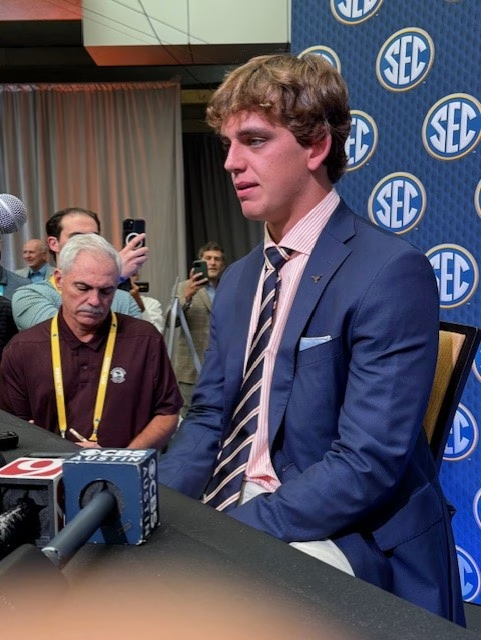
2026 offensive line prospect John Turntine III was a key player on North Crowley’s 2024 Class 6A Division I state championship team, and he is one of the Longhorns’ top recruiting targets on the O-line. As of this writing, he is ranked as the #3 prospect in Texas for the 2026 class according to the 247Sports Composite, and Inside Texas reported in May that he plans to announce his commitment on July 4. Turntine, whose father played defensive tackle at TCU, has a stated goal of entering the medical field after the end of his football career. He has been known by the nickname “Dr. John” since at least his sophomore year, probably not because of a love for New Orleans jazz and blues.
If young Mr. Turntine were to spend his college career at the University of Texas and later take a post-football educational path that leads to him becoming Dr. Turntine, he would join a distinguished group of Longhorn football players who went on to become medical professionals. Included in that group are surgeons, physicians, pediatricians, gynecologists, medical school instructors, dentists, physical therapists, and registered nurses, as well as a few others who specialized in medical care for non-humans as veterinarians.
Below are some notables among UT’s historic football lettermen who entered the medical field after their time on the 40 Acres. Numbered among them are six UT Athletics Hall of Honor inductees, four football team captains, and three players who were starters on national championship teams. The list will proceed chronologically from the earliest to most recent players, and the dates in parentheses after their names are the year(s) in which they are recognized as Texas football lettermen.
This is not by any means an exhaustive list, and if you know of any Longhorn football men not mentioned in this post who have worked in the medical field, please mention them in the comments.
Authors note: Since this post’s publication on June 9, a number of readers (one of them a player mentioned in the post!) have informed me of some other Longhorns I did not mention who went into the medical field. Those additional names — as well as those of some Longhorn football players who were not lettermen — have been added at the end of this post as an addendum.
James Morrison (1893)
Morrison, a Virginia native, was one of the primary organizers of the very first University of Texas varsity football team in 1893. He attended UT as a graduate student after graduating from Hampden-Sydney College in Virginia, where he had been a captain of that college’s club football team. He started at right tackle in the first UT football game on November 30, 1893, and scored the first touchdown in program history after recovering a fumble by the team’s fullback and carrying the ball over the goal line. Morrison served as team captain in two of the four games Texas played in that inaugural season. He was the son of a physician, and after his brief time at UT he attended the University of Virginia as a medical student and was the captain and fullback on UVA’s 1897 football team. After completing medical school, he spent one year as the football coach at Add-Ran College (now TCU), and later had a long career as an eye, ear, nose, and throat specialist in his native Virginia.
George Kindley (1904)
Kindley, a native of Graham, Texas and a very tall man at 6’6”, played guard on the UT football team and was a thrower on the track & field team. He received his bachelor’s degree from UT in 1905, and later attended what is now called the University of Texas Medical Branch in Galveston, from which he graduated in 1911. He was a captain in the medical corps during World War I, and practiced medicine until his retirement in 1961. He spent most of his medical career in private practice, but was also the superintendent of Parkland Memorial Hospital in Dallas for a time in the 1920s.
Bob Ramsdell (1905-07)

Ramsdell played on the UT football team for three years in the first decade of the 20th century. He had two younger brothers — Fred and Marshall Ramsdell — who also played football at Texas. Bob Ramsdell, though not a tremendously big man even for his own era at 175 pounds, was a highly-regarded tackle while at UT. In 1912, UT alum and football letterman Richard Franklin put together one of the earliest all-time Texas football teams, which was then published in the Alcalde, the magazine of the UT ex-students’ association. Franklin named Bob Ramsdell as the first team right tackle on his all-time UT lineup.
Ramsdell went on to attend the University of Texas medical school in Galveston, and afterwards worked as a physician.
Marshall Ramsdell (1909-11)
Marshall Ramsdell, younger brother of the aforementioned Bob Ramsdell, was a three-year letterman on the Texas Longhorn football team after graduating from Austin High School. He played tackle and was captain of the 1911 Longhorn team as a senior. Like his brother Bob, he went on to attend the UT medical school in Galveston. He worked as a general practitioner after receiving his M.D. in 1915, then a decade later he moved to San Antonio and had a long career as a pediatrician.
Allen McMurrey (1915-16)
McMurrey was the first of nine UT football lettermen produced by Cuero High School. He played both end and halfback on the Longhorn football team and was a two-year letterman. He served as a hospital apprentice during World War I, and later attended Harvard Medical School, from which he graduated in 1921. After a decade in general practice, he began working as a specialist in gynecology in 1932. During his career he was president of the Harris County Medical Society and president of the Texas Obstetrical and Gynecological Society. During World War II he served on the Board of Examining Physicians. He was distinguished in his field, and according to his obituary he was “a recognized authority and frequent author on the study of endometriosis.”
Simeon Hulsey (1920)
Hulsey, a native of Bonham, Texas, began his college career at Rice and was a member of its 1917 football team. After serving in World War I, he enrolled at the University of Texas and joined the Longhorn football team. He won a letter after starting multiple games at left guard on the 1920 team. He went on to attend the University of Pennsylvania’s medical school and graduated in 1925. During World War II he was the commanding officer of the 36th Evacuation Hospital and held the rank of colonel.
He had an enormously long medical career and was noted as a pioneer in the treatment of allergies. He spent most of his working years in private practice in Fort Worth, and at one point was president of the Tarrant County Medical Society. He remained in active practice until his retirement in 1994, at the age of 95.
Bobby Moers (1938)
Moers had minimal football experience when he tried out for the Longhorn varsity squad in 1938, and he had not even suited up for UT’s freshmen football team when he first enrolled. He played one season as a halfback, but afterwards gave up football, and was much more acclaimed for his work in basketball and baseball. He was a slick-dribbling basketball player and was twice named an All-American. In baseball he was a three-year letterman (1938-40) and was twice named to the All-Southwest Conference team as a third baseman. He served in the Army Air Corps during World War II, and after graduating from the UT medical school in Galveston he had a long career in his native Houston as a physician and surgeon. He was inducted into the UT Athletics Hall of Honor in 1964.
George Petrovich (1944, 1947-48)
Petrovich, a native of Palestine, Texas and the son of Hungarian immigrants, was a three-year letterman in football with the Texas Longhorns, with his college career interrupted by his service in the U.S. Army during World War II. He played tackle and was named to the honorable mention All-SWC team in 1947. He was also a thrower on the track & field team and was the Southwest Conference champion in the shot put in 1949. After playing for two seasons in the NFL with the Chicago Cardinals, he attended the University of Texas School of Dentistry in Houston. Following his graduation with a D.D.S., he practiced as a dentist for nearly four decades.
Pat Tolar (1953-55)
Tolar was one of three future Longhorns who played on San Antonio Jefferson’s 1949 state championship football team. He was a three-year letterman with the Longhorns, playing quarterback and end. After college, he served in the Air Force and attained the rank of lieutenant colonel. He graduated from the UT medical branch in Galveston in 1961, and was licensed to practice medicine in Texas for almost 50 years. He was for many years an OB-GYN in San Antonio.
Glen Dyer (1954)
Dyer came to UT as a basketball recruit from Sinton, but ended up joining the Longhorn football program. He was a member of the Longhorn varsity squad for three seasons as a quarterback, and he won his only letter in 1954. He was picked by the San Francisco 49ers in the 20th round (and 237th overall pick) of the 1955 NFL Draft, but instead of going into pro football he attended and graduated from the UT School of Dentistry in Houston. He served in the Army and ran the dental clinic at Fort Sill, Oklahoma. After settling in Tyler in the early 1960s, he ran his own dental practice for several years, then tutored many future dentists as the supervisor of the dental clinic at Tyler Junior College.
Johnny Genung (1960-62)
Genung came to UT after leading Wichita Falls to the Class 4A football state championship in 1958. He played quarterback at Texas and spent much of his career as a backup before starting several games as a senior in 1962. He attended UT Southwestern Medical School after his graduation from Texas, and later served in the Navy and was the team doctor of the Naval Academy’s 1969 football team. He went on to have a long career as an orthopedic surgeon in Austin. He was inducted into the UT Athletics Hall of Honor in 2004.
Johnny Treadwell (1960-62)
Treadwell came to UT after starring at local Stephen F. Austin High School. He played linebacker and guard for the Longhorns and was among the most highly-regarded (if not the most highly-regarded) linebackers in program history before the arrival of Tommy Nobis. He was named a unanimous All-American as a senior in 1962. After graduating from UT, he attended Texas A&M’s veterinary school and worked as a veterinarian in Austin for many years. He was inducted into the UT Athletics Hall of Honor in 1985.
Warren Gremmel (1967)
Gremmel came to UT from San Antonio’s MacArthur High School and started at tackle for the 1966 Longhorn freshmen team. As a sophomore in 1967 he was the Longhorns’ regular starter at right guard, despite standing in at a listed 6’1” and 210 pounds. He was not as good of a fit at guard once the team switched to the wishbone triple-option offense the following year, and he spent the rest of his UT career as a reserve. Gremmel’s father was a doctor and Air Force major who was killed in a plane crash when Warren was in junior high, and he eventually followed his father into the medical field. He graduated from the South Alabama College of Medicine and practiced family medicine for many years in Louisiana.
Ted Koy (1967-69)
Ted Koy was the son of 1930s Longhorn football and baseball legend Ernie Koy Sr., and the younger brother of early 1960s Longhorn halfback Ernie Koy Jr. He was a standout halfback for the Longhorns in the late 1960s. As a senior in 1969, he was a co-captain of UT’s undefeated national championship squad. He rushed for over 1,300 yards in his three seasons with the Longhorns and was picked in the 2nd round of the 1970 NFL Draft. After playing five seasons of pro football, he went to Texas A&M’s veterinary school, then ran his own veterinary clinic in Georgetown for many years. He was inducted into the UT Athletics Hall of Honor in 1995.
Bobby Mitchell (1968-70)
Mitchell was a football and track star at Wheat Ridge High School in Colorado, where he was a teammate of fellow future Longhorn Freddie Steinmark. He played three years with the Longhorn varsity football team and was an All-Southwest Conference guard as a senior in 1970. He went on to attend the Baylor College of Dentistry and has been a longtime dentist in Dallas, where he still runs his own cosmetic dentistry practice.
Dan Terwelp (1970)
Terwelp came to Texas from San Antonio McArthur and was a member of the Longhorn varsity football team for three seasons. He started at least one game at defensive end in 1970, the season in which he won his only letter. He graduated from the UT School of Medicine in San Antonio and went on to a career as a pediatrician in Austin.
Greg Dahlberg (1971-73)
Dahlberg was recruited to Texas after winning all-state honors as a linebacker at San Antonio Lee. He played linebacker for the Longhorns for three seasons, and he was briefly the team’s starting center early in the 1972 season (his junior year) before moving back to linebacker. He attended the UT School of Dentistry in San Antonio and had a long career practicing in that field, and was also an associate professor at that school for 28 years.
Bill Hamilton (1973-76)
Hamilton was recruited to UT from Las Cruces, New Mexico, where he was a star quarterback and led Mayfield High School to New Mexico’s 4A state championship in 1971. He converted to linebacker while at Texas and was one of the team’s top tacklers during his years as a starter. As a junior in 1975 he was credited with seven forced fumbles, which remained a program single-season record for 29 years until it was broken by Derrick Johnson in 2004. He was one of three team captains as a senior on the 1976 team. He went on to graduate from the University of Texas Medical Branch in Galveston in 1981, and was a longtime orthopedic surgeon at Baylor Scott & White in Temple until his retirement in 2018, the year he was inducted into the UT Athletics Hall of Honor.
Mark McBath (1976-78)
McBath was a highly-recruited prospect in the 1976 recruiting class out of Corpus Christi King. Texas recruited him as a wishbone quarterback, a position he’d played in high school, while some other schools wanted him as a defensive back. He became UT’s starting QB late in his freshman year, and held on to that position early in his sophomore year before a season-ending injury against Oklahoma. He spent most of the 1978 season (his junior year) as a backup, but returned to the Longhorn lineup against Maryland in the 1978 Sun Bowl and had a touchdown rushing and passing in UT’s 42-0 win. McBath was the son of a dentist and had a longtime ambition to graduate from medical school, and after his grades dipped during a tough junior season he announced in January of 1979 that he would step away from football and forego his senior season to concentrate on academics. After graduating from UT he attended the University of Texas Health Science Center at Tyler, and since graduating from that school he has been a general surgeon, a surgical oncologist, and a clinical instructor.
Richard Slaydon (1978-79)
Slaydon came to UT from Bridge City and was a two-year letterman playing defensive end for the Longhorns. He graduated from Texas with a Bachelor of Science in nursing, then had a three-decade career as a Certified Registered Nurse Anesthetist in Brownsville.
Kris Stockton (1996, 1998-2000)
Stockton was a special teams regular with the Longhorns for four seasons. He handled kickoff duties and backed up Phil Dawson at placekicker as a freshman in 1996, and later was the team’s placekicker for three years. He also was the team’s primary punter in 1998 and 2000. He made the All-Big 12 second team as a senior in 2000. After the end of his playing career, Stockton attended the University of Texas Medical School at Houston, and went on to become an orthopedic surgeon.
Terrol Dillon (1998-99)
Dillon was a graduate of San Antonio Southwest who began his collegiate career at the Naval Academy and lettered on its 1995 football team. After leaving the Academy he enrolled at UT and walked on with the Longhorn football team. He was a special teams standout, and as a senior in 1999 he set a single-season team record by blocking four punts. After working for over a decade first as an assistant football coach and then as a firefighter, Dillon became a Certified Registered Nurse Anesthetist in 2019.
Brett Robin (2000-03)
Robin was the leading rusher on Austin Westlake’s 1996 state championship team as a sophomore. As a senior he signed with Texas as part of the legendary 1999 recruiting class, Mack Brown’s first full recruiting cycle as head coach. He was a four-year letterman with the Longhorns, making his mark on special teams and as a third-down back. He finished his career with 789 yards from scrimmage and five touchdowns. After graduating from UT in 2004, he attended the UT Health Science Center at San Antonio and graduated with his M.D. in 2008. He is now an orthopedic surgeon in Austin.
Trey Bates (2001, 2004)
Bates was a reserve offensive lineman who appeared in 17 games during his four years with the Longhorn program, and was a four-time first team Academic All-Big 12 honoree for his work in the classroom. After receiving his M.D. from the University of Texas Medical School at San Antonio, he trained further in anesthesiology at the Tulane University School of Medicine. He has worked as a physician in San Antonio for the past 11 years.
Robert Killebrew (2004-07)
Killebrew was a three-year starter at linebacker for the Longhorns and made the honorable mention All-Big 12 team as a sophomore on UT’s 2005 national championship team. He later attended the University of St. Augustine for Health Sciences and received a doctorate in physical therapy. He now works as a physical therapist in his hometown of Klein.
Patrick Ojeaga (2016)
Ojeaga, a McAllen native and the son of a gynecologist, was a two-year member of the Longhorn football program as a walk-on defensive tackle. After his time at UT, he received his medical training at the UT-Rio Grande Valley School of Medicine. He was a UT System student regent for a one-year term (2020-21), and graduated with his M.D. in 2021. He is now a physician in Dallas.
Addendum
As I expected would happen, a number of readers have pointed out names of Longhorn players not mentioned in this post who had careers in the medical field. Most of them are UT football lettermen, but a few are not. Those names (both lettermen and non-lettermen) are added to the piece in this “addendum” section rather than shoehorning them into where they would have fit chronologically in the preceding portion.
Other Longhorn football lettermen in the medical field
Ghent Graves (1917-19)
Graves, a graduate of Galveston Ball High School, played end on the Longhorn varsity football team and was a three-year letterman. He was the captain of the 1919 Longhorn team. In addition to football he also competed with the Longhorn track & field team, and in 1920 he was the Southwest Conference co-champion in the pole vault. His father was a doctor and at one time a professor at the UT medical school in Galveston, and he would follow his father into the medical field. He attended Harvard Medical School and was a longtime doctor and internal medicine specialist. Dr. Graves was inducted into the UT Athletics Hall of Honor in 1985.
Lawrence Hamilton (1917)
Hamilton, a Dallas native, attended UT and won a letter playing tackle on the 1917 Longhorn football team. After serving in the Army during World War I, he attended the UT Medical Branch in Galveston and graduated with an M.D. in 1924. He worked as a doctor for nearly four decades and lived for the last 17 years of his life in Rogers, Texas.
David Russell (1959-61)
Russell was an all-state halfback at Amarillo High School who signed with Texas in 1958. He was a three-year letterman on the Longhorn varsity football team. After graduating from the UT Medical Branch in Galveston and completing his residency at UT Southwestern Medical Center in Dallas, he was a longtime gynecologist in Arlington.
Mike Bayer (1970-72)
Bayer came to UT from Austin Reagan and was a three-year letterman, playing defensive back on three Southwest Conference champion Longhorn teams. He went on to graduate from the UT Medical Branch in Galveston and was a longtime pediatrician in his hometown of Austin.
Jeff Zapalac (1970-71)
Zapalac was a graduate of Austin’s McCallum High School, and the son of UT’s longtime offensive line coach Willie Zapalac. He was a pre-med student and a two-year letterman with the Longhorn varsity team. As a junior, he was the starting center on UT’s 1971 Southwest Conference champion team. In the spring of 1972 he announced that he would forego his final season of eligibility to attend dental school, and he went on to become an orthodontist.
Jim Hilliard (1974)
Hilliard was an all-state guard at Port Arthur Jefferson. He was a defensive end on the Longhorn varsity squad for three seasons and won a letter as a senior in 1974. After graduating from UT, he went on to attend the UT Medical Branch in Galveston, and after his graduation and subsequent residency he was a longtime orthopedic surgeon in Arlington.
Tighe Huber (1974)
Huber came to UT from Port Arthur Jefferson and was a member of the Longhorn varsity as a defensive tackle, winning his only letter in 1974. He initially returned to his hometown without graduating, but nearly a decade after leaving UT he completed his undergraduate education at Lamar University in Beaumont, then attended medical school in San Antonio. He was a physician in Nederland for many years before his death from pancreatic cancer in 2018.
Rudy Izzard (1977-79)
Izzard, a graduate of San Angelo Central, was a three-year letterman for the Longhorns at defensive back. He was a dentist in his hometown for many years.
Bert Vasut (1979-80)
Vasut was a starter on La Grange High School’s 1975 team that won the Class 2A state championship, a team that also featured future Longhorn All-American cornerback Johnnie Johnson. Vasut was a two-year letterman at linebacker for the Longhorns, and after graduation he attended the UT Health Science Center in San Antonio and has been a pediatric dentist in Cedar Park since 1987.
Richard Walton (1995-98)
Walton signed with the Longhorns out of Bay City in the 1994 recruiting class, and spent nearly his whole career as a backup/reserve quarterback. After redshirting as a freshman, he appeared in 22 games over the course of four seasons, most of which he was a backup behind starting QB James Brown. He finally won the starting QB job as a fifth-year senior in 1998, but suffered a broken hand in the second game of that season, which led to Major Applewhite taking over the position and holding it for most of three seasons. After graduation, Walton attended the UT Health Science Center at Houston and became a radiologist.
Matt Murray (1999)
Murray was a star linebacker at McAllen Memorial who walked on at Texas after graduating high school in 1996. He won a letter as a senior linebacker at Texas in 1999. He had had an interest in sports medicine since suffering an ACL injury during high school, and after his graduation from UT he attended the UT Health Science Center San Antonio. He went on to train under the legendary Dr. James Andrews and is now an orthopedic surgeon in San Antonio, specializing in sports medicine.
Bryan Pickryl (2002-03)
Pickryl was an all-state defensive end at Tulsa-area powerhouse Jenks, and was a five-star prospect when he signed with Texas in 2002. He was the most highly-regarded Oklahoman ever so sign with the Longhorns, but his career was brief and marred by injury. He played in 15 games across two seasons at Texas, but after undergoing his third shoulder surgery in the span of 22 months, he took a medical redshirt in 2003 and ended his football career. After his time at Texas, he attended grad school at Baylor and graduated with an M.B.A. specializing in healthcare administration, and since then he has worked in a variety of roles for different hospitals and healthcare providers.
Karim Meijer (2004-05)
Meijer was a walk-on defensive back and special teams contributor from Katy Taylor who appeared in 22 games with the Longhorns between the 2004 and 2005 seasons. He was awarded a scholarship shortly before the start of the 2005 season. After graduating from UT, he attended UT Southwestern Medical School in Dallas and became an orthopedic surgeon specializing in sports medicine. He is currently the Head Team Physician of the NFL’s Denver Broncos, and previously held the same position with the New Orleans Saints.
Longhorn non-lettermen in the medical field
Edward Lee Batts
Batts enrolled at the University of Texas in 1893 after attending Bastrop’s public schools. His older brother Robert Lynn Batts was a law professor at UT and a prominent attorney in Austin. Ed was a substitute member of the first UT varsity football team, but was not a starter in any games and has never been recognized as a letterman. He was a medical student from 1894 to 1897, and after completing his medical education he was a physician in San Angelo for several years.
Sandy Esquivel
Esquivel was born in Mexico in 1904 to a Mexican father and an American mother. He moved with his family to El Paso at a young age and was a multi-sport star at El Paso High School before enrolling at UT in 1922. He played on the Longhorn freshmen football team in 1922 but did not win a letter in that sport, though he did star in other sports. He won letters in basketball, track & field, and cross country while at UT, and was team captain in both basketball and track. A distance-running specialist, he set a school record in the two-mile run that stood until 1949. He attended the UT Medical Branch in Galveston and graduated in 1930, and was an orthopedic surgeon in Austin for 34 years. He was inducted into the UT Athletics Hall of Honor in 1968.
Alan Baum
Baum was a standout halfback/quarterback at Austin High School and signed with UT as a high school senior in 1960. He made some plays as a halfback on the 1960 Longhorn freshmen team and was on the varsity roster in 1961 but did not win a letter. Not seeing a path to playing time in the backfield with the likes of Ernie Koy Jr., Tommy Ford and others on the team at the time, Baum quit the Longhorn team in early September of 1962 to focus on his pre-med studies. After graduating from UT, he attended the UT Medical Branch in Galveston and went on to a career as a highly-regarded ophthalmologist in Houston. He served a one-year term as president of the Texas Medical Association in 1999-2000.
Mickey Macaluso
Macaluso was a star running back at Austin High School who held the school’s record for rushing yards in a season at the time of his graduation. He signed with Texas in the 1971 recruiting class, which also included backfield stars Roosevelt Leaks, Joey Aboussie, David Bartek, and Wade Johnston (who spent his UT career at linebacker). Macaluso was frequently injured and changed positions a number of times as a Longhorn, working out at different times as a halfback, fullback, and defensive back. He never won a letter at UT, but after graduating he went on to study dentistry at the University of Texas Health Science Center in San Antonio, and has been a dentist and dental surgeon for over four decades.
Bo Carrick
Carrick was an all-state center at El Paso Burges who was named to the El Paso Times’ 1970s All-Decade Team for local high school players. He signed with UT in its 1972 recruiting class, played on the Longhorn freshmen team that fall, and was on the varsity roster for one year in 1973. After attending dental school in San Antonio, he practiced dentistry while serving in the Navy, then in private practice in Austin.
If you’ve enjoyed this and/or other posts of mine on this site that dove into various topics and rabbit holes related to Texas Longhorn football history, please check out (and subscribe to!) my Substack page, Journey Through Texas (and) Longhorn History, where I go on similar historical deep dives.