Rooster Andrews -one of a Kind 1
William Edward “Rooster” Andrews
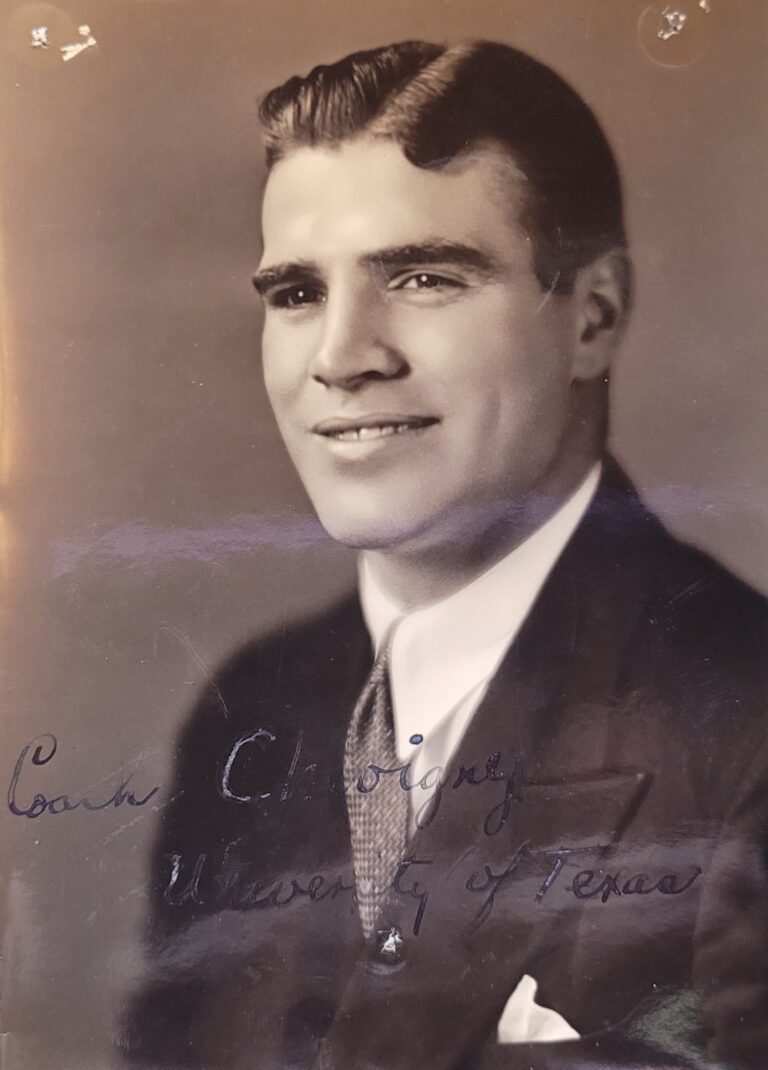
Rooster was offered a scholarship at Texas A&M, but Kutner interceded and convinced Coach Bible to offer him a scholarship. After Rooster graduated, Coach Bible said he was “the best manager I ever saw.”
Class of 1945
Inducted into HOH 1966
FOOTBALL (1941-45, Manager, Kicker, Halfback)
BASEBALL (1944, 1946, Manager)
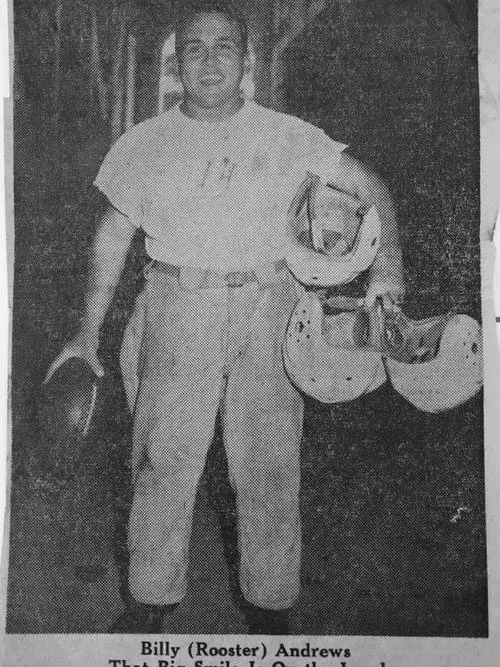
Standing 4″ 11″ Rooster Andrews was the Longhorn football manager, kicker, water boy, and halfback during the mid 40’s. Short in stature but tall in spirit, Rooster was inducted into the Longhorn Hall of Honor in 1966.
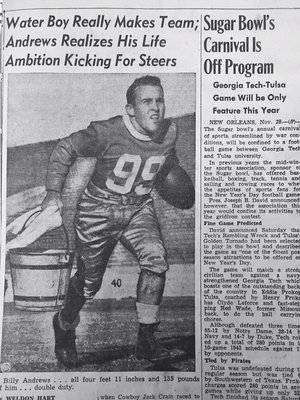
Rooster roomed with Malcolm Kutner, Joe Parker, Roy Dale McKay, and Bobby Lane, and all were destined for stardom.
During the 1943 TCU game, all hell broke loose after a 42-6 victory by the Longhorns. Rooster makes two extra-point kicks against the Horned Frogs, and the coaching staff thought that the Horns were making fun of their team. The TCU head coach was madder than hell and ran onto the field after the game and said to Rooster, “What are you doing here?” The TCU coach said that if Rooster was the extra point kicker, let’s see Bible put him in against Texas A & &M. Bible did as requested, and Rooster kicked the extra point to put Texas up 14-13 over Texas & M.


Even though Rooster was only 4 foot 11, his roommate Bobby Layne said, “You forget about his smallness pretty quick” and “before long, he becomes as big as you””” His four years at Texas are bigger than life. In 1941, Rooster Andrews went from water boy to drop kicker and a baseball player for the Texas Longhorns. Though he never played a down of high school football, he drop-kicked several extra points for the Longhorns and completed a memorable pass to Bobby Layne on a fake kick in Texas’ Cotton Bowl in a win over Missouri in 1946.
As roommates, there is no question that Rooster and Bobby Layne exposed each other’s mischievous nature. Rooster Made Road Games Fun For The Players. He Managed To Stow Golf Clubs On The Bus And Organize The Poker Games. Bobby Layne spent some time on crutches because he and Rooster rolled their car on the way to a ranch party. Another time, Rooster Says, “We Were Roughhousing Around, Chasing Each Other, And Bobby Stuck Is Foot Through A Window As He Fell.” Bobby Had Stitches In The Foot, And The Next Day, Threw A No Hitter Against The Aggies.

1943
Campbell, Hilliard, Borneman, Rooster Andrews
One of his favorite moments at Texas occurred when he was put in a baseball game against Texas A&M with the directive to use his diminutive stature to get a walk but instead made the game-winning hit against Texas A&M.


After his college years Rooster’s list of accomplishments continued to grow, but he is best known for designing the logo for the Longhorn football helmet.

In 1961, Coach Royal asked Rooster Andrews to create a Longhorn sticker. One of Roosters’ images depicted a Longhorn head, and Royal immediately knew that was the logo he wanted for the helmet. Royal understood that in branding, “less is more,” and with his marketing vision and Rooster’s Longhorn “sticker,” a marketing bonanza for UT started that, as of 2017, ranks UT as the number 1 in brand royalties for licensed products.
Rooster’s image would become the most iconic symbol of any University. Alcalde points out that The “sticker” was not complicated by a message that confused football fans with comic imagery. The simple, clear, pure, distinct, definite, and uncomplicated image of the burnt orange Longhorn in relief on the white helmet was immediately identifiable. Alcalde says, “Royal’s genius was in placing the logo in what was to become, as television coverage of college football grew, the prime piece of real estate in college athletics: the side of the football helmet”.

To the left, Rooster is the Clerk of the Course singing the National Anthem with other important dignitaries.
Rooster Andrews was given the Doak Walker NFL Alumni Award in 1987 for contributions to football.


Rooster Andrews
is on top
Rooster Andrews died on January 21, 2008, at 84, but his contributions to Longhorn traditions are a portal to the past. He is part of the bridge built, which reminds Longhorn fans that heritage shapes the present and empowers the future. His contributions to our great University will never be surpassed.
Billy Dale is a proud member of the 1967 Longhorn football recruiting class.


Rooster Andrews
Contributions to Longhorn traditions represent a portal to the past that reminds Longhorn fans that heritage shapes the present and empowers the future.
Rooster Andrews
Rod C Keller – Remembers Rooster Andrews.
Billy, I grew up with Rooster’s nephew Danny Andrews, and we worked at the Rooster’s location at Anderson Lane and Shoal Creek in the late 70’s. Rooster’s son Griff ran the store, and it was loaded with Longhorn memorabilia. Occasionally, Rooster would drop by, and it was like a Longhorn God had arrived. Rooster’s brother Bunny was also an exceptional man who was another Texas icon. My friend Danny is also a special friend. The whole Rooster Andrews family is wonderful. I sure miss the stores. Nothing like them today! Hook ‘em!