Surf’n’Turf: UT’s Best 1-2 Running Punch
Surf’n’Turf: UT’s Best 1-2 Wishbone Running Punch
By Larry Carlson
If you were fortunate enough to witness the effectiveness and greatness of the Texas Longhorns who ran roughshod on the college football world in the triple option era, you know about now legendary runners such as Chris Gilbert, Steve Worster, Roosevelt Leaks and Earl Campbell. And the storied,wheeler dealer QBs, James Street, Eddie Phillips and Marty Akins.
The talent-rich backfields that helped crank out back-to-back natties, six Southwest Conference titles in a row were four-pronged as merciless ground-gobbling machines.
But which duo packed the biggest 1-2 punch in UT’s 9 years of wishbone ball? Remember, we never got to see Rosey at FB and Earl rambling on the pitch. Leaks’ spring injury in ’74, five months before Campbell suited up as Rosey’s young pupil, robbed us of that. Making an incredible, but not full, recovery, Roosevelt Leaks gutted it out and played productively in a limited role that fall. Campbell, the freshman, motored for just under 1,000 yards. As for blaster and blowtorch potential together, we shall never know.
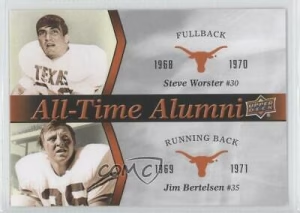
It says right here, though, that there’s no doubt that FB Steve Worster and RB Jim Bertelsen packed the best, biggest wallop of any joint partnership delivered by a Longhorn backfield. Ever. With apologies to Vince and Jamaal. Because stats aren’t the whole story. And a QB as leading rusher makes for apples and burnt oranges comparisons.
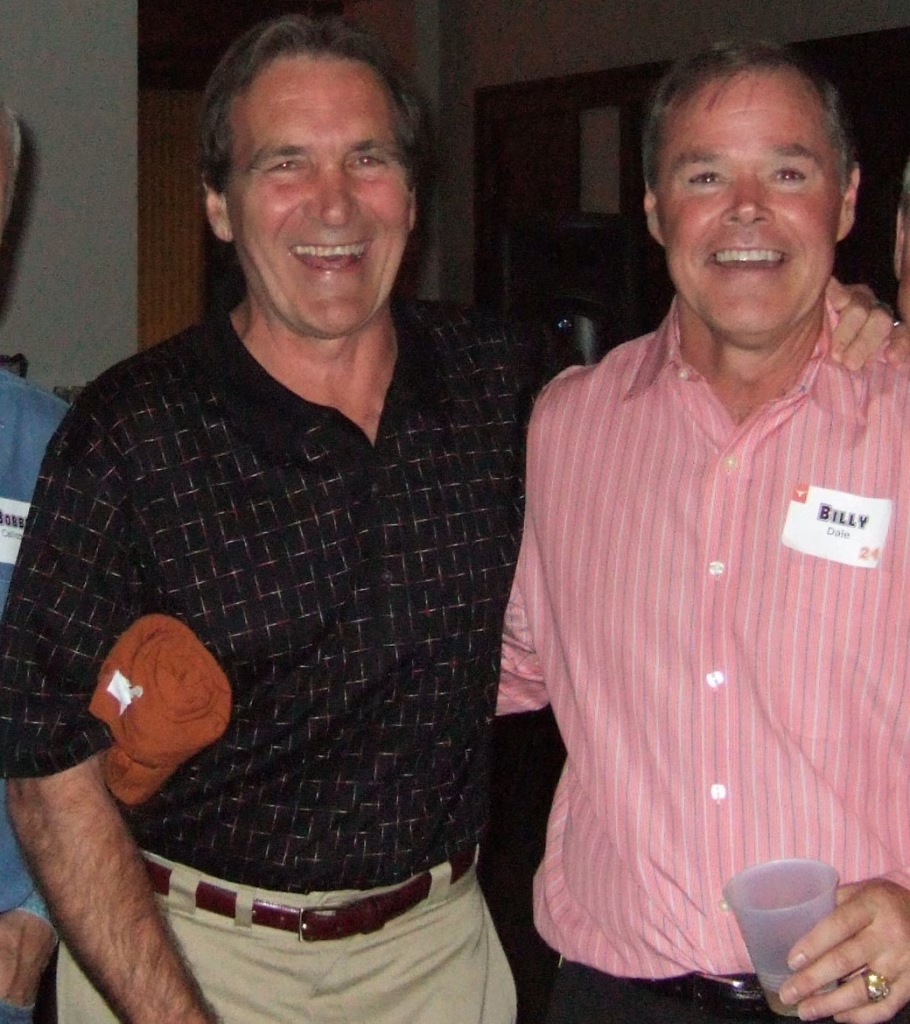
I’m always pestering former Longhorn players for remembrances about their teammates. Driving home recently, I heard a favorite oldie, “Surf City.” For some reason, this time it reminded me of when my friend Billy Dale described the running style of one of his wishbone running mates, Jim Bertelsen.
“He just glided,” Billy had told me. “I think he could’ve put a book on his head and it wouldn’t have fallen off while he ran.” It always stuck with me, and with Jan & Dean harmonizing about “two girls for every boy” in Surf City, I somehow pictured Bertelsen, dreamily navigating a sea of green, the perfect football wave.
It’s funny how the mind works. Especially when you’re an ancient sort who never has figured out computers or TV remotes but who still remembers Longhorn jersey numbers and hometowns, along with state capitals and all the presidents, in order. So you’re gonna have to take my word on this: The next thing I thought of was “surf and turf,” the dining decadence of American gods of the ’60s and ’70s. And I thought, “Surf and turf…that’s Bertelsen and Steve Worster. I’ve gotta use that.” While Bertelsen “surfed,” Worster was the king of chewing up turf.
A story was born, if you will.
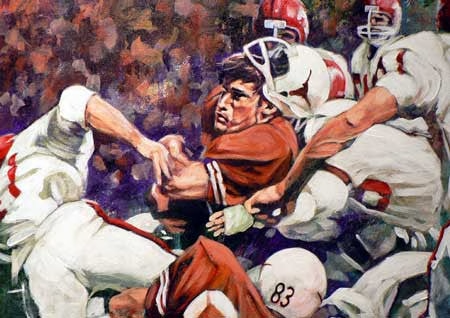
Actually, the story was written more than a half-century (geeez) ago. That’s when Worster and Bertelsen, Bertelsen and Worster — in ’69 and ’70 — were spurring the Texas Longhorns to back-to-back national titles.
So I got to thinking of the appropriate Hollywood types to likely order up “surf’n’turf. Probably Paul Newman and Clint Eastwood’s “Dirty Harry” Callahan. Later, Jon Hamm’s Don Draper character in “Madmen” would have no doubt partaken in the lobster tail, a medium-rare filet and two, maybe three martinis. And — back to football, Worster and Bertelsen — the salad dressing had to be “Wishbone.”
Enough of the preamble. Steve Worster headed the heralded UT signing class of ’67. It came to be known as “the Worster Bunch.” The bruiser from Bridge City became varsity-eligible as a soph in ’68. The wishbone, masterminded by Longhorn assistant Emory Bellard, was created to utilize young Worster (6-0, 210) while also showcasing big Ted Koy and the slippery All-American halfback, Chris Gilbert.
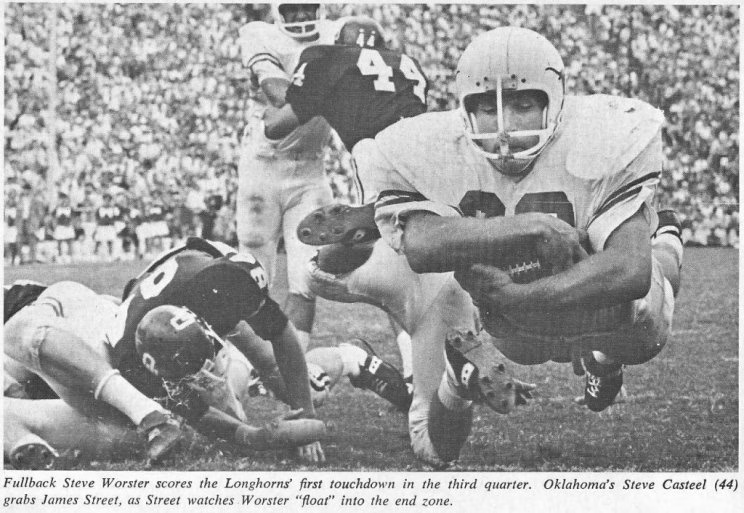
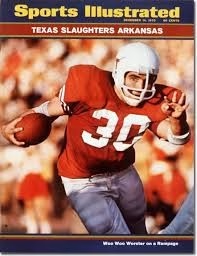
What unfolded has often been chronicled. Texas sputtered in a tie against Houston and a loss to Texas Tech. Coach Darrell Royal replaced Bill Bradley with James Street as the new formation’s ringleader and the Horns were off to the races. Gilbert, no longer the only guy for defenses to key on (he had rushed for more than 1,000 yards in his soph and junior seasons, in spite of that), zipped to a career high 1,132 yards. Koy racked up 441 and Worster powered his way to 806 yards, a 5.0 average and 13 touchdowns. When I asked Billy Dale to again reflect upon the styles of his running buddies last week, he reaffirmed Steve’s unparalleled role and contributions. Dale, the back who rotated in as a key running/blocking contributor in ’68 and ’69, (and memorably scored the winning TD against Notre Dame) then started in the ’70 backfield with Worster, Bertelsen and QB Eddie Phillips. He said Worster was the Wishbone’s engine, the fullback who made the system possible. “Steve was the first option, who, with his straightaway running style, kept the defense on its heels and gave James (Street), and particularly Jim (Bertelsen) the opportunity to use his speed to get to the outside corner,” Dale explained.
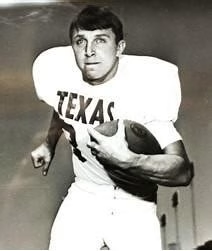
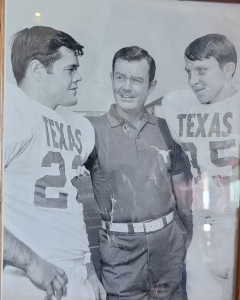
Michigan State’s venerable coach, Duffy Daugherty, contacted Royal after the ’68 season and expressed interest in learning the intricacies of the well-oiled wishbone. “You don’t want my formation, Duffy,” Royal retorted. “You want my fullback. And he’s got two more years with me.” So Texas, having finished Gilbert’s career on a nine-game win streak, was among the favorites to win a natty when the ’69 season — college football’s 100th — kicked off. Joining Street, Worster and Koy in the starting backfield was a sophomore from Hudson, Wisconsin, part of the metro area of Minneapolis-St. Paul, Minnesota, a rare out-of-state Longhorn. Jim Bertelsen, at 5-11, 197, was about the size of Worster but employed a different style to dent defenses. “I would say Steve was a stomper when he carried the ball…he ran with high knees and flat-footed,” recalls Dean Campbell, a 5-5, 150 pound receiver and return specialist who would star for the ’70 and ’71 Horns and was redshirting in 1969. “Jim had what I would call deceptive speed,” Campbell says. “He was a smooth runner and his long stride enabled him to pull away from most defensive backs.”
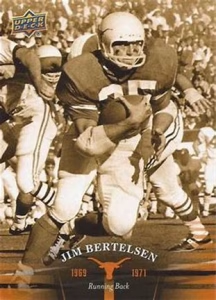
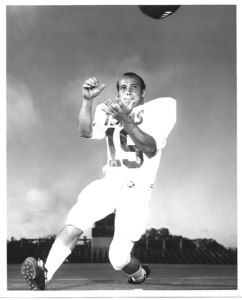
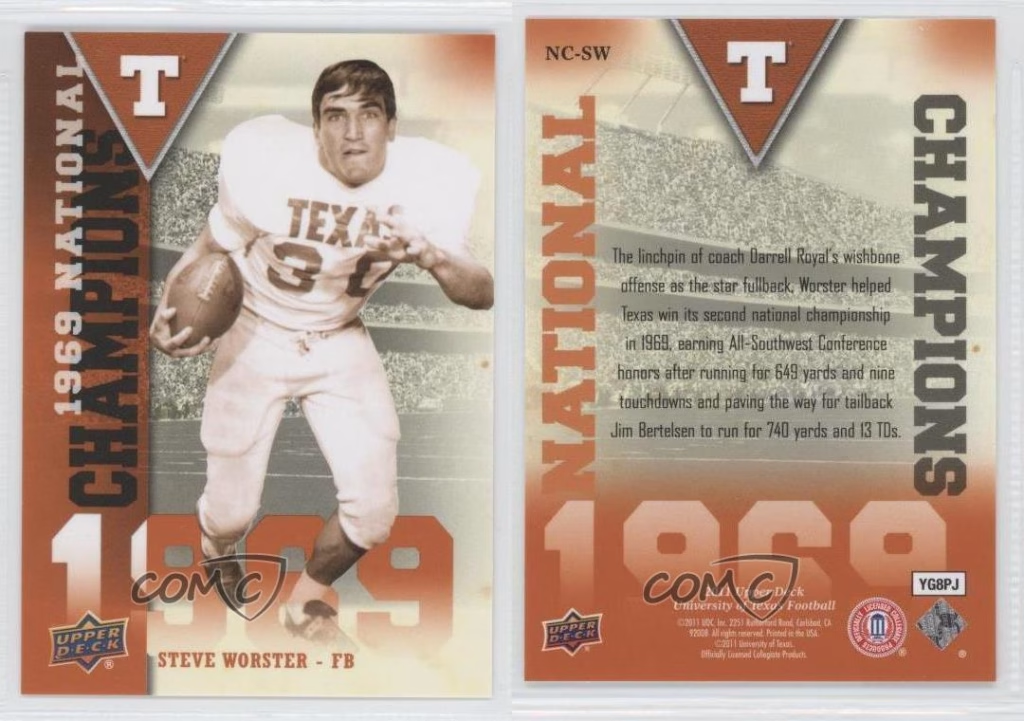
Everything clicked for the ’69 Steers. Bertelsen, the first-year player, led the rushing attack with 740 yards and a 7.1 average. He was honored as “All-Southwest Conference.” Worster earned All-America honors (and his second of three straight All-SWC designations) with “just” 649 yards, a little shy of five yards per pop. Back in the day, when your team was bludgeoning most opponents by four, five or six touchdowns (or annihilating TCU, 69-7), your starters sat out much of the second half. “Steve had no ego,” Campbell offers. “He knew that our opponents could take him out of a triple option play if they chose to, by closing with their defensive ends to take the fullback.” That, Campbell — who was a college football coach for 38 years — explains, would force the quarterback to pull the ball and go to their next read (keep…or pitch to the trailing halfback). “Steve didn’t care if he got four carries or 40 carries,” Campbell shrugged.
In the magical ’69 season, adding on to the Bertelsen-Worster totals, Street and Koy each ran for more than 400 yards. The depth of Texas is illustrated by the fact that Dale was one of five other Longhorns who rambled for more than 200 yards…in essence, creating a 1,000-yard rusher.
The coach in Dean Campbell (UT, Rice, Texas Tech, A&M, Air Force, New Mexico and North Carolina) is never far from the surface when you sit down across from him for a sandwich. “Steve would’ve been a great tailback in the “I” formation, but having him so close to the line of scrimmage and in a four-point stance made it difficult for defenses to see him,” Dean says. “He hit the line of scrimmage quickly, had great balance and vision. He was the perfect wishbone fullback.” Campbell says that Bertelsen, too, would’ve thrived in the “I,”
“I’m not sure if he ever felt comfortable in a three-point stance but he had no ego, either. Jim was an outstanding blocker, which is rare for most great running backs.”
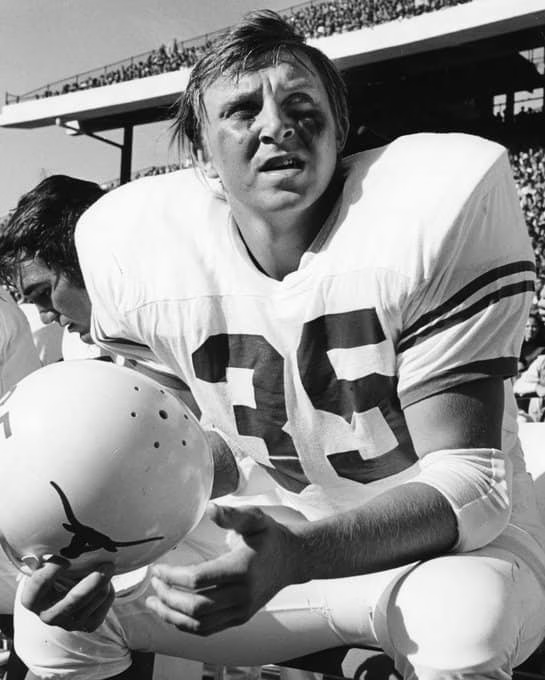
B
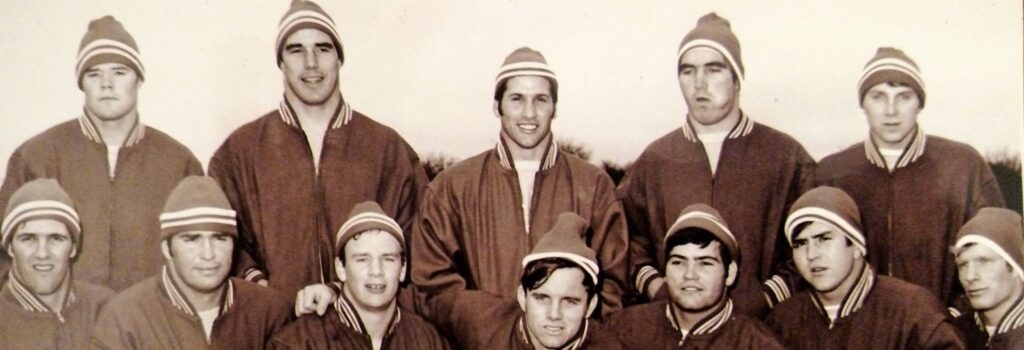
But in the wishbone, effective blocking was essential. It wasn’t just the warriors of the forward wall — Bobby Wuensch, Bobby Mitchell, Deryl Comer, Mike Dean, Forrest Wiegand and others — who knocked defenders off their feet. Worster, Bertelsen, Dale, Koy…they all excelled. It was a job requirement.
And if Worster was generally “Mr Inside” and Bertelsen “Mr Outside,” Jim could mix it up inside, too. Worster, who set a UT record with 36 career rushing TDs, got them the hard way, straight up the gut, meeting collisions head-on, never losing a yard.
“Steve generally did not make long runs,” Dale says about his old “weekend roomie” who shared hotel quarters the nights before games. “Instead, he used the power of his upper torso to defeat tacklers.”
“Inside the five yard-line we would run the ball to the tight end side and get a body on a body with an automatic give to the fullback,” Campbell says, explaining that the wishbone wasn’t always “option” football.
“Steve was virtually unstoppable.”
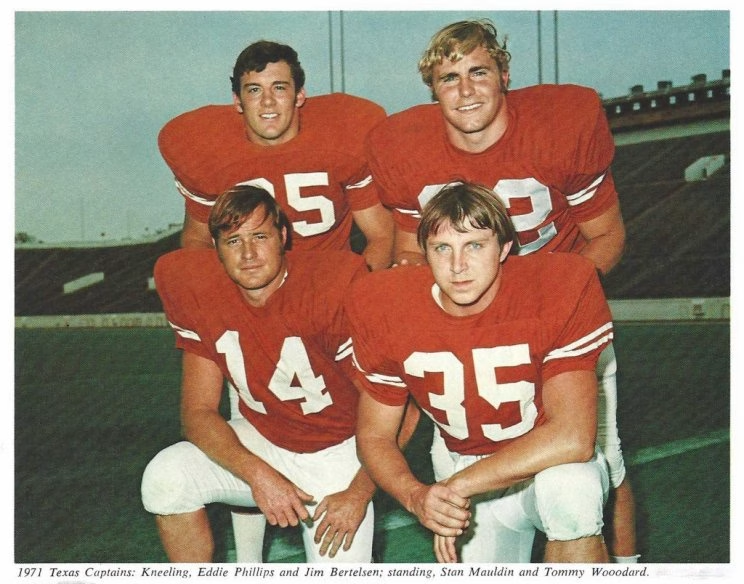
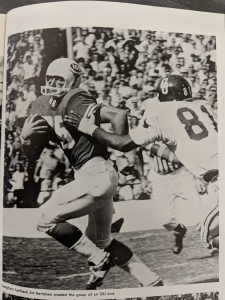
Stan Mauldin, the one-time walk-on who became a starting linebacker at Texas (and captained the ’71 Horns, along with Bertelsen, Eddie Phillips and Tommy Woodard) recalled recently that a slight tweak to the wishbone by Bellard and DKR made a huge difference early on. Worster, as fullback, was positioned two feet deeper, so as to hit the line later with more momentum and less of an angle. Stan pointed to two Worster bursts to cap the late, 85-yard, winning drive over OU in ’68. Woo went 14 yards on one, then seven for the touchdown in a 26-20 gem of a win. “The timing for the (quarterback’s) read with Steve really made a difference in the mechanics of our option,” Mauldin summed up.
Bertelsen scored the biggest TD of the ’69 regular season on a two-yard plunge against Arkansas, setting up the game-winning PAT by Happy Feller. “If it was a short yardage or goal line play,” Campbell says, “Jim ran with his shoulders low…and he was a strong runner.”
Most of the time in their two seasons together, “Moonface” and “Woo” truly were called upon to be “surf and turf.” In 1970, the burnt orange ran their win streak to 30 games, earned their second straight national title and third of what would eventually become six consecutive SWC crowns. And check the odometer and the tread. The Horns had burned rubber on opponents, setting another school record: 3,745 yards in the ten-game regular season, good for more than five yards a try, resulting in 51 rushing touchdowns. Whew.
Worster pounded his way to career bests in ’70: 898 yards, 5.6 yards per carry and 14 scores. That, in spite of painful injuries that he played through.
Most fields were now synthetic (UT installed AstroTurf in ’69) but Steve was still stomping, still punishing would-be tacklers, still eating up turf.
Bertelsen was the sublime complement, riding the wave to 891 yards and 13 TDs at six yards per carry. A year later, with Steve gone, Jim — defying rib injuries — led the Horns to an unprecedented fourth straight SWC championship, again accounting for close to 900 yards.
“He had the most explosive contact blast I ever encountered,” old friend and former teammate, Chal Barnwell, later said, “and a high gear that accelerated to Mach speed with no obvious exertion.”
Worster and Bertelsen, despite differing styles, were cut from the same cloth.
Neither was big on small talk. Dean Campbell described Worster as “quiet, reserved, hard-working.” Of Bertelsen, Dean said, “Jim was also a very quiet person but he had a very dry sense of humor.”
Generally laconic, but both gents made plenty of friends and were consistently cited for their humility.
Both were senior captains, honored by their teammates.
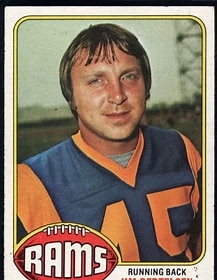
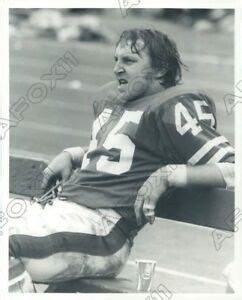
When their football days were over (Worster played briefly in the Canadian Football League, Bertelsen starred five years for the LA Rams) they both returned to Texas.
Worster spent most of his years back in the Bridge City area in Texas’s southeast tip, working in sales. He was inducted into the UT Hall of Honor, the Texas High School Football Hall of Fame, the Cotton Bowl Hall of Fame and the Texas Sports Hall of Fame. He died in 2022.
Bertelsen, also a member of the UT Hall of Honor, worked in Austin before retiring in nearby Wimberley. Far from America’s Dairyland, he came to be known as a standout horseman and an expert with a lasso, a pure-dee Texan. He preceded Worster in death, passing away in 2021.
Both are keenly missed by their surviving family members and teammates.
Billy Dale, pal and backfield mate to both, salutes them fondly as friends, and sums up the key to their prowess on the gridiron. “Jim was the wishbone’s finesse with deceptive speed, and Woo was the Bull, the Mack truck running over opposing players.”
Texas fans never tired of that steady, high-protein diet: Surf’n’Turf, baby.
(TLSN’s Larry Carlson is a member of the Football Writers Association of America. He teaches sports media at Texas State University — write him at lc13@txstate — and watched Worster and Bertelsen admiringly while in high school in San Antonio. Steve Worster is his all-time favorite player.)
See less