Bright Spots by Larry Carlson
BRIGHT SPOTS IN BURNT ORANGE

By Larry Carlson https://texaslsn.org
Sometimes you have to look for a silver lining. You have to squint hard on a gray day when a ray of sunshiny hope is as difficult to find as a haystack needle.
Maybe the boss was in a bad mood. Then the I-35 or I-10 or I-20 traffic was a white knuckler, a stop-and-go beatdown. Even the weather forecast was ominous.
So when you arrive home intact, you pour that drink with justice, prep some steaks and commence to conjure lemonade from what had been a lemon of a day.
The point is this: As Henry Hill, the young mobster-in-waiting who narrates “Good Fellas,” shrugged: “Every once in a while, I’d have to take a beating…the way I saw it, everybody takes a beating some time.”
The great Marvin Gaye, in “Inner City Blues,” reeled off these day-doomers:
“…hang ups, let-downs, bad breaks…setbacks,” then topped it with the dagger of “Natural fact is, aww honey, that I can’t pay my taxes…makes me wanha holler…throw up both my hands…”
Hell, even Mick Jagger lamented the shortage of satisfaction.
And even the storied Texas Longhorns football program has endured a rough season or two, some dry spells. Those who witnessed the hard times can recall remarkable “ups” in down times, magnificent individual and collective performances and achievements amid disappointment in the ultimate team game. Bright spots.
That, dear readers, is the topic for today’s treatise. I won’t dissect each losing season or all the ones that may have disappointed. Consider this a sampling of chicken salad, somehow whipped up from, well, … you know.
We’ll start here. The Horns endured their worst season, with but a single victory, back in 1956, Elvis Presley’s breakout year. That band of Longhorns was nothing but hound dogs. But then bring in Darrell Royal, just 32, and the Steers morphed instantly into a Sugar Bowl team. In one season. A mighty quick silver lining in the wake of 1-9.
Let’s uncover some other jewels found in the — thankfully for Texas fans — mostly rare burnt orange landfills.
_______________
1976: 5-5-1
THE SETTING:
Twenty years passed in the wake of the ’56 disaster before UT tasted a really sour season. Texas had won or shared seven Southwest Conference titles in eight years, with two national championships. But the pedigree mattered not at all in the autumn of America’s bicentennial. The Horns just didn’t really have a quarterback to run the intricate wishbone offense. And star fullback Earl Campbell was seeing the training room as often as he saw the playing field. A dozen or so other Longhorns were regulars on the disabled list.
BRIGHT SPOTS:
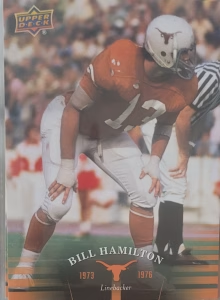
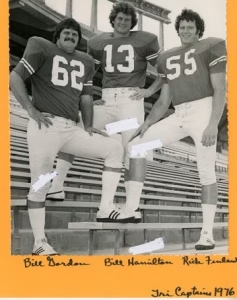
The defense was stellar, as it always was under Royal’s right arm, Mike Campbell. Two seniors, Lionell Johnson and Bill Hamilton, from Winnfield, LA and Las Cruces, NM, respectively — back when out-of-staters at UT were as rare as Austin traffic jams — rang up tackles like nobody had since Tommy Nobis. Johnson totalled 175, Hamilton 154. Another senior, Rick Fenlaw of Amarillo, also cracked the century mark with 105 stops. Consider those gents, along with a band of precocious freshmen on defense, to be among the bright lights in a dark year. As for the future, even brighter was an 18-year-old with an Olympic gold medal. Johnny Lam Jones, the comet from Lampasas, rushed for more than 600 yards and a 5.3 average.
COLD, HARD FACTS:
It started with a shocking road loss to lightly regarded Boston College, a hint of foreshadowing. Word was, OU was cheating and spying with impunity and Houston was the new, fast kid on the SWC block, reaping a Cotton Bowl in its first season.
The Sooners and Horns tied, 6-6, reducing DKR to a broken man, dry-heaving after the contest. A few weeks later, the Cougs doused UT’s home winning streak that started in ’68. A&M beat Texas in Austin for the first time since disastrous 1956, and only the second time since 1922.
It took a season-ending 29-12 win against Arkansas to ensure that Royal never had a losing year on The Forty Acres. The Horns finished 5-5-1 and DKR retired. He was 52.
_____________
1986: 5-6
THE SETTING:
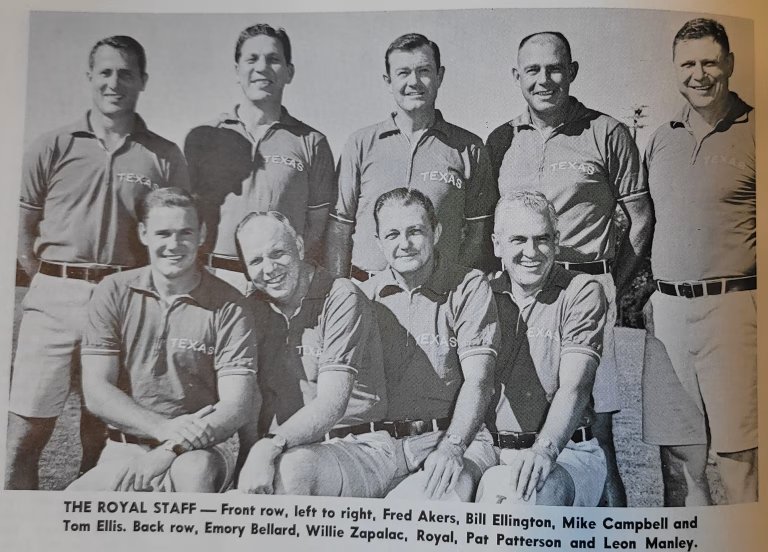
Fred Akers was the first choice to fill Rpyal’s Texas-sized boots and his teams won 75 percent of their games in his first nine seasons. A perfect regular season in the ’77 debut was nicked by a loss to Notre Dame in the Cottom Bowl. But Texas was in the SWC hunt every year, won the Cotton Bowl after the ’81 campaign and rolled to a perfect ’83 behind a crushing defense. But they lost a quirky Cotton Bowl to Georgia on a late flub that still haunts, and it was the first thread in an unraveling. Texas was number one in ’84 after flashy W’s against Auburn and Penn State, then managed a rain-soaked tie against OU on a Jeff Ward field goal at the gun.
After that, things went south. The 3-0-1 melted down into a 7-4-1 mess and 1985 wasn’t much better. UT went 8-4, fell to OU and aggy, then lost to a smallish, undermanned Air Force squad to put a lid on it. Akers’ bowl record sank to 2-7.
Things had to get back to the standard in ’86. Didn’t they?
BRIGHT SPOTS:
As it had been a decade earlier, the defense brought the season’s only solace.
It was especially salty during the last month, never allowing more than two TDs.
Linemen Brian Espinosa and Blake Brawner topped 100 tackles each, along with linebacker Duane Duncum.
COLD, HARD FACTS:
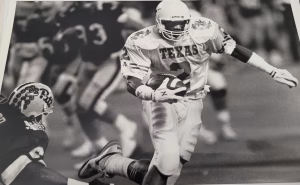
The downward spiral crashed to rock bottom in 1986. “No offense” was the tag Fred Akers had heard for several seasons. He tried to juice things with a new coordinator and lots of passing by QB Bret Stafford. But the attack was inconsistent, in spite of quite a few electric plays from sophomore halfback Eric Metcalf.
Akers’ team lost its third straight to A&M and college ball’s highest paid coach, swaggering Jackie Sherrill. Texas finished 5-6, its worst season since Dwight Eisenhower was in his first term at 1400 Pennsylvania Avenue. In the end, UT athletic director DeLoss Dodds cut Akers loose. Fair or not, one losing season had been deemed one too many.
_________________
TIMEOUT: Time for LIFETIME ACHIEVEMENT HONORS in Silver Linings Category
Britt Hager, 1984-85, 1987-88
The tackling machine only played on one losing team, his senior season when he racked up 195 total tackles en route to All-America honors. But he came to Texas right when the program began to decay, and had to be a beacon amid the darkness of 24 losses.
Hager wasn’t big in size and conducted his work in a businesslike manner with absolutely no histrionics after tackles and big plays. His trademark was long hair that cascaded from the back of his helmet, paving the way for one of his sons, Breckyn, who played for UT from 2015-18 and sported similarly long locks.
Britt holds the Texas career record for tackles — a mind-boggling 499 — and that single season (’88) mark of 195. He played nine NFL seasons, mostly with Philly.
Eric Metcalf, 1985-1988
Metcalf was Fred Akers’ final super blue-chip signee. He was a versatile weapon as a runner, receiver and return man, while also earning All-America status as a Longhorn long jumper. But UT football was limping through a rough four years, and his workhorse ways, much like Hager’s on defense, in ’87 and ’88 didn’t make the national splash they would have in another era.
Like his dad, Terry, before him, Eric was a star in the NFL. He chalked up All-Pro honors, made Pro Bowls, and piled up more than 17,000 all-purpose yards.
_____________________
AND NOW…BACK TO “THE BRIGHT SPOTS”
1991: 5-6
THE SETTING:
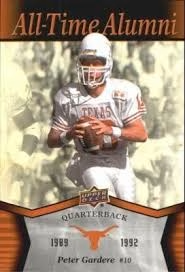
Optimism was back in vogue at the Forty Acres. After six lackluster seasons and an unbearable six losses to A&M, Texas really had “shocked the nation” on its 1990 tour. The regular season was a 10-1 work of art that included bold victories over Penn State, OU, Houston, and the Aggies. Head Coach David McWilliams was rewarded with a contract extension, and why not? Peter Gardere, just a junior, would be back in the saddle to guide the offense and the defense; in spite of losing several key players, the team was loaded for bear.
THE BRIGHT SPOTS:
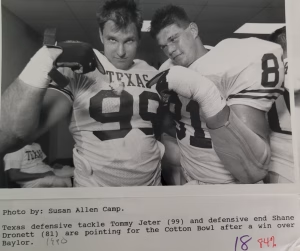
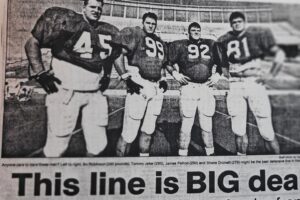
Go ahead and call them the very best front four the Longhorns ever fielded. They were magnificent. Call the roll, in alphabetical order: Shane Dronett. Tommy Jeter. James Patton. Bo Robinson.
This fearsome foursome anchored a crew, supported well by middle linebacker Mical Padgett, that led the nation most of the season and gave up more than two TDs only three times.
But the heroics were blunted by an offense stuck in park. The Longhorns scored more than two TDs on only four occasions.
COLD, HARD FACTS:
As it turned out, the dream ’90 season was the outlier among the five years that home-grown, down-home son David McWilliams coached the Horns. He was fired in December after a 5-6 ledger…he had coached three losing seasons and four of his teams had a total of 24 losses. He was dismissed and replaced by a northerner, John Mackovic, who seemed the polar opposite of McWilliams in football philosophy, dress, mannerisms and manners. Old guard Texas fans pursed their lips, buckled up and hoped for the best.
––––––––––––––––––––––
1997: 4-7
THE SETTING:
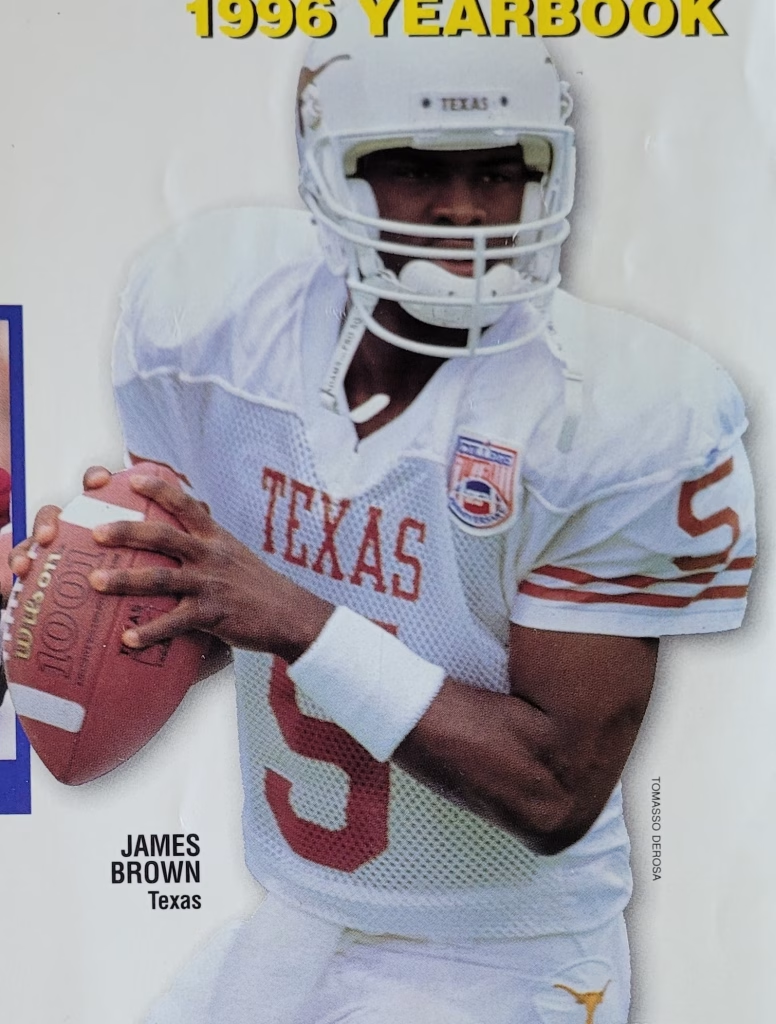
Texas was coming off a surprise conference title in its first Big XII season. The Horns, at 7-4, had been a big underdog against mighty Nebraska in St. Louis but pulled off the upset that QB James Brown had “guaranteed.” Fans were grudgingly beginning to acknowledge that John Mackovic might be a pretty good coach. After two throwaway seasons to start, Texas had won a Sun Bowl, then won the last Southwest Conference championship and the Big XII title. Mackovic, following his audacious “Roll Left” call that sealed the monster triumph against the Cornhuskers, was the toast of college ball. And he had Brown and star RB Ricky Williams ready for ’97.
THE BRIGHT SPOTS:
Ricky Williams, in his third year at The Forty Acres, was virtually unstoppable. He rambled for 1893 yards, averaging an obscene 6.8 yards per touch, en route to 25 touchdowns. The San Diego guy was magnificent. On a bad team, as it turned out.
For many, the brightest spot came just after the season. See below.
THE COLD, HARD FACTS:
Following a predictable butt-kicking of Rutgers in the opener, Texas got obliterated, 66-3, by UCLA in Austin. Football fans, nationwide, thought it was a typo/misprint as the score scolled by on their televisions. “Rout 66” was real, though, and the Longhorns were the roadkill. Texas rebounded against Rice (duh), lost to Oklahoma State, managed to beat OU but then went on a four-game losing streak. Quarterback James Brown, so steady the previous three seasons, had an off year. He completed just under 50 percent of his passes, threw for only five TDs and suffered 11 picks.
Nothing and nobody but Williams clicked all season. No one else rushed for even 200 yards. Ricky was UT’s lone All Big XII selection.
The only other player who enjoyed success was third-team QB Marty Cherry. He was spotted on TV by the right people while playing during the UCLA debacle. Cherry was soon “the face” for Ralph Lauren and Abercrombie & Fitch, traveling the world and forgetting about the life of a scrub QB on a 4-7 team.
And for hordes of Texas backers, the true bright spot of the year was a big one, just after Thanksgiving. John Mackovic was fired. He was replaced by Mack Brown of North Carolina.
________________________
2010: 5-7
THE SETTING:
The steadiest program in the first decade of a new century in college ball, Texas stacked nine straight seasons of double-digit wins from 2001-09. An early shoulder injury to QB Colt McCoy at the Rose Bowl national championship bout might well have cost UT what would have been its second natty in five seasons.
Now McCoy was gone to the NFL, along with the splendid Jordan Shipley. And three superlative Longhorn defenders — DB Earl Thomas plus linebackers Sergio Kindle and Lamarr Houston — had been among the draft’s top 44 choices.
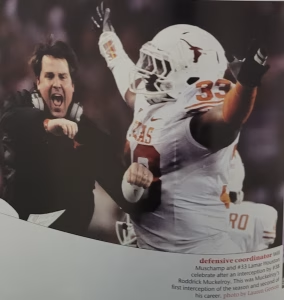
But Mack Brown and fiery defensive coordinator Will Muschamp had returning talent.
Some Texas fans believed that young Garrett Gilbert, the phenom sophomore from Lake Travis, might eventually outshine McCoy.
THE BRIGHT SPOTS:
Well, Texas beat Nebraska again. In Lincoln. Again.
Call it a short list of bright spots for a team whose seniors had won 35 games in three seasons. Individually, several players distinguished themselves. Defensive end Sam Acho was the squad’s lone first-team All-Big XII pick. And despite a defense that gave up 130 points in one four-game midseason stretch, all losses, the secondary could boast about talent. Aaron Williams, Curtis Brown, and Blake Gideon all earned mention in postseason all-star lists.
COLD, HARD FACTS:
Those pundits who warned that Mack Brown hadn’t given Gilbert enough work in ’09 (until McCoy’s injury forced it) while pushing Colt for the Heisman were validated. Gilbert, the bluest of blue-chippers, often looked lost in his second season. He was intercepted 17 times, and his body language depicted a young man carrying a Texas-sized burden.
The Horns started 3-0 against lightweight foes, then managed but two W’s in their final nine contests. The unthinkable had happened. Texas slid into dead last in the Big XII standings. The mighty had fallen.
And nobody could have guessed how long the slump would last.
There were rumors from insiders that Brown had planned to retire after the title game against Nick Saban’s Alabama, handing the keys to Muschamp, who had been officially anointed as “head coach in waiting.” That had not transpired.
Whatever the case, Muschamp had had enough of waiting. He accepted the head coaching job at Florida. Brown would have no more losing campaigns on the Forty Acres. But his next three teams would lose 14 games and lots of luster.
______________________
2016: 5-7
THE SETTING:
It was year three of the Charlie Strong era in Austin. Strong’s teams had underwhelmed with 6-7 (including an embarrassing Texas Bowl loss to Arkansas) and 5-7 records. The “hotseat” was hotter than Laredo. The only luck Charlie had encountered had been bad, from player injuries (David Ash) to costly ref’s calls (Oklahoma State, 2015).
When Texas outlasted Notre Dame, 50-47 in a double-OT opener in Austin, the hopeful believed that UT’s luck had turned. It had not.
THE BRIGHT SPOTS:
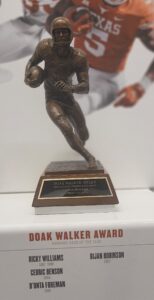
There were good players. Standouts such as DT Malcom Brown and RB Malcolm Brown. Quarterback Shane Buechele as a freshman. Jerrod Heard, setting a Texas total offense record against California, though UT lost, no thanks to a haywire PAT. But the Sirius-bright, guiding light of individual merit was RB D’Onta Foreman and his rousing 2016 season. The big baller from Texas City ran for 2,028 yards and won the Doak Walker Award as America’s top running back. Foreman, displaying breakaway speed to accompany a punishing, battering-ram capability, was terrific.


COLD, HARD FACTS:
Two months after Texas tamed the luck of the Irish, the Horns were 5-4. They knew their last three games — against 11th-ranked West Virginia. barrel-bottom Kansas and Gary Patterson’s tough TCU — would tell the season’s story. And it did.
The burnt orange played valiantly in a close loss to WVU. No cause for embarrassment. That would come the following week. A Kansas team that had lost nine in a row somehow took down Texas, 24-21, in Lawrence. The overtime defeat marked a new low in a trying seven-year span for UT. When TCU shelled the Steers in Austin to finish the 5-7 season on a three-game losing streak, Athletic Director Mike Perrin gave his head coach the boot. Strong’s record at Texas was 16-21.
____________________
2021: 5-7
THE SETTING:
Texas fans were ready for new leadership. Tom Herman had arrived from the University of Houston after three losing seasons under Charlie Strong. And he had delivered four winning seasons. Four bowl wins, too, as many as Fred Akers, David McWilliams and John Mackovic had managed in a combined 21 years.
But in spite of a ten-win Sugar Bowl champion team in year two, the Horns had not progressed as hoped.
Sarkisian arrived with the Saban-driven Bama championship pedigree to go with his own head coaching experience. And he promised a dynamic offense that would live by an “All gas, no brakes” credo.
THE BRIGHT SPOTS:
Casey Thompson had replaced the injured Sam Ehlinger at quarterback in the previous year’s Alamo Bowl. He launched four touchdown passes in what, ironically, turned out to be Tom Herman’s final half-hour as coach.
Thompson was excellent in the first part of ’21. And it wasn’t his fault that the 4-1 Longhorns blew a 38-20 halftime lead against OU, losing, 55-48.
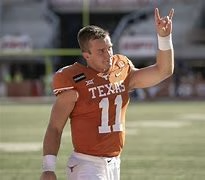
Thompson had a good season, as did his fellow backfield studs, Bijan Robinson and Roschon Johnson. A skinny blur of a wide receiver, a Cali freshman named Xavier Worthy, caught passes worth almost 1,000 yards.
And while many, many Longhorn fans rightly remember the great O-lineman of the mid-’90s, Blake Brockermeyer, they also lamented that Blake’s twin blue chipper sons, Tommy and James, turned down Texas for Alabama (Tommy later transferred to TCU then retired because of injuries; James moved to TCU then on to Miami, where he was a starter in the national title game against Indiana). But perhaps they forget the twins’ older brother, Luke. He came to UT as a walk-on. He later earned a scholarship and was a starting linebacker in ’21, finishing second in tackles only to DeMarvion Overshown. A bright spot, indeed. Luke now coaches linebackers at Oklahoma State.
COLD, HARD FACTS:
It was kept a secret. But Casey Thompson had been injured in the shootout loss to OU. He sustained ligament damage in his right (throwing) thumb. Thompson showed courage and determination and played through the pain but his velocity and accuracy were never the same. The defeat in the Cotton Bowl began a chain of unfathomable six losses in a row. Five of the six L’s were in the single score range. But UT went from October 2 to November 26 without the taste of victory. A gritty 22-17 home win against Kansas State in the finale was fueled by Thompson, Johnson and a salty defense, and it somehow gave Texas a promise of next year. And next year would be different, with a new QB and three more W’s. But that ’22 team would still be a season from greatness.
______________________
21st CENTURY LIFETIME ACHIEVEMENT HONORS in Silver Linings Category:
Jaxon Shipley, 2011-2014
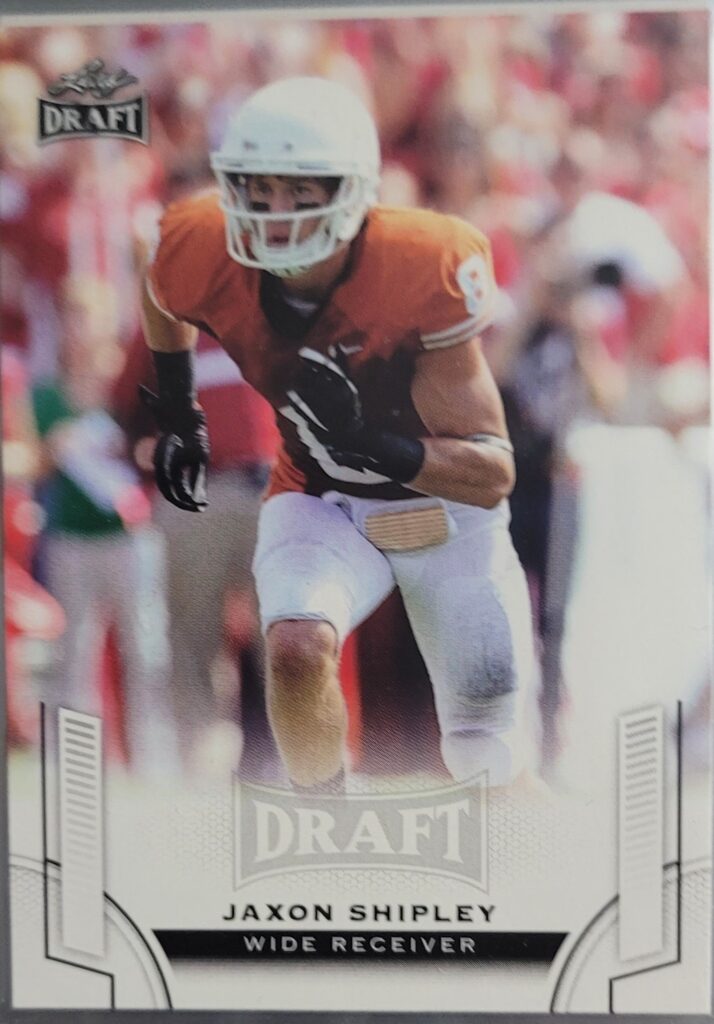
Little brother to Jordan, UT’s all-time greatest pass receiver, Jaxon distinguished himself in spite of one major handicap. He never had a great QB chunking passes to him, at least not for long. His brother, as we all recall, was Colt McCoy’s roomie and BFF. They were dynamite as a duo.
Jaxon caught passes from the oft-injured, luckless David Ash, then Case McCoy and Tyrone Swoopes. There was never continuity. Still, Jaxon emerged as just one of three Longhorns to post three seasons of 50 or more catches. Not even Jordan is on that elite short-list. The younger Shipley finished his days at Texas as the third most prolific receiver in UT history, trailing only Jordan and the great Roy Williams. One wonders what he might have achieved had he been surrounded by a steadier lineup.
Bijan Robinson finished at Texas as an All-American. He’s an NFL star in Atlanta.
Sam Ehlinger quarterbacked Texas to four straight winning seasons and is the lone UT QB in history to be 4-0 in bowl starts. He’s now set for his sixth NFL season
Roschon Johnson came to the Forty Acres as a blue-chip quarterback recruited by everybody. He ended up being UT’s Swiss Army Knife of a player, doing whatever he was called upon to do. Johnson was a team captain and a regular on the Big XII Commissioner’s Honor Roll. He plays for the Chicago Bears
The above players did not endure a string of losing seasons at UT.
But based on their character and superlative play, they deserved better in the win column while wearing the burnt orange.
________________
( TLSN’s Larry Carlson is a member of the Football Writers Association of America. He teaches sports media at Texas State University and lives in San Antonio. Write him at lc13@txstate.edu )
***********************