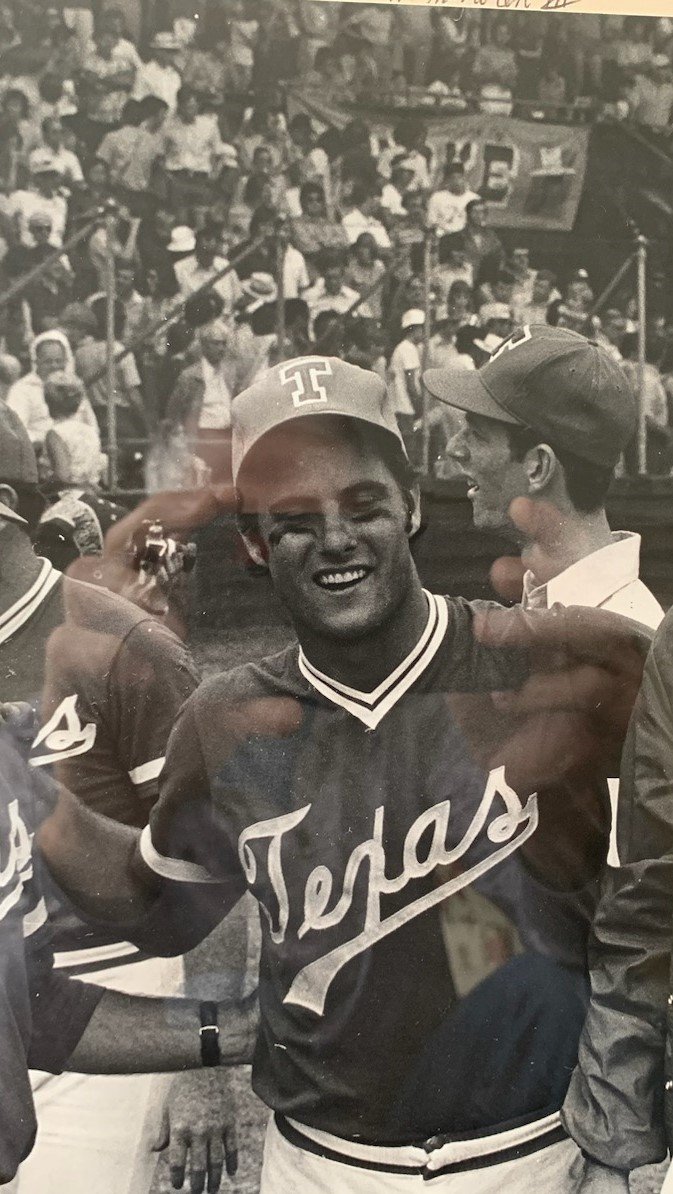
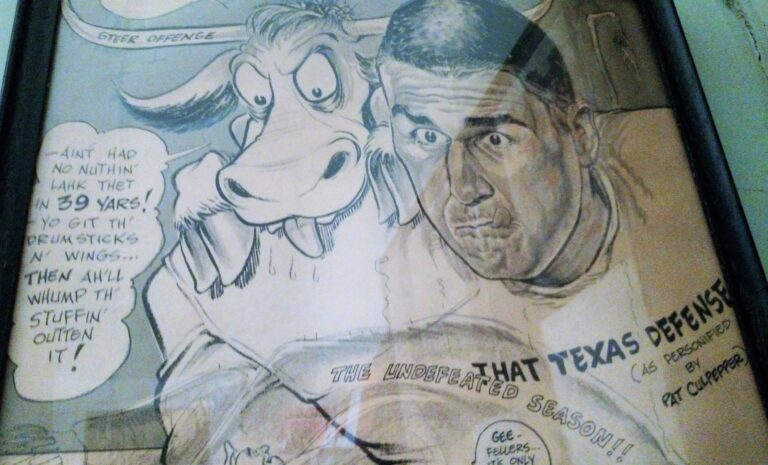
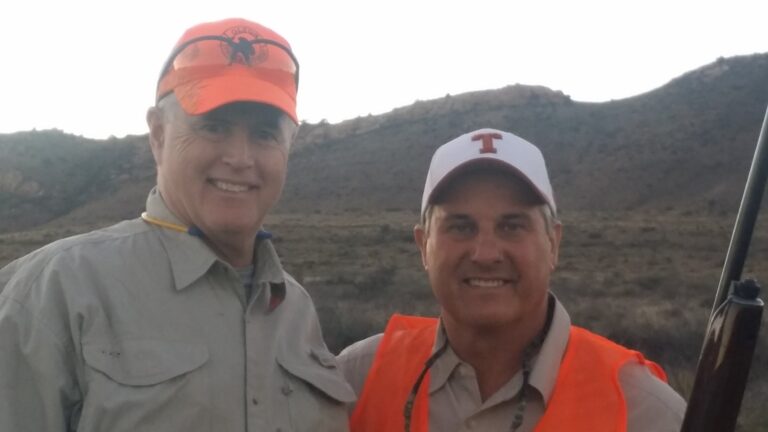
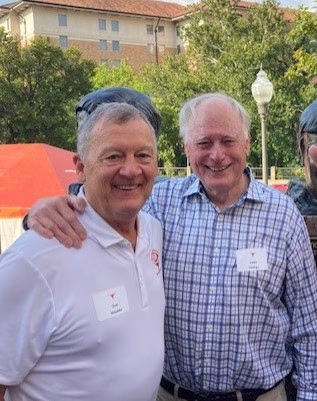
12/22/2025 Professor Carlson interviews Bill Atessis, Dean Campbell, Scott Palmer, and Billy Dale about the 1970 National Championship team.
CARLSON/TLSN: Let’s start with this. As the 1970 season came on the horizon, your Longhorn teams had won 20 straight, two Southwest Conference titles, two Cotton Bowls and a national championship. Any recollections and expectations from that summer of ’70 as the season approached? You had lost some terrific players such as James Street, Glen Halsell, Tom and Mike Campbell, Ted Koy, Leo Brooks, Bob McKay…
PALMER: I thought we would still be a really good team with Eddie (Phillips) taking over for James (Street). We lost some great players to the pros and graduation but returned guys like Bill Zapalac, Bill Atessis, Bobby Wuensch, Scott Henderson, Bobby Mitchell, Mike Dean and Jim Achilles, who are all but Achilles now in the Longhorn Hall of Honor.
ATESSIS: We had such a wealth of talent. It was a reloading process. I recall my sophomore year (’68) at UT when I started at defensive tackle. In the OU game I suffered a knee injury and Scott (Palmer) came in to replace me. Then Scott got injured and Leo Brooks replaced him. All three of us went on to play in the NFL. That’s the depth of talent we had during those years.
DALE: I thought we had quality replacements and didn’t feel there would be much dropoff on the level of play on either the offense or defense. History proved this correct.
CARLSON/TLSN: College football is now 365 days of workouts, nutrition, ice plunges and such. How were y’all preparing that summer, did you have a job and did you stay in Austin or return to your hometown?
CAMPBELL: Growing up in Austin, my Grandfather owned a construction company so I worked for him every summer from junior high until I graduated from UT.
DALE: I went home (to Odessa) but I chose not to follow Frank’s (trainer Frank Medina) workout schedule and instead created my own, which was challenging.
PALMER: I stayed in Austin and shared an apartment with Eddie, (DB) Jimmy Gunn and Mack McKinney, who had graduated. I worked for the state that summer. I lifted weights three times a week and then twice a week during the season.
ATESSIS: I worked at a friend’s electrical supply company in Houston. I got a call one day from an NFL scout, inviting me to run 40-yard dash trials at the Oilers’ practice field. I told him I would, and went out in the middle of a typical hot, humid summer day in Houston. When I arrived there were several other local players in line to run. I had changed into running gear and got in line without any warming up or stretching and proceeded to run my first 40. I had a 4.7 time and was encouraged but the scout asked me to run another, so I got back in my stance and ran it. But this time, as I was finishing up I got a pull in my right hamstring. Initially, I didn’t think it was too bad and the scout told me to not to run for a week and treat with ice.
As it turned out, the pull was worse than I thought and I ended up going to Austin early for treatment. When Coach Royal found out what had happened, he called the NFL scout and summarily chewed his butt and told him they would not time our players outside our practice field in the future. That pull bothered me most of the season but I was able to play with it. Damn thing still bothers me today.
CARLSON/TLSN: Perfect lead-in to this. How did y’all feel about Coach Royal, in the way of respect, fear…admiration? Was he approachable or more of a deity up on the coaching tower above the practice field?
ATESSIS: I respected Coach Royal and he was a big part of why I chose UT. He was a disciplinarian and expected your best effort. He didn’t hesitate to let you know when you missed an assignment, especially when watching the game films. However, he was also there to offer help or advice with any life experiences you may be going through. He was very humble and a fiercely competitive man.
PALMER: We all respected him and you only spoke when spoken to. You just didn’t want to be called to his office. It happened to me once and I was wondering what I had done. Coach just said “You’ve been invited to the Senior Bowl and Hula Bowl. Choose one.” With a sigh of relief, I said ‘Senior Bowl.’ And that was that
He only became friendly with you after your playing days were over. He knew how to handle his players. He was a great coach and a great man.
DALE: Personally, I was terrified of him. Whenever he approached me in any setting, I’d immediately head in the opposite direction. On rainy days we would use the Gregory Gym hallway to stay dry on our way to class. If Coach Royal’s office door was open, I’d either run past his office as fast as I could, or even crawl by once so he couldn’t see me from his desk. Was this desperate? Maybe, but I wasn’t the only one — though I won’t reveal any names of the others.
CAMPBELL: I had a different relationship with Coach Royal than most of the players. I had lived in the same neighborhood since I was eight years old. He had given me a standing invitation to come to practice any time I wanted, and that led to my interest in becoming a coach. Coach Royal, Rooster and Bunny Andrews were tremendous role models and mentors to me after my Dad passed away my sophomore year in high school.
CARLSON/TLSN: Y’all, as a team, had seen your teammate, Freddie Steinmark, go through having a leg amputated back in December, the week after the big win against Arkansas. Then, his appearance on crutches for the Cotton Bowl and his debut on a prosthetic leg at the team banquet. Now, in the fall of ’70, he was helping out as a coach. How inspiring or emotional was that?
ATESSIS: Freddie was one of the bravest persons I’ve known. I am fortunate to still have a relationship with his brother, Sammy, who was Freddie’s biggest fan, and we still share stories about him and how much he is missed.
DALE: At first, I hadn’t managed the situation well and felt uneasy due to my own lack of maturity and uncertainty about how to interact. I think some others shared similar concerns. Upon Freddie’s first return to the locker room the environment was tense. Recognizing this, Freddie later chose to lighten the mood by dressing as a pirate who had lost his leg, which prompted laughter and helped create a more positive and supportive atmosphere among the team.
CAMPBELL: Freddie was an inspiration to everyone around him. He always had a smile on his face and kept a great attitude through it all. Freddie helped coach the freshman team that year and he was a mentor and good role model to all those freshman players. He would’ve been a great coach.
CARLSON/TLSN: I’ve gotta ask for some remembrances of your legendary trainer and disciplinarian, Frank Medina. For a guy who stood about five feet nothin’, he struck fear into lots of Longhorns. I’ve heard about running the stands at 5 a.m. and all kinds of hell. How ’bout some thoughts or memories?
CAMPBELL: Frank Medina also lived in our neighborhood and I went to school with his daughter. In the summer, Frank would put on a strength and conditioning program for any high school players in Austin who wanted to participate. I learned from Frank how you could push yourself when you thought there was nothing left in the tank. I walked on at Texas in the spring of ’69. The first day I went through the conditioning program with the team, Frank called me in his office after the workout. I thought he was going to cut me but instead he encouraged me. He told me he had watched me play since junior high and knew I could play at this level. But he said, because of my size (5-5, 150), I would never get a “look” from the coaches unless I finished first in every drill.
The majority of our players never had to take part in some of those “extra” after-practice workouts Coach Royal despised players who were “overweight.” He thought it was an indication of laziness or lack of character. If you were one of those guys, you were on “Frank’s List.” They would have to put on rubber sweatsuits and work out in the sauna room with the heat turned up until they could hardly stand. Once you had reached your target weight, you were no longer on “Frank’s List.”
DALE: Frank Medina believed that football was not a sport for the weak-spirited.
He loved doing his job…but none of the players loved him doing his job. He drove the players hard during the infamous “Medina Sessions.” The survivors were “Medina-ized” and made the team. Frank had an unusual speech pattern and took liberties with the English language. The way he constructed his sentences and his cadence was Yoda-like, long before the first “Star Wars” movie. My favorite quote about Frank Medina is from Glenn Blackwood (1975-78). He says, “You know what he was like? Darrell Royal was Obi-Wan Kenobi and Frank Medina was Yoda. This little guy was a piece of work.
‘Mr. Man..come on, Mr. Man,’ Medina would say. He couldn’t remember our names, so he just called us all ‘Mr. Man.’ One time he had us run “the religious relays. ‘I want the Baptists over here, the Methodists here…’ I’ve never seen anything like him.
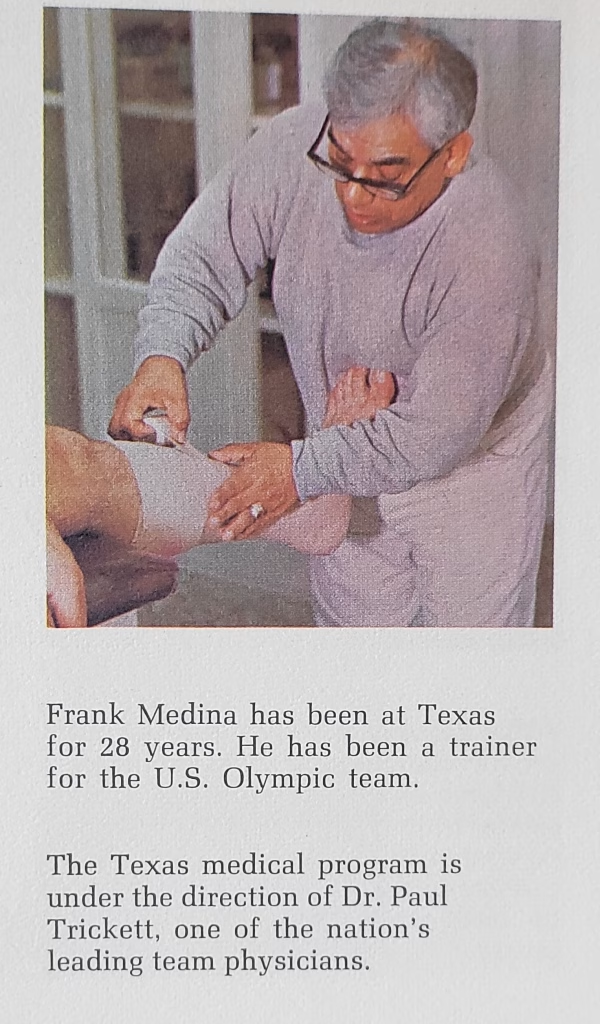
ATESSIS: ‘Show me what you got!’ Frank’s motto was to challenge you to give it your all and don’t hold back. Push your limits to be the best you can be. Frank was an institution at UT and responsible for much of our success for being physically fit and treating whatever injuries we did incur.
CARLSON/TLSN: How nervous or psyched do you remember feeling before games? I’ve heard that Bobby Wuensch, for one, was a Jekyll & Hyde guy who could transform into a pregame locker room madman.
DALE: All of us dealt with pre-game jitters in different ways but all of us knew to steer clear of Bobby’s “preparation for the game” ritual.
CAMPBELL: The only times I remember being really nervous was if it was really windy or the other team had a left-footed punter. Both of those made fielding punts difficult. I was always keeping an eye out for Bobby Wuensch before games. If I saw him coming around the locker room, I would go hide in the shower. He liked to pinch your cheeks until they almost bled, or you promised him you would play the best game you had ever played.
CARLSON/TLSN: Alright, let’s get to the start of the ’70 season. Y’all demolished California in Austin, then went out to Lubbock and schooled the Red Raiders.
Then it was time for UCLA at Memorial Stadium. For younger fans who might not know, that last-minute, 20-17 win over the Bruins on the Eddie Phillips-to-Cotton Speyrer catch-and-run is still considered the greatest finish ever for a Texas home game. It built the win streak to 23 and electrified the crowd and stadium. Your memories?
CAMPBELL: As a wide receiver, you never get a chance to see what’s going on as far as defensive fronts are concerned. You’re just reading coverages and our job was to block the man responsible for the deep third on your side of the ball. Cotton and I were just wondering what was going on because we never had any runners breaking into the secondary. UCLA had done a great job studying our wishbone offense and had come up with a scheme we had never seen. Hats off to them and praise the Lord that Eddie made a great throw and Cotton made a great catch and we snatched a victory from the jaws of defeat.
PALMER: All I remember is grabbing coach (Willie) Zapalac in a bear hug when Eddie and Cotton connected on the T-D pass.
DALE: On the second play from scrimmage, I was knocked unconscious and separated my shoulder. Despite that, I continued to play for most of the game. The details of the game remain hazy, but one vivid memory stands out. During Cotton’s legendary catch I was split out to the right and ran a hook inside, serving as a safety valve for Eddie if he needed an option. This positioning had me facing the East side of the stadium as Cotton scored. The moment Cotton crossed into the end zone was unlike anything I had ever experienced. The noise and the movement of the fans throughout the stadium was overwhelming. It was only after the touchdown that the fans truly understood we had won the game, creating an unforgettable scene of excitement and triumph.
ATESSIS: I was on the sidelines close to where Cotton caught the pass. Watching the two UCLA defensive backs jump the route and knock each other down, Cotton catching it and running it in with under 20 seconds left on the clock…I was ecstatic, jumping and grabbing teammates. It’s still to this day one of my favorite memories of the season.
CARLSON/TLSN: It sure stands the test of time. Talk to Longhorn fans, and two million of them were there to see it. Alright….next up was OU. Y’all won tough ones in ’68 and ’69 and led only 3-0 with five minutes left in the first half in ’70. But while the Sooners were debuting their version of the wishbone, y’all came on big and whipped them,
41-9. It was the largest margin of victory over Oklahoma until the 49-0 win in 2022 But your win was so costly, with Cotton breaking an arm and being lost for the season.
PALMER: Losing Cotton was a big loss for our team.
ATESSIS: No doubt, losing Cotton was a big loss for us. He was as gifted a receiver as there was in the country. The fact that OU came out in the wishbone was surprising but nothing new for us. We’d been defending against it for several years on our practice field.
CARLSON/TLSN: Okay, time for some general questions for you gents. When you got a chance to blow off some steam, eat something good or drink something cold, what were your favorite hangouts back in the day?
PALMER: The Bucket and the Flagon.
CAMPBELL: I was a regular at Dirty’s. It was a Thursday night tradition for me, usually at about 9:30. Growing up, I had a friend whose Dad owned Dirty’s at the time. We used to work on weekends upstairs, cutting onions and tomatoes.
ATESSIS: Pink Lizard. And the Stallion, where on Wednesday nights they had a chicken-fried steak special for one dollar. If you were there at the right time, good ol’ Sarge Eastman would pick up the tab.
CARLSON/TLSN: It’s been often said that Steve Worster was quite the ladies’ man.
Any comments?
DALE: For three years, on Friday nights, the team was sequestered at an undisclosed motel for home and away games. Steve and I roomed together. In addition, Steve’s room at Moore-Hill Hall was next to mine, so we shared some Fridays and Saturdays together and…yes, he was very popular with the girls.
CARLSON/TLSN: Some players from just after y’all played have talked of DKR’s fondness for country music and for bringing the likes of Willie Nelson and others to practice or even to ride on the team bus to the OU game. Was any of that going on yet?
ATESSIS: You bet it was. I went to Coach Royal’s house one night with James Street to a social event he was having, and some of the Texas New York Jets players were there, along with Joe Willie Namath. I noticed this long-haired, pony-tailed guy sitting on the couch, playing the guitar. I had no idea who he was and found out later that night that it was Willie Nelson, entertaining the group.
CAMPBELL: I can remember Willie coming to practice on occasion, and I think one time he did a concert after the spring game.
PALMER: That summer, I was down at the stadium, running, and I saw Coach Royal talking to some fellow on the field. He was wearing a green cowboy outfit. I asked one of the managers who it was and he replied, ‘Willie Nelson.’ I said, ‘Never heard of him.’
CARLSON/TLSN: Time for me to get back to asking some football questions. Texas had plenty of players in back-up roles who would’ve been starters at most schools. These days, they’d be gone in the portal. Who are some teammates you recall who perhaps didn’t get the notice they deserved?
ATESSIS: (Running back) Tommy Asaff.
CAMPBELL: I always thought Gary Keithley could’ve been one of the greatest quarterbacks Texas ever had. Gary transferred to UTEP where he had a great career and then played in the NFL. He just wasn’t a good fit for the triple option offense.
CARLSON/TLSN: After the UCLA game, only the Baylor game — a 21-14 UT victory — was close the rest of the year. With the Arkansas game still looming in December, y’all crushed the Aggies for the third straight season. What stands out when you recall the rivalry and the short week that led up to those Thanksgiving games?
CAMPBELL: I wish we could go back to playing A&M and it being the only college game on Thanksgiving day. A&M wasn’t very good in those years but times have changed and A&M has now replaced Arkansas as our second most important game.
ATESSIS: The Aggie dinner at the stadium, when each player would get up and say why he wanted to beat the Aggies. I also remember what (A&M) Coach (Gene) Stallings told me when I went to visit A&M as a recruit. I walked into his office. He had his back to me and swiveled around to face me. He then proceeded to tell me I didn’t have the guts to come to A&M. I always looked forward to showing him what kind of guts I had.
CARLSON/TLSN: That’s pretty rich. Your three years, the Horns won by 35-14, 49-12 and 52-14. And that one in ’70, your final Aggie joke on Stallings, set up the “Volume II” of the Big Shootout against Arkansas. Again, for younger fans who weren’t yet on the planet, the ’69 game in cold Fayetteville, with Texas number one, the Hogs number two and President Nixon helicoptering in…was a dream set-up. Y’all won with epic fourth quarter heroices to overcome a 14-0 score and win the national title, 15-14.
So…now that it was time to play another excellent Razorback team, this time in Austin, what was the team’s attitude about maybe settling the score…since UT had been forced to overcome six turnovers a year earlier?
ATESSIS: I don’t recall “settling a score” sentiment. Our defense held them to 14 points on six turnovers. It was more of the same and especially on the goal line. We prided ourselves in our goal line defense.
CARLSON/TLSN: Well, December 5, 1970, brought a warm, Indian Summer afternoon in Memorial Stadium. The main drama of “Shootout II”…really the only drama in this version came early, not late. After you and the Hogs traded TD’s, y’all reclaimed the lead, 14-7, and UA responded by taking the ball to the lip of the cup. Your ol’ teammate, linebacker Stan Mauldin, told me recently that Texas knew going in, that Arkansas tailback Bill Burnett had the goal line tendency to take the handoff, do a high spring in the air and launch himself over the offensive line, usually into the end zone. But Stan said that UT’s defensive boss, Coach Mike Campbell, used scientific theories such as “every action has an equal and opposite action.” He taught the Texas linebackers to line up deep and mirror Burnett’s technique.
The rest is history. Texas slammed the door on fourth and goal, then drove 99 yards for a 14-point swing and a 21-7 lead en route to a 42-7 ass-kicking. As a refresher, y’all outrushed the number four team 464 yards to 20 yards. The total O stat line was 517-165. Worster and Jim Bertelsen combined for five TD’s and 315 yards on the ground.
ATESSIS: It was the last game at Memorial Stadium for many of the Worster Bunch class. I think the realization that many of us had was to go out with a bang.
CAMPBELL: After having coached at Arkansas, and becoming good friends with some of the players on the ’69 and ’70 teams at Arkansas, I learned that the ’69 game was such a heartbreaker for the Hogs that they never got over it. They went into the ’70 game with a little doubt in their minds. They had played so well in ’69 and we had played so poorly and still won. In ’70, we thought it would be another really close game. We prepared well and played well. The rushing stats tell the whole story on both sides of the ball.
CARLSON/TLSN: So, number one Texas was 10-0 again, and number one. And the UPI crowned the Longhorns as national champions, as was its custom, before the bowl games. The Cotton Bowl invited Notre Dame and QB Joe Theismann to challenge the top-ranked Horns for the second straight year.
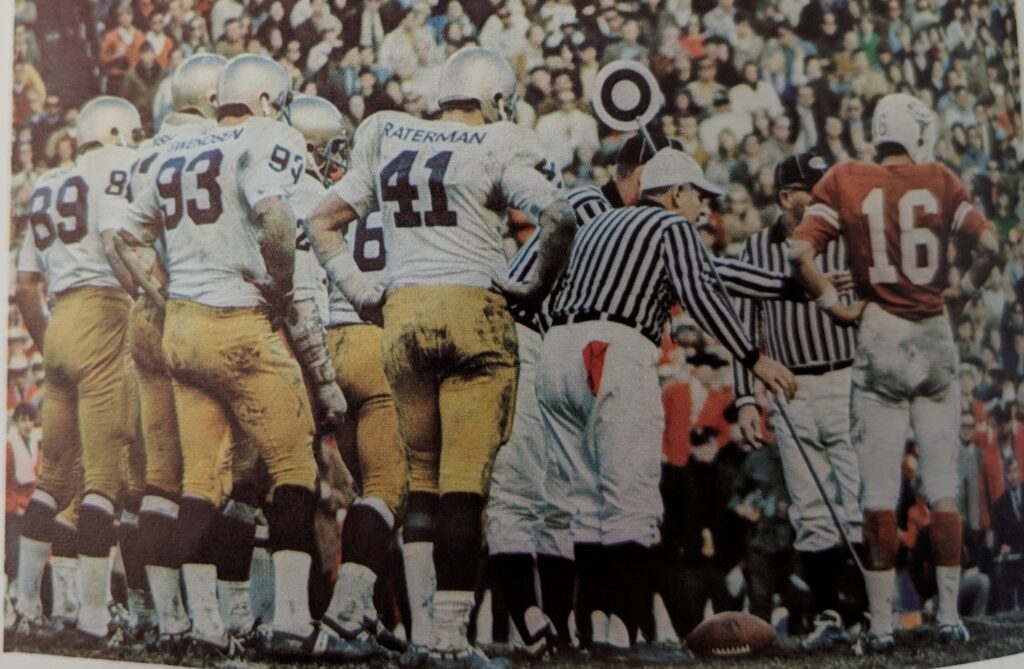
For readers, the Irish were much, much bigger than UT in the trenches. Worster was very banged up and Royal later said he shouldn’t have played him. Notre Dame was able to cramp UT’s ground game for the most part…but at the expense of letting Eddie Phillips run wild on keepers. Pick your poison. The Horns fumbled an incredible nine times and lost five of them plus an interception. The Irish led, 21-3, early in the third. Phillips and UT went to the pass and got some yards but hit only 10 of 27. It ended in a 24-11 loss, finishing the 30-game win streak. Texas actually outgained Notre Dame,
426-359…but the turnovers hurt too much.
How tough was it to see the season, the streak and some playing careers end?
PALMER: I cried like a baby.
DALE: Comparing the 1969 season to the 1970 season, the high quality of team play was equal but the injury factor wasn’t. Steve Worster was hurt late in the season and never recovered. Eddie Phillips was injured during the Cotton Bowl and Cotton’s (Speyrer) season-ending injury against the Sooners prevented his heroics that helped us win the previous Notre Dame game.
CAMPBELL: I’ve always believed that the hardest games to win are those that follow a really big win. The 1970 win over Arkansas was arguably one of the biggest wins in UT history, not just because it was for the conference championship but also it was for a national championship. There was a lot of celebrating going on, and rightfully so. But I think we lost that competitive edge that we’d had going into the Arkansas game. We had accomplished all our goals. For Notre Dame, who never has to play for a conference championship and had finished their season with a close win over Air Force, they went into the bowl game with an attitude of “we gotta get better.”
CARLSON/TLSN: I’ve heard over the years that quite a few Longhorns felt that — both seasons — Notre Dame had a lot of folks who were “jerks,” while the Texas players felt they were looking in the mirror when judging Arkansas’s conduct.
ATESSIS: The Notre Dame players and coaching staff didn’t seem to have much respect for our team or coaches and had no problem expressing their disdain with derogatory comments on and off the field. The Arkansas players reflected their coach’s (Frank Broyles, Royal’s good friend) philosophy of sportsmanship. On and off the field, they showed class and respect for their opponents.
DALE: Defeats are more brutal when victory is close. (In ’69) Arkansas had many chances to win that game. Decades later, the Arkansas players hosted a reunion in Fayetteville for both teams to honor the two teams that fought for the 1969 national championship, a proud moment for both teams. That legendary Texas-Arkansas game demonstrated to TV executives the value of broadcasting college football and marked a defining moment in the history of college sports.
CARLSON/TLSN: Absolutely. And fifty-five years later, we have an October-November stretch of eight weeks with college ball on ESPN, Tuesday night through late Saturday night. It’s great for the fans, the advertisers and the execs you mentioned.
Following the ’70 season, Texas won three more SWC crowns, finishing with six in a row, started by the Worster Bunch signing class. Six in a row!
For comparison, Longhorn football teams have won nine conference championships, and one national title since then…in more than a half-century. What endures most for you, about the accomplishments for the Texas teams you played for?
PALMER: The lifelong friendships.
DALE: Including the 1963 team, the 1969 and 1970 teams set a benchmark of how to win with class, for future teams to follow.
CAMPBELL: I think it was the culture that Coach Royal had developed, that we went into every game expecting to win, not hoping to win. We were going to run the ball down your throat and stone you on defense. He recruited a lot of players that were captains on their high school teams because he wanted players that were good leaders and he wanted players who had character and intelligence. He wanted players who put the team first and those who knew how to play with class.
ATESSIS: The lifelong relationships with the players, managers, trainers, fans and coaches that defined us. Hook ’em!
CARLSON/TLSN: I can’t thank you gents enough for your time and your terrific recollections. This was a huge treat for me. The 1970 team is my favorite, and I still think it’s the greatest Longhorn team ever. Thanks and Hook ’em.
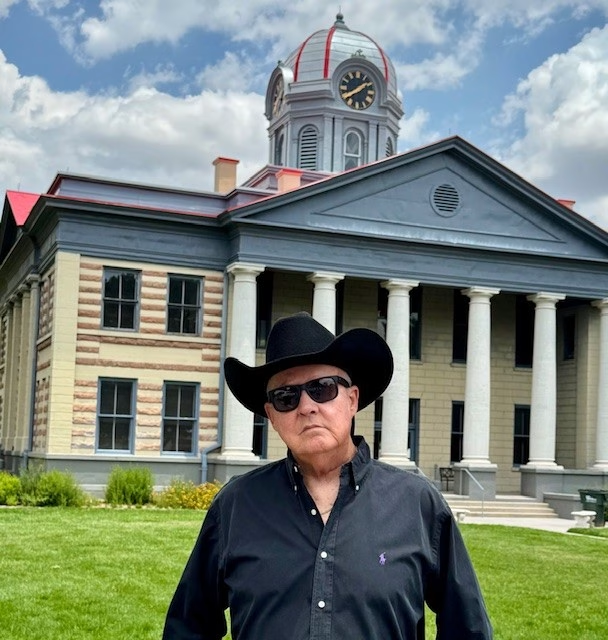
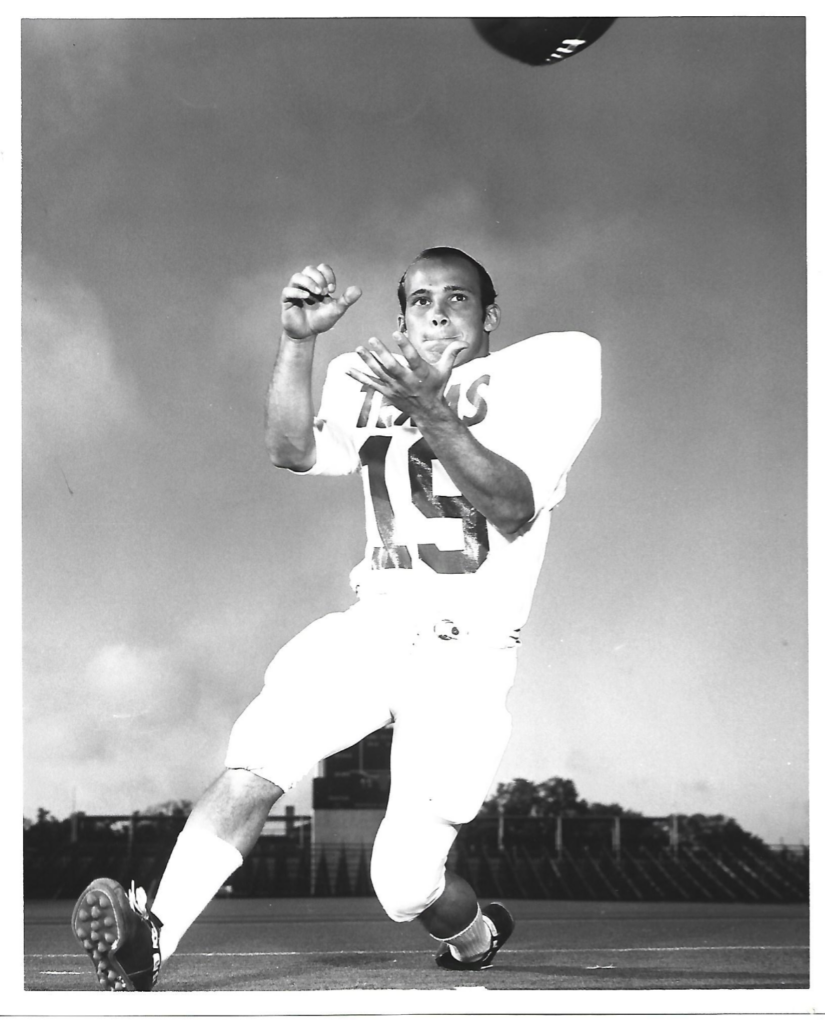
1970 Dean Campbell 
Billy Dale 
Scott Palmer